


Key Takeaways
- FFAI shares decline despite Faraday Future obtaining hybrid transmission patent
- New patent technology underpins extended-range electric vehicle development
- AIHER hybrid system designed for enhanced range with reduced mechanical complexity
- Super One production timeline remains contingent on securing additional capital
- Innovative powertrain technology positioned for upcoming FF and FX vehicle platforms
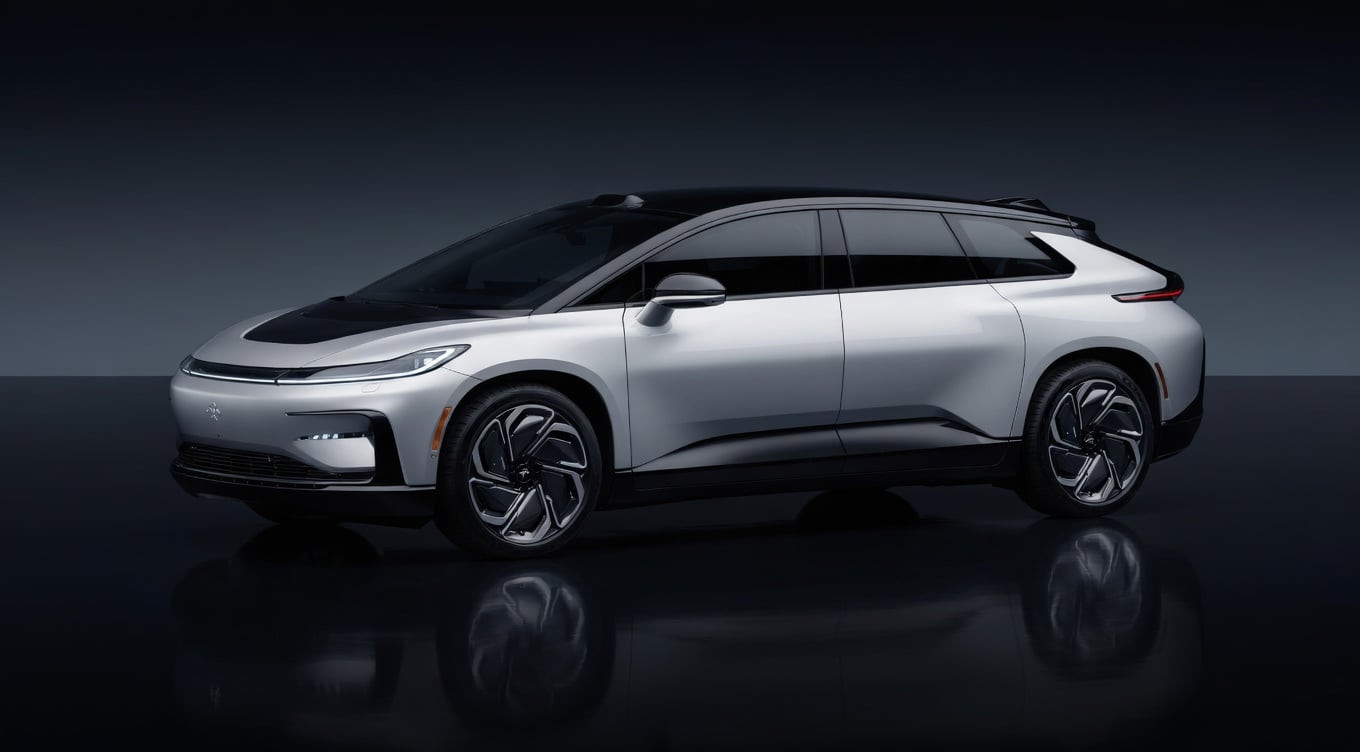
Faraday Future (FFAI) has obtained a United States patent for an innovative hybrid transmission architecture intended for extended-range electric vehicles. This breakthrough technology may power upcoming FF and FX platforms while streamlining mechanical design and enhancing energy transfer efficiency. FFAI shares dropped 8.09% to close at $0.2373, though the stock recovered modestly with a 0.34% uptick in pre-market activity.
Faraday Future Intelligent Electric Inc., FFAI
U.S. Patent Office Awards Hybrid Powertrain Technology to Faraday Future
The United States Patent and Trademark Office has awarded Patent No. 12,630,004 to Future AIHER, a subsidiary of Faraday Future. This intellectual property protects a range-extending hybrid transmission architecture that independently manages the engine, generator motor, differential assembly, and drive wheels. Faraday Future submitted the patent application in June 2025, receiving formal approval in May 2026.
The proprietary design employs multiple shaft assemblies and clutch mechanisms to engage or disengage various power sources as needed. The combustion engine and generator motor can function in tandem to drive the wheels or operate through separate pathways. This configuration enables multiple operational modes while minimizing the mechanical intricacy typically associated with conventional hybrid architectures.
Conventional plug-in hybrid platforms often struggle with power delivery lag, elevated manufacturing costs, and intricate mechanical linkages between core components. Faraday Future engineered this transmission solution to overcome these limitations while delivering superior range extension and operational efficiency. Furthermore, the streamlined architecture may enhance vehicle responsiveness, durability, and performance across diverse operating environments.

Intellectual Property Strengthens Future AIHER Business Model
Faraday Future established Future AIHER in March 2025 to engineer and market extended-range electric powertrain technologies. The division concentrates on hybrid architectures that integrate range-extension capabilities with dual electric and internal combustion energy sources. Its product portfolio encompasses an AI-enhanced hybrid extended-range platform and a distinct extended-range drivetrain solution for forthcoming models.
The automaker intends to integrate this patented innovation across its FF product range and the budget-conscious FX vehicle family. Specifically, the technology may power the anticipated FX Super One alongside its existing 800-volt pure-electric variant. Faraday Future projects that the hybrid configuration will deliver extended operational range while minimizing complex mechanical interfaces.
The organization has also tailored this technology for markets experiencing harsh winter climates, particularly throughout the eastern United States. Frigid temperatures frequently diminish battery capacity and curtail the effective range of pure electric vehicles during everyday operation. Therefore, the extended-range architecture could deliver supplementary energy when battery efficiency deteriorates under extreme weather scenarios.
Production Rollout Hinges on Capital Acquisition
Faraday Future intends to commence Super One manufacturing with either the 800-volt battery-electric configuration or the AIHER hybrid variant. The organization must obtain adequate strategic or intermediate-term capital before initiating volume production and customer fulfillment. This funding will enable manufacturing operations, supply chain management, vehicle validation, and the comprehensive commercial launch of both anticipated configurations.
Following successful capital acquisition, Faraday Future projects initial battery-electric deliveries within a six-to-nine-month window. The manufacturer has outlined a subsequent delivery wave within 12 to 15 months and another within 21 to 24 months. The AIHER configuration demands extended development cycles due to its novel hybrid transmission and powertrain integration.
Faraday Future anticipates initial AIHER deliveries within nine to 12 months following the receipt of necessary manufacturing capital. It has scheduled a second delivery phase within 21 to 24 months and a third within 24 to 28 months. While the patent bolsters the technical viability of this roadmap, adequate financing remains critical for executing production and fulfilling customer orders.
Get 3 Free Stock Ebooks
Discover top-performing stocks in AI, Crypto, and Technology with expert analysis.
- Top 10 AI Stocks - Leading AI companies
- Top 10 Crypto Stocks - Blockchain leaders
- Top 10 Tech Stocks - Tech giants



