



Key Highlights
- Ethereum’s price against Bitcoin reached 0.02858 BTC, surpassing resistance that held for multiple weeks
- ETH-focused ETFs recorded more than $128 million in net capital inflows throughout July, exceeding Bitcoin’s performance
- The newly launched Robinhood Layer 2 network utilizes ETH for transaction fees and validates on Ethereum’s main network
- Bridged ETH on Robinhood’s chain increased approximately tenfold within seven days, crossing the $100 million threshold
- Bitmine chairman Tom Lee identifies the ETH/BTC breakthrough as evidence of a pivotal crypto market shift driven by stablecoin adoption, asset tokenization, and Ethereum’s monetary narrative
Ethereum has successfully pierced a significant resistance barrier against Bitcoin that remained intact since June, with the ETH/BTC trading pair ascending to 0.02858. This development has captured the focus of market observers evaluating whether this represents a sustained trend reversal or merely a temporary uptick.
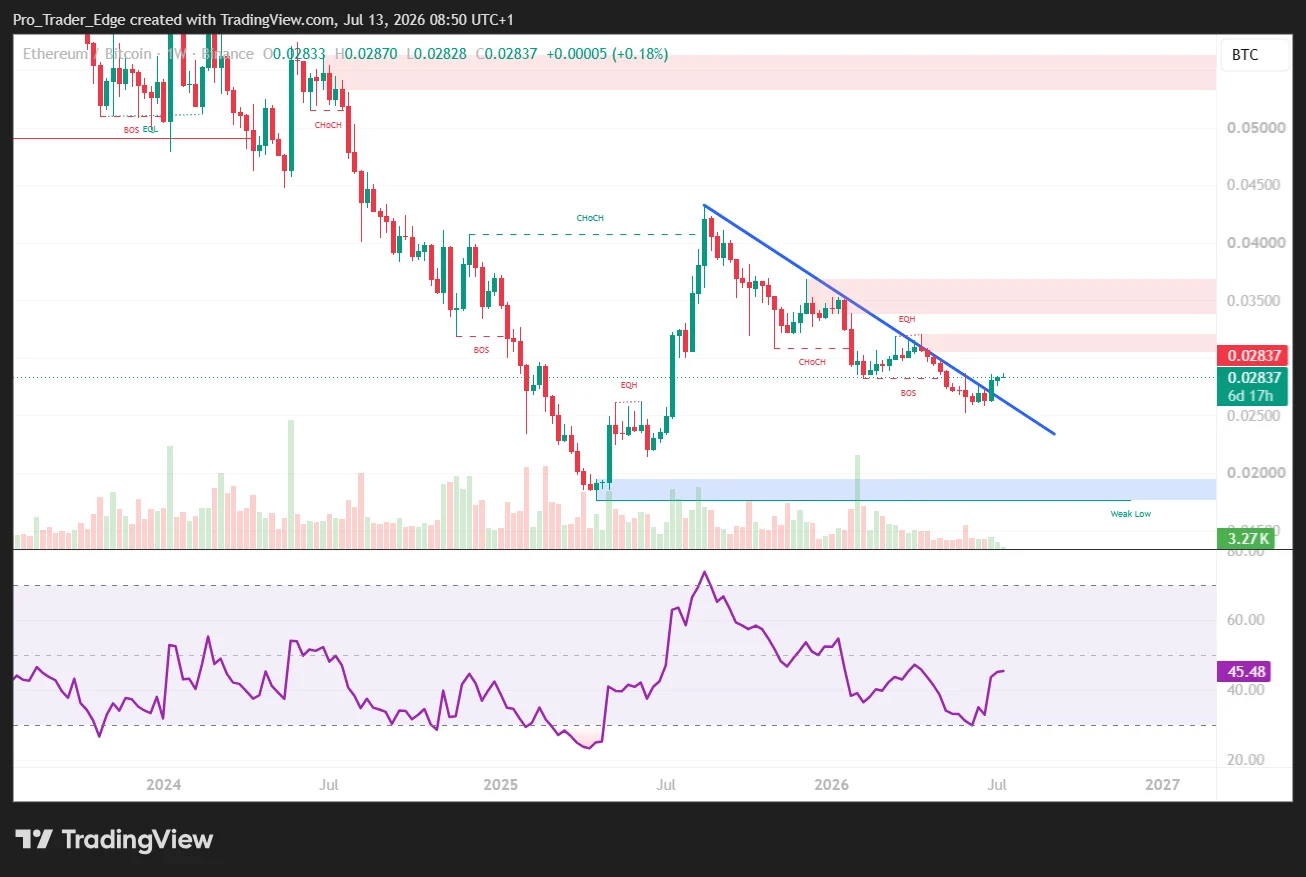
Tom Lee, who chairs Bitmine, characterized this breakthrough as evidence that cryptocurrency markets are entering a transformative phase. He highlights expanding stablecoin usage, increased tokenization activity, and emerging Ethereum-based initiatives as fundamental supporting elements. Lee additionally referenced declining petroleum prices and legislative advancement on the CLARITY Act as favorable market conditions.
Lee has monitored the ETH/BTC trading ratio for several months, viewing it as a key market health indicator. His perspective suggests that the concept of “ETH as money” will experience growing acceptance during the latter half of 2026.
Institutional Capital Flows Favor Ethereum
Exchange-traded funds focused on Ethereum have captured more than $128 million in net capital inflows during July, outstripping Bitcoin ETF performance across the identical timeframe. This pattern indicates that institutional investors are deliberately expanding their Ethereum positions.
Bitmine has been building its Ether holdings through what Lee characterized as an intensive acquisition campaign. He recently suggested that this aggressive accumulation strategy is approaching completion.

Bitcoin’s market dominance has simultaneously climbed, advancing 1.5% in July and approaching the 60% resistance threshold. This movement suggests some investment capital may still be gravitating toward Bitcoin rather than exiting it.
The ETH/BTC pair remains down 7.72% across the previous three-month period, despite this week’s upward movement. Spot Ethereum investment vehicles also experienced a seven-consecutive-week outflow period in late June, a pattern that has only begun to reverse.
Robinhood’s Layer 2 Network Creates Fresh Demand Dynamics
A primary catalyst supporting Ethereum’s recent momentum is Robinhood’s recently deployed Layer 2 blockchain infrastructure. This network employs ETH as its core transaction fee token and finalizes operations on Ethereum’s foundational layer.
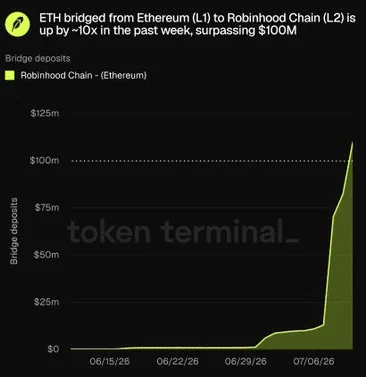
Lee characterized the platform as a breakthrough offering that has already processed greater transaction volume than numerous established decentralized trading platforms. As network activity expands, corresponding demand for ETH grows alongside it.
Blockchain analytics reveal that ETH bridged from Ethereum’s primary layer to Robinhood’s network increased nearly tenfold within a single week, exceeding $100 million in total value. Market participants are transferring substantial liquidity into this ecosystem.
This represents a tangible, quantifiable demand mechanism for ETH, connected to genuine transaction usage rather than purely speculative trading.
Ethereum’s Q3 2025 ETH/BTC advance climbed 53% before market pressure eliminated approximately half of those gains. The present 5% Q3 2026 increase is more modest, yet underpinned by greater blockchain activity and institutional capital flows compared to earlier rallies.
Whether this breakout maintains momentum throughout the remainder of 2026 will reveal if Lee’s recovery prediction was accurately timed or overly optimistic.
Get 3 Free Stock Ebooks
Discover top-performing stocks in AI, Crypto, and Technology with expert analysis.
- Top 10 AI Stocks - Leading AI companies
- Top 10 Crypto Stocks - Blockchain leaders
- Top 10 Tech Stocks - Tech giants



