



Key Takeaways
- ETH momentarily declined to $1,500 in June 2026, representing approximately 70% down from the August 2025 all-time high of $4,953.
- Ethereum’s decline exceeded Bitcoin’s due to increased volatility, diminished ETF inflows, and cascading liquidations of leveraged positions.
- Reclaiming $1,750 resistance could trigger a rally toward $1,800–$2,000.
- Prominent analyst Crypto Patel is building positions between $1,550 and $1,000, projecting eventual targets of $10,000–$20,000.
- ETH’s trajectory remains closely tied to Bitcoin’s price action and the ETH/BTC trading pair dynamics.
Ethereum’s price reached a multi-year low of $1,500 during June 2026, subsequently rebounding above the $1,620 mark. This dramatic downturn has sparked intense debate among traders: has ETH established a firm bottom, or is a further decline to $1,000 on the horizon?
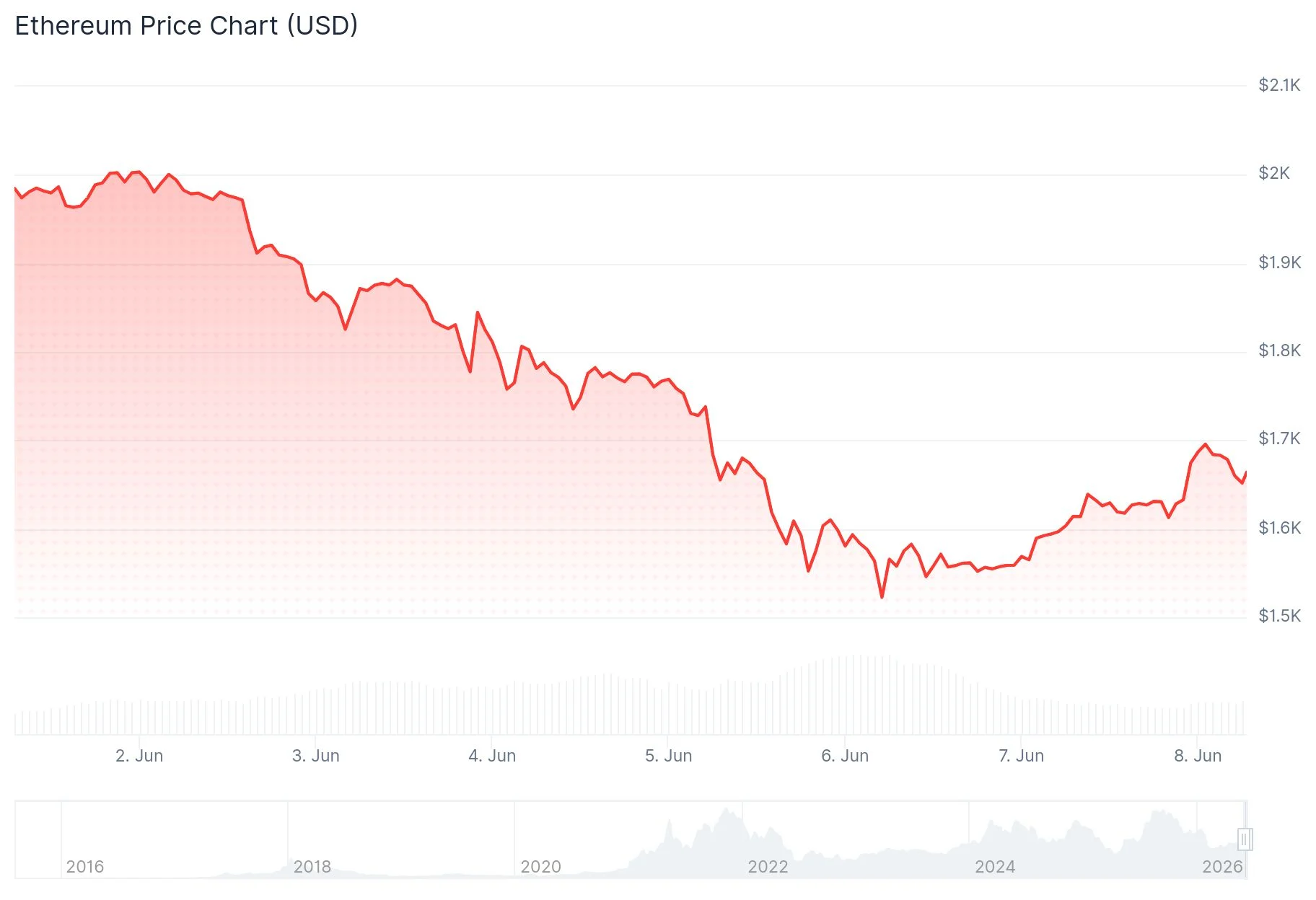
From its August 2025 zenith of $4,953, Ethereum’s descent has been characterized by gradual erosion followed by sharp capitulation. The catalyst for the recent plunge included a robust U.S. employment report that diminished expectations for Federal Reserve rate reductions. Escalating geopolitical tensions between the United States and Iran compounded market anxiety. Spot Bitcoin ETFs experienced unprecedented capital outflows, with Ethereum ETFs suffering parallel withdrawals. The liquidation cascade exceeded $1 billion across leveraged cryptocurrency positions, with Ethereum long positions bearing significant damage.
This perfect storm of negative factors pushed Ethereum to the psychologically critical $1,500 threshold — a price level not witnessed since previous bear market cycles.
Understanding ETH’s Steeper Decline Versus Bitcoin
While Bitcoin experienced approximately 50% drawdown from its peak, Ethereum suffered a steeper 70% correction. This disparity stems from Ethereum’s higher beta coefficient relative to Bitcoin. ETH characteristically exhibits amplified volatility in both upward and downward market movements — during selloffs, Ethereum typically experiences magnified losses.
The ETH/BTC ratio has maintained a downward trajectory since 2021. Bitcoin’s spot ETF debut in January 2024 ushered in consistent institutional capital allocation. By contrast, Ethereum’s ETF products, introduced subsequently, failed to generate comparable demand volumes. This institutional interest disparity has left ETH more vulnerable during market downturns.

Leveraged trading positions intensified the decline. Concentration in ETH long contracts reached elevated levels. When June’s selloff materialized, these overleveraged positions faced rapid liquidation, creating a downward price spiral.
Respected market analyst Crypto Patel directly confronted investor anxiety through social media commentary, counseling followers against capitulation-driven decisions. He disclosed that he is “slowly accumulating ETH/USDT in the $1,550–$1,000 range,” acknowledging that precise bottom-calling remains impossible. Patel estimates Ethereum’s downside potential extends to approximately $1,000, while maintaining conviction that long-term valuations between $10,000 and $20,000 remain “very possible.” His forecast anticipates the subsequent altcoin bull cycle materializing between 2026 and 2027.
Critical Price Levels for ETH
Following the $1,500 capitulation low, ETH rallied beyond $1,620 and currently maintains position above the 100-hour moving average. Near-term resistance appears at $1,700, followed by $1,750 — corresponding to the 50% Fibonacci retracement level of the decline from $2,005 to $1,505.
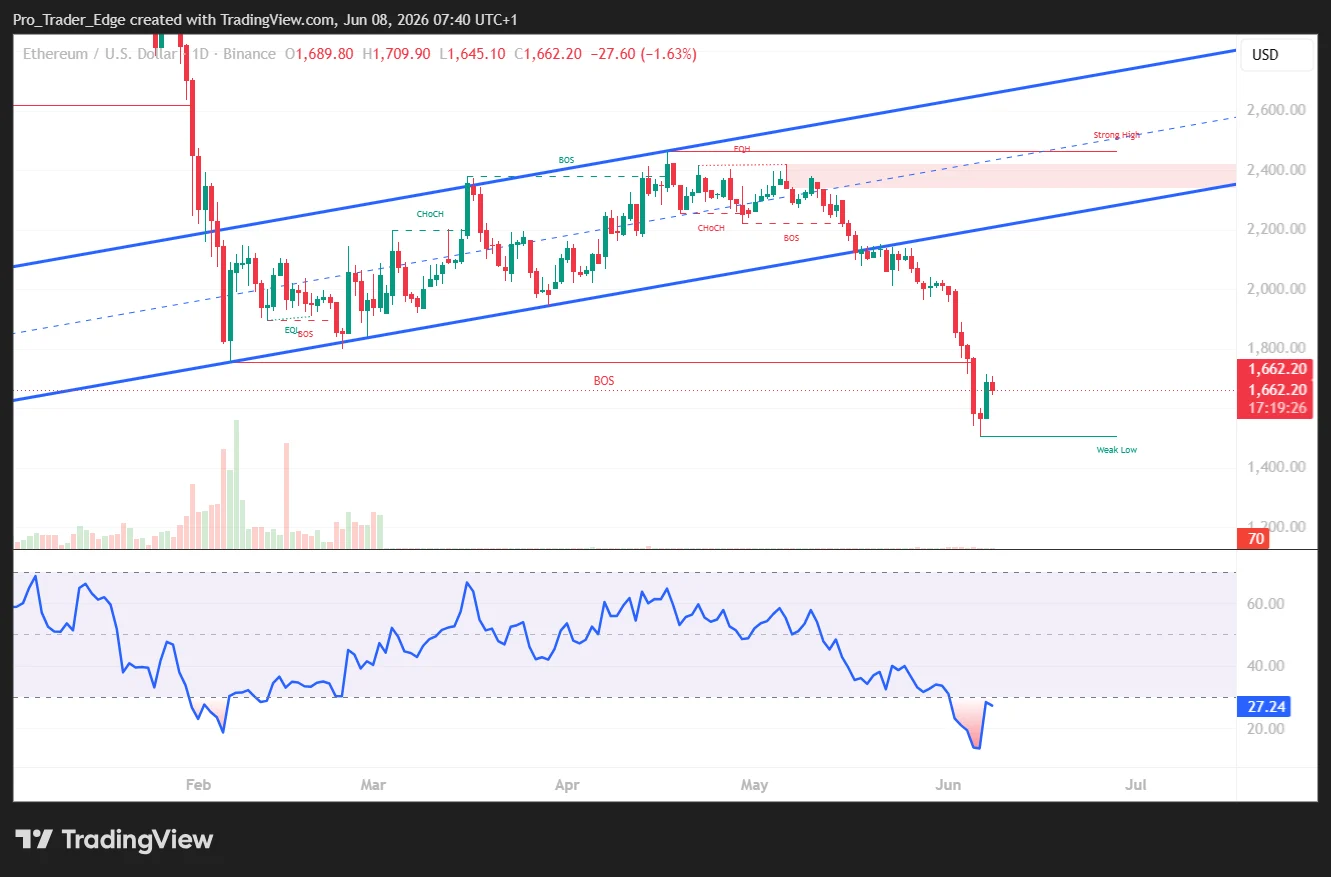
Successfully breaching $1,750 resistance could catalyze momentum toward $1,800, $1,885, and potentially the psychological $2,000 barrier. Conversely, rejection at $1,750 would likely result in retracement toward $1,620 support, with $1,600 representing secondary support. The $1,500 level remains the definitive support threshold below current prices.
Ethereum corporate treasury holdings add another dimension to market dynamics. BitMine reported approximately $9.58 billion in unrealized ETH losses, while SharpLink’s Ethereum position registered roughly $1.59 billion in paper losses at the cycle bottom. While neither entity has signaled distressed selling, these substantial unrealized losses underscore the balance sheet vulnerability associated with maintaining ETH exposure through severe corrections.
As of early June 2026, ETH trades near $1,620 with bulls defending the recovery above the critical $1,600 support zone.
Get 3 Free Stock Ebooks
Discover top-performing stocks in AI, Crypto, and Technology with expert analysis.
- Top 10 AI Stocks - Leading AI companies
- Top 10 Crypto Stocks - Blockchain leaders
- Top 10 Tech Stocks - Tech giants



