



TLDR
- Futures contracts for the Dow Jones Industrial Average advanced 317 points, representing a 0.6% increase, during Tuesday’s pre-market session.
- The Nasdaq Composite achieved its 23rd all-time closing high of 2026, propelled by enthusiasm surrounding large-cap technology companies and artificial intelligence.
- Nvidia’s stock price advanced more than 2% in early trading, pushing the chipmaker’s total market capitalization toward the $6 trillion milestone.
- The benchmark 10-year Treasury note yield remained at 5.3%, marking its highest closing point in nearly a quarter century.
- Crude oil markets weakened, with Brent benchmark prices sliding beneath the $100 per barrel threshold for the first time in several weeks.
US stock futures posted solid gains in early Tuesday trading as momentum in the technology sector showed no signs of fading. The upward movement persisted despite ongoing pressures from elevated government bond yields and higher diesel fuel prices.
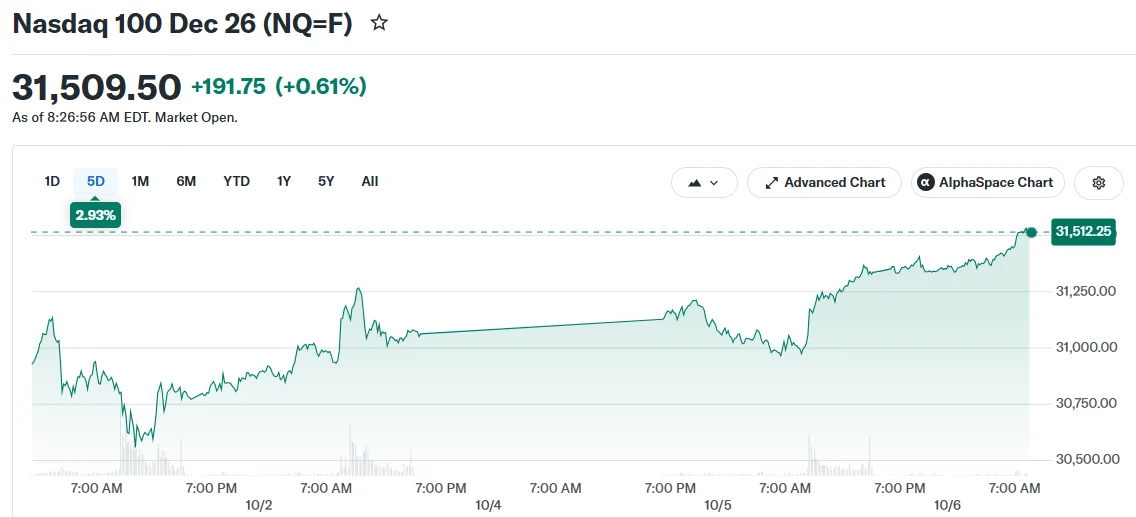
Futures tied to the Dow Jones Industrial Average climbed 317 points, representing a 0.6% advance. The S&P 500 index futures added 0.5%, positioning the benchmark just 1% away from its record peak. Meanwhile, Nasdaq 100 futures jumped 0.7%.
Technology Sector Powers Market Gains
The technology-focused Nasdaq Composite index registered its 23rd record closing level of 2026 during Monday’s session. Major technology corporations drove the rally higher, with market participants maintaining their focus on the expanding artificial intelligence sector.
Shares of Nvidia advanced over 2% during pre-market hours on Tuesday. The semiconductor giant’s total market capitalization now stands within striking distance of the $6 trillion mark.
The chip designer received additional support from positive developments involving one of its key manufacturing partners in Asia. Taiwan-based Foxconn released robust quarterly earnings on Monday. The financial results underscored persistent worldwide appetite for AI-related infrastructure and computing equipment.

Widespread enthusiasm surrounding artificial intelligence applications has, for the moment, eclipsed worries about weakness in other economic sectors. Market participants have consistently purchased equities during temporary pullbacks.
Government Bond Yields Reach Levels Not Seen in Decades
Treasury market dynamics continue generating unease among certain market participants. The yield on the benchmark 10-year note showed minimal movement early Tuesday, holding at 5.301%. This represents its highest closing reading in 24 years.
The 30-year Treasury yield remained stable at 5.663%, a rate last observed in 2002. Both yields briefly touched even loftier levels during Monday’s trading, reaching 5.349% and 5.703% respectively.
Notwithstanding these elevated borrowing costs, equity investors have maintained their view of stocks as an inflation protection mechanism. This perspective has helped counterbalance anxieties related to higher financing expenses.
Market observers are now focusing attention on a scheduled Treasury Department auction of three-year notes slated for Tuesday. The offering carries a face value of $58 billion.
Shorter-maturity government bonds currently appear appealing to institutional buyers. The probability of a Federal Reserve interest rate increase in October has diminished as well. That recalibration came after disappointing employment statistics published last Friday.
Financial markets anticipate the auction will proceed without complications given the current environment.
Oil prices declined on Tuesday as well, contributing to the constructive sentiment across equity markets. Brent crude, serving as the global pricing benchmark, shed 0.7% to settle at $99.62 per barrel. The price now sits beneath the psychologically important $100 level.
West Texas Intermediate, the domestic US standard, decreased 1.1% to $88.41 per barrel.
Energy market specialists attributed the decline to expanding production volumes from Middle Eastern nations. Petroleum exporters throughout the Persian Gulf have been recalibrating their output strategies.
Kuwait reported that its current production stands at 75% of levels maintained before recent regional conflicts. Saudi Arabia separately reduced the official selling price of its flagship Arab Light crude grade for Asian customers receiving November deliveries.
The moderation in energy markets has provided relief from wider inflationary pressures.
No significant economic data releases are on the calendar for the current week. This absence leaves artificial intelligence-related equity speculation and inflation anxieties as the primary catalysts influencing market direction.
Corporate earnings announcements scheduled for Tuesday include results from Constellation Brands and Lamb Weston Holdings. The economic data calendar remains sparse throughout the remainder of the week.
Get 3 Free Stock Ebooks
Discover top-performing stocks in AI, Crypto, and Technology with expert analysis.
- Top 10 AI Stocks - Leading AI companies
- Top 10 Crypto Stocks - Blockchain leaders
- Top 10 Tech Stocks - Tech giants



