



Key Takeaways
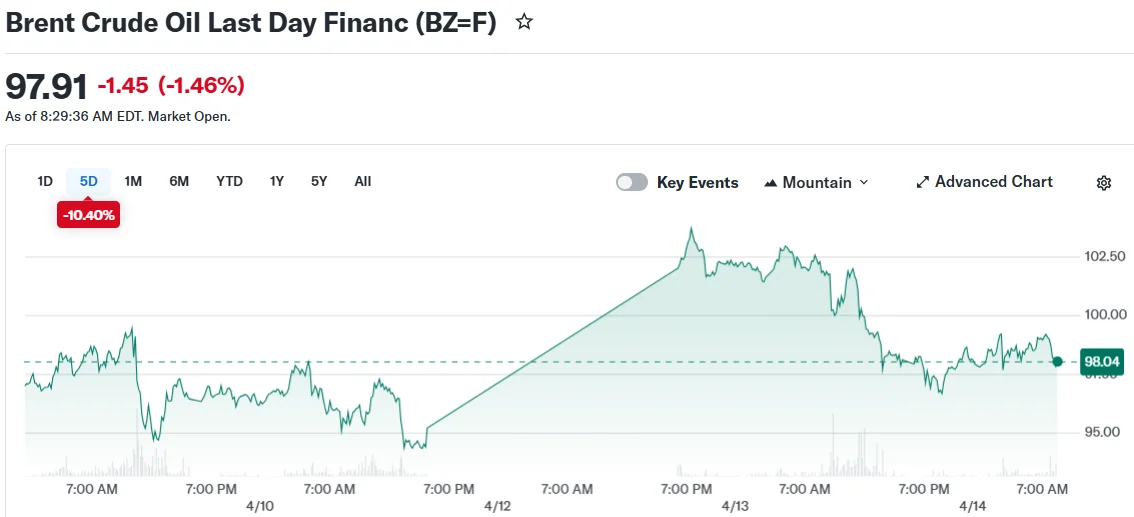
- Brent crude futures declined 0.3% to reach $99.04 per barrel, while WTI plummeted 1.6% to $97.47 on Tuesday
- Beijing denounced Washington’s naval blockade of Iranian ports as “dangerous and irresponsible”
- Riyadh expressed concerns that the blockade might provoke Tehran into further military action
- Diplomatic sources indicate another round of Washington-Tehran negotiations could take place in Islamabad before the truce expires
- According to the IEA, worldwide oil production has plummeted by 10.1 million barrels daily since hostilities commenced
Crude oil markets experienced downward pressure Tuesday as global powers intensified their criticism of Washington’s naval blockade targeting Iranian ports, even as investors monitored developments in potential diplomatic breakthroughs between the United States and Iran.
Brent crude futures experienced a 0.3% decline, settling at $99.04 per barrel. Meanwhile, West Texas Intermediate saw a sharper drop of 1.6%, finishing at $97.47 per barrel.
Washington initiated the blockade on Monday. President Trump characterized the measure as a strategic effort to compel Iran toward accepting a comprehensive peace settlement. The naval operation encompasses Iranian port facilities along with significant portions of the Persian Gulf, Gulf of Oman, and selected zones within the Arabian Sea.
Beijing responded forcefully to the action Tuesday. According to the South China Morning Post, a representative from China’s foreign ministry characterized the blockade as “dangerous and irresponsible.”
Riyadh has similarly voiced apprehensions. According to the Wall Street Journal, Arab diplomats revealed that Saudi Arabia is pressing Washington to withdraw the blockade, concerned it might provoke Tehran into heightening the confrontation.

Chinese President Xi Jinping unveiled a four-point peace proposal following discussions with the Crown Prince of Abu Dhabi, contributing to mounting international pressure for de-escalation.
Notwithstanding the diplomatic controversy, President Trump stated Monday that the “right people” within Iran remain interested in reaching an agreement. He acknowledged that Iranian representatives had reached out to the White House expressing willingness to engage in negotiations.
Washington’s primary requirements include complete reopening of the Strait of Hormuz and Tehran’s commitment to halt uranium enrichment activities for two decades.
Vice President JD Vance, who headed the American delegation during last weekend’s negotiations in Islamabad, rejected characterizations of the talks as unsuccessful. In an interview with Fox News, he described “good conversations” and emphasized that the “ball is in Iran’s court.”
Pakistan has extended an invitation to facilitate another round of negotiations before the existing two-week truce concludes. Both Pakistani and Iranian representatives confirmed this development to Reuters.
The Market Impact
WTI futures settled beneath Brent crude on Tuesday for the second straight trading session. Prior to April 2, this pattern hadn’t occurred in almost four years. Market observers interpret this development as evidence that traders are incorporating some optimism regarding a potential peace agreement.
The International Energy Agency cautioned that current pricing may not fully account for the magnitude of the supply disruption.
The Supply Picture
The IEA disclosed that worldwide oil production declined by 10.1 million barrels daily in March, dropping to 97 million barrels per day. The agency characterized this disruption as unprecedented in scale.
Oil consumption is projected to decline by 80,000 barrels per day throughout this year.
Washington has positioned 16 naval vessels in the Middle East region, although none are presently operating within the Persian Gulf.
Israel and Lebanon were scheduled to initiate direct peace negotiations in Washington on Tuesday, with Secretary of State Marco Rubio participating in the diplomatic discussions.
Get 3 Free Stock Ebooks
Discover top-performing stocks in AI, Crypto, and Technology with expert analysis.
- Top 10 AI Stocks - Leading AI companies
- Top 10 Crypto Stocks - Blockchain leaders
- Top 10 Tech Stocks - Tech giants



