



Key Highlights
- Brent crude declined 0.8% to settle at $106.91 per barrel while WTI decreased 1% to $101.14 on Wednesday’s session
- Both major oil benchmarks have maintained prices at or exceeding $100 per barrel since the U.S.-Israeli conflict with Iran commenced in late February
- Tehran’s blockade of the Strait of Hormuz has interrupted approximately 20% of worldwide oil and LNG shipments
- President Trump will engage in discussions with Chinese President Xi Jinping Thursday through Friday; China represents Iran’s largest crude oil purchaser
- The Energy Information Administration projects the Strait will stay closed through at least late May, with shipping volumes unlikely to normalize until late 2026
Crude oil markets experienced a retreat on Wednesday, halting a three-session advance. Brent crude futures declined 0.8% to settle at $106.91 per barrel, while U.S. West Texas Intermediate crude slipped 1% to close at $101.14.
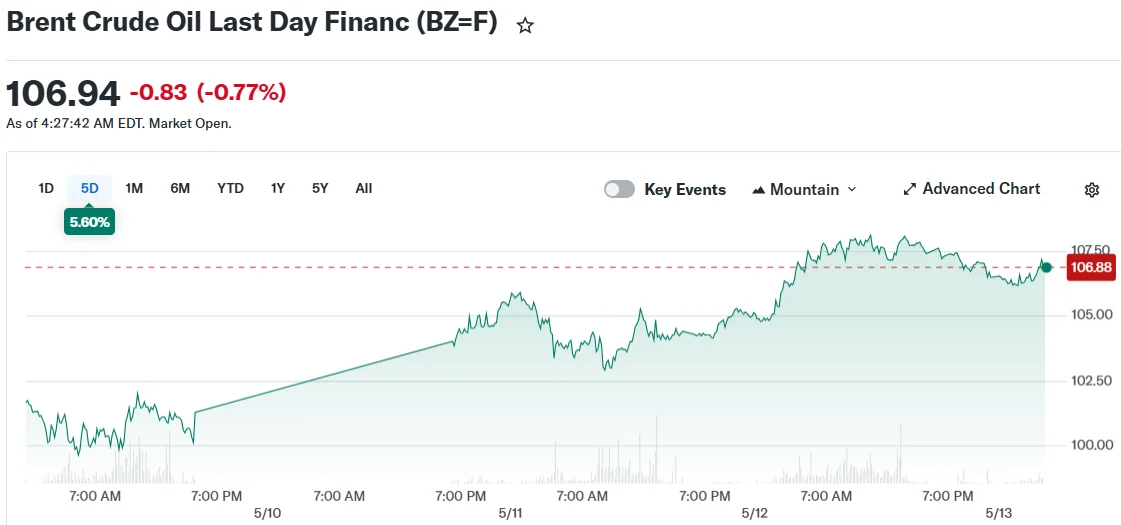
The decline occurred as market participants awaited developments regarding a tenuous Middle East ceasefire and monitored expectations surrounding the upcoming summit between President Donald Trump and Chinese President Xi Jinping, scheduled for Thursday and Friday in Beijing.
[[EMBED_0]]
Both primary oil benchmarks have remained at or surpassing $100 per barrel since the U.S.-Israeli military conflict with Iran initiated in late February. The confrontation prompted Tehran to essentially close the Strait of Hormuz, a critical maritime passage.
Approximately 20% of the world’s oil and liquefied natural gas typically transits through this strategic waterway. The blockade has constrained worldwide supply and maintained elevated price levels.

“The market remains highly reactive to every update from the region, meaning sharp swings are likely to persist,” said Priyanka Sachdeva, senior market analyst at Phillip Nova.
During Tuesday’s trading session, prices had climbed more than 3% following diminished prospects for a sustainable ceasefire. This development reduced expectations regarding a potential reopening of the strait in the near term.
Supply Disruptions From Iran Conflict
Market analysts at ING noted that energy markets continue operating “in limbo” ten weeks following the conflict’s outbreak. Supply interruptions throughout the Persian Gulf region combined with decreasing stockpiles are creating uncertainty about future market conditions.
U.S. crude oil stockpiles decreased for a fourth consecutive week last week, based on data released by the American Petroleum Institute. Distillate reserves also showed declines. Official government inventory figures were scheduled for release later on Wednesday.
Eurasia Group indicated in a research note to clients that the supply shortfall has already surpassed one billion barrels. The consultancy anticipates oil will maintain prices above $80 per barrel throughout the remainder of the year.
The U.S. Energy Information Administration forecasts the Strait of Hormuz will remain impassable until at least late May. Even if maritime traffic resumes in June, shipment volumes are projected to remain below prewar levels until sometime in late 2026.
Beijing Summit Between Trump and Xi
Trump stated Tuesday he doesn’t anticipate requiring China’s assistance to resolve the conflict with Iran. China purchases more Iranian crude oil than any other nation despite ongoing U.S. sanctions enforcement.
The Trump-Xi summit is attracting significant attention from energy market observers. Any modification in Beijing’s stance regarding Iranian oil purchases could influence global supply equilibrium.
Escalating oil prices are impacting American consumers. Transportation fuel expenses have increased, and U.S. consumer price indices rose substantially for a second consecutive month in April, registering the highest annual increase in nearly three years.
Economists project additional inflationary pressure in coming months. The Federal Reserve is broadly anticipated to maintain current interest rate levels, which could eventually moderate oil demand over the medium term.
Get 3 Free Stock Ebooks
Discover top-performing stocks in AI, Crypto, and Technology with expert analysis.
- Top 10 AI Stocks - Leading AI companies
- Top 10 Crypto Stocks - Blockchain leaders
- Top 10 Tech Stocks - Tech giants



