


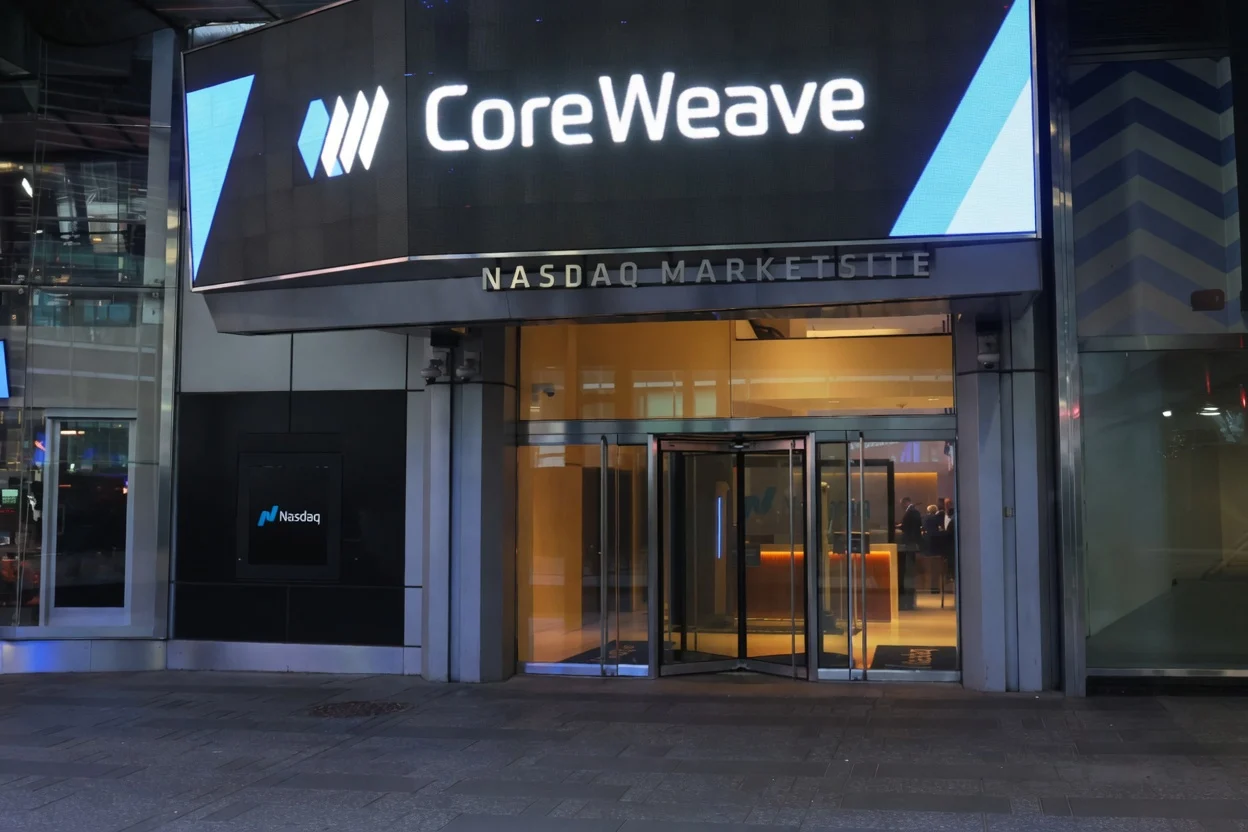
Key Takeaways
- CoreWeave shares declined 3.4% to close at $83.53, touching an intraday bottom of $79.46, while trading volume registered 20% below typical levels
- Analyst consensus remains Moderate Buy with a $135 mean price objective, featuring targets reaching as high as $250
- Reports of Meta’s possible expansion into AI cloud infrastructure have triggered competitive concerns among CoreWeave shareholders
- Company insiders have divested more than $3 billion in shares during the previous 90-day period, primarily through scheduled tax-related transactions
- First-quarter results disappointed expectations with adjusted EPS of -$1.40 versus the -$1.17 estimate, despite revenue climbing 111.6% annually to $2.08 billion
CoreWeave (CRWV) experienced a 3.4% pullback on Tuesday, settling at $83.53 following an intraday descent to $79.46. The previous session concluded at $86.46.
CoreWeave, Inc. Class A Common Stock, CRWV
Trading activity registered approximately 23 million shares, representing a 20% shortfall compared to typical session volumes — indicating the decline wasn’t fueled by widespread selling pressure.
Year-to-date performance remains positive at 26%, though the stock has retreated 41% over the trailing twelve months, positioning well beneath its 50-day moving average of $106.86.
Tuesday’s weakness emerged amid mounting investor apprehension centered on two primary catalysts: Meta’s reported interest in AI computing services, and substantial insider divestment activity.

A Bloomberg analysis revealed Meta is exploring the possibility of offering AI computational resources and infrastructure capacity to external clients — a strategic shift that would place it in direct rivalry with CoreWeave’s primary revenue stream.
Rosenblatt preserved its Buy recommendation with a $250 price objective, contending the Meta threat is exaggerated. Wolfe Research and Evercore ISI both reaffirmed Outperform ratings with $150 targets.
Insider Transaction Activity Draws Attention
Insider divestment has captured market attention. Over the preceding 90 days, company insiders have liquidated shares exceeding $3 billion in aggregate value.
Most recently, General Counsel Kristen J. McVeety divested 22 shares for $1,889 on July 6, pursuant to a Rule 10b5-1 trading arrangement established in May 2025.
Prior to that, insider Brian Venturo sold 76,912 shares on July 1 at an average price of $86.99, generating approximately $6.69 million in proceeds. This transaction decreased his holdings by 21%.
Insider Brannin McBee liquidated 56,707 shares on June 30 at $95.69, totaling roughly $5.43 million — representing a 14.9% reduction in his ownership stake.
Both transactions were conducted through pre-established Rule 10b5-1 arrangements designed to satisfy tax liabilities associated with equity vesting. While procedurally standard, the magnitude has nonetheless attracted investor scrutiny.
Recent Earnings Disappointment Lingers
CoreWeave’s most recent quarterly disclosure on May 7 contributed to negative sentiment. The company reported adjusted EPS of -$1.40, falling short of the -$1.17 consensus estimate by $0.23.
Revenue reached $2.08 billion, representing 111.6% year-over-year expansion. While top-line momentum remains robust, profitability challenges persist — net margin currently registers at -25.57%.
Analysts collectively project full-year EPS of -$4.57.
Despite the earnings shortfall, multiple analysts maintain the post-results selloff represents an overreaction. BNP Paribas holds the Street’s most optimistic price target at $192, while Cantor Fitzgerald maintains a $167 objective. Wells Fargo elevated its target to $155 in May.
Among 35 analysts tracking the stock, 21 assign Buy ratings, 12 recommend Hold, and 2 rate it Sell.
The company’s debt-to-equity ratio stands at 3.68, accompanied by a current ratio of merely 0.31 — a balance sheet configuration that introduces meaningful risk alongside the growth narrative.
CoreWeave’s market capitalization ranges between approximately $37–45 billion, session-dependent. The company unveiled ARIA, an AI-powered research agent, this week — though analysts don’t view it as a near-term catalyst.
Get 3 Free Stock Ebooks
Discover top-performing stocks in AI, Crypto, and Technology with expert analysis.
- Top 10 AI Stocks - Leading AI companies
- Top 10 Crypto Stocks - Blockchain leaders
- Top 10 Tech Stocks - Tech giants



