



Key Highlights
- Cardano’s price has risen 11% throughout May 2026, currently hovering between $0.27 and $0.28 with key resistance zones at $0.30–$0.32
- Founder Charles Hoskinson verified that the updated CLARITY Act recognizes ADA as decentralized, not a security
- Large wallet addresses containing 1M+ ADA tokens now hold 67.47% of circulating supply
- Derivatives market open interest has nearly doubled from $69M in February to $122M currently
- Technical indicators suggest a potential move toward $0.34 if ADA breaks decisively above $0.28
Cardano has experienced an 11% price appreciation since May 2026 began, propelled by two significant catalysts: advancements in U.S. cryptocurrency legislation and sustained buying from institutional-sized wallets. While the upward momentum is notable, ADA continues trading within a defined range on shorter timeframes without a clear breakout confirmation.
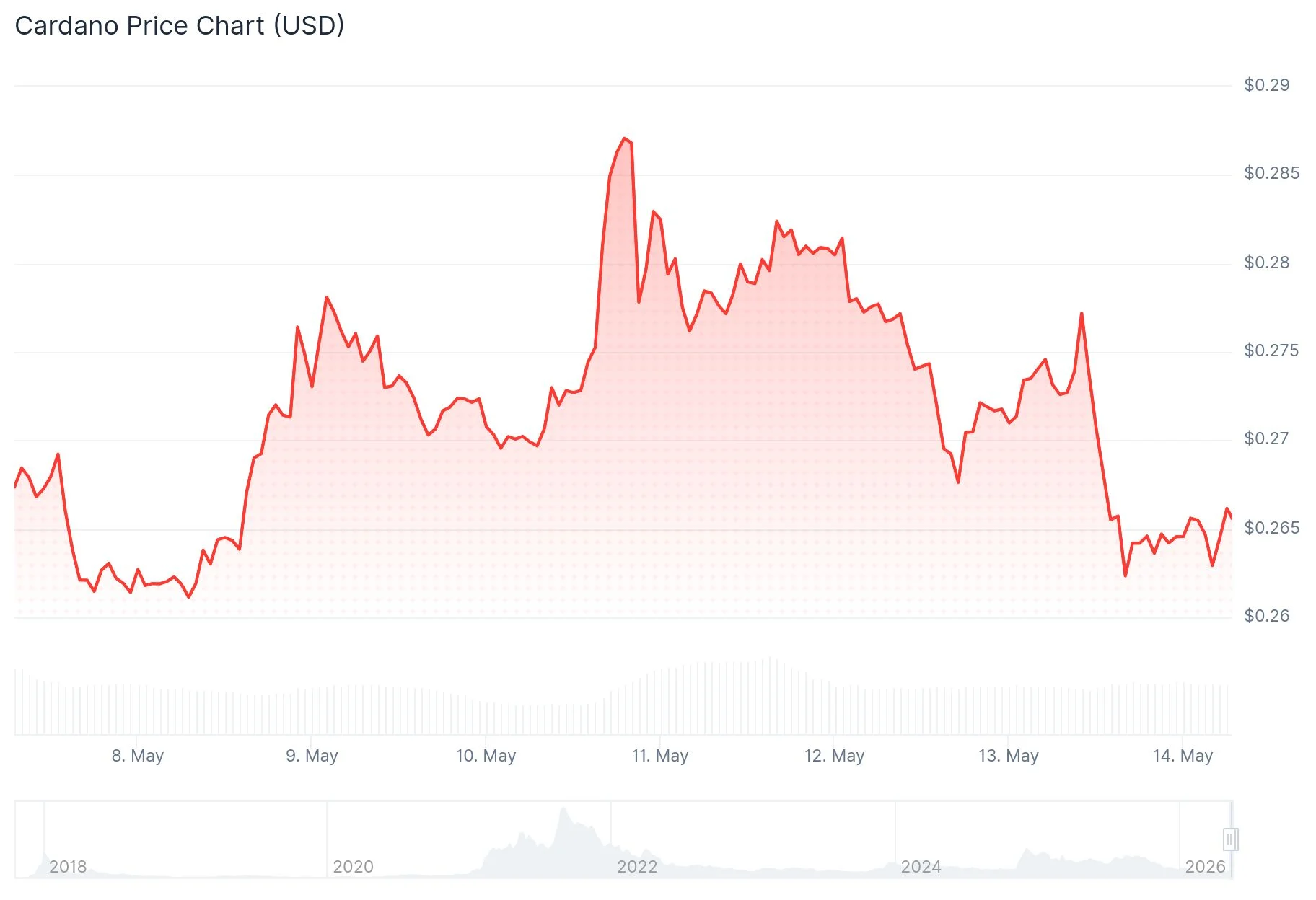
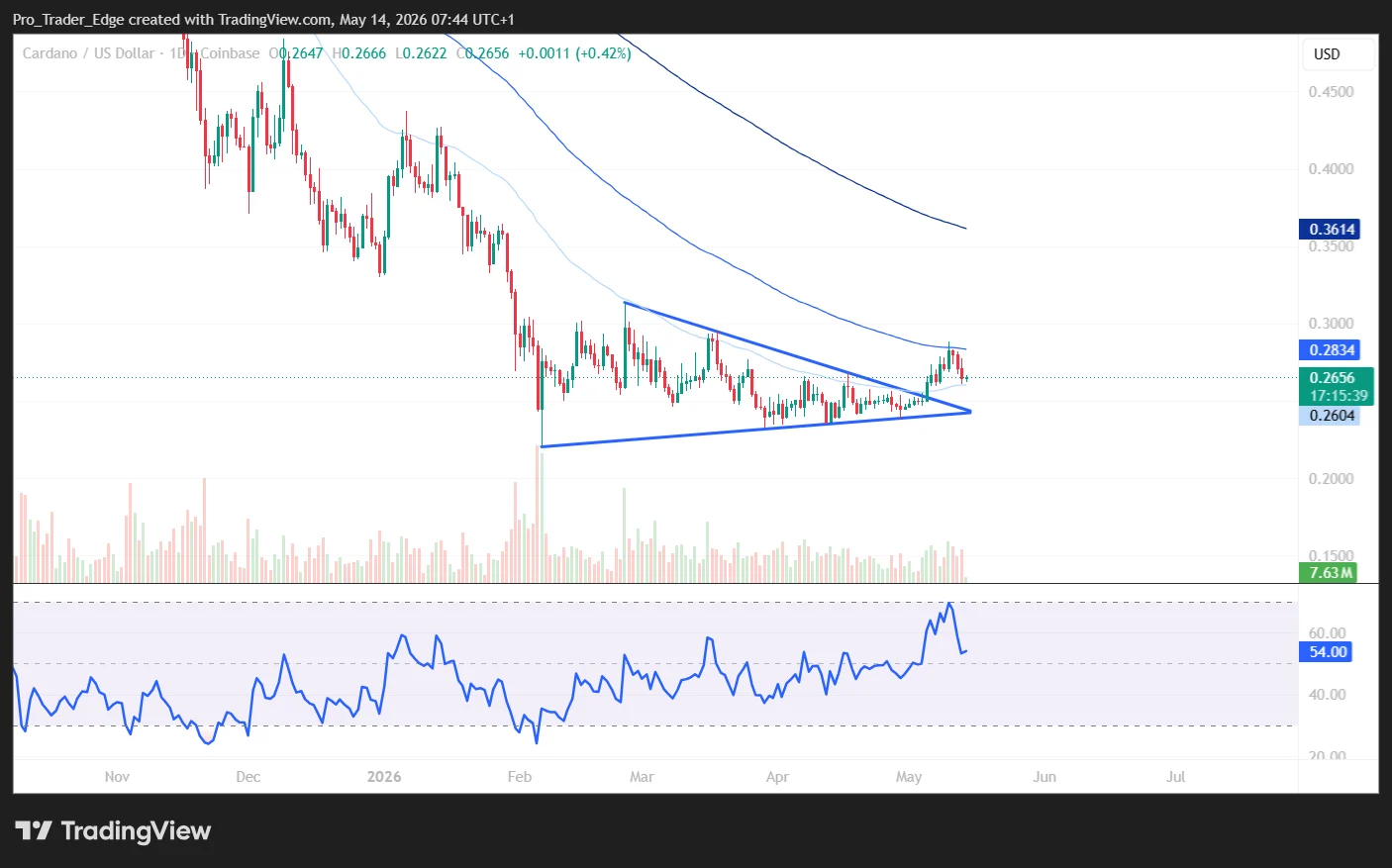
The digital asset is presently changing hands near the $0.27–$0.28 level. After rebounding from a critical demand area situated between $0.24 and $0.25 in recent sessions, ADA printed its most significant weekly candlestick since mid-March. The immediate ceiling lies at $0.28, while more substantial overhead pressure exists within the $0.317–$0.329 corridor.
Downside protection remains intact between $0.254 and $0.266, which corresponds with the 50%–61.8% Fibonacci retracement levels from the prior swing. Should this foundation fail, the next meaningful support structure appears around $0.227–$0.233.
Cardano’s creator Charles Hoskinson publicly supported the modified CLARITY Act through social media, commending Senator Tim Scott for demonstrating “strong leadership” in refining the legislation. Hoskinson verified that the amended framework acknowledges ADA’s non-security classification, crediting Cardano’s decentralized governance architecture.
Hoskinson had initially expressed concerns about the CLARITY Act’s earlier version, cautioning that certain digital assets might face security designation. The revised legislative text now provides more favorable treatment for decentralized blockchain networks, directly benefiting projects structured like Cardano.

Institutional Wallets Continue Expansion
According to analytics from Santiment, significant ADA stakeholders have maintained consistent accumulation patterns since December 2023. Addresses containing a minimum of 1 million ADA tokens now possess 25.09 billion units — representing 67.47% of available supply. This buying behavior has persisted despite ADA’s 71% market capitalization decline over the preceding nine months.
Technical momentum signals align with a moderately optimistic outlook. The Relative Strength Index registers 60.28, positioned above the 50 midpoint threshold. The MACD indicator shows 0.00673 versus its signal line at 0.00444, generating a positive histogram reading of 0.00229 that reflects strengthening buyer participation.
Futures Market Interest Expands
Open interest across ADA derivative contracts has expanded from $69 million during February to $122 million presently, based on Coinglass tracking. Within Binance’s ecosystem, the long-to-short positioning ratio stands at 2.30, indicating bullish bets outnumber bearish positions by more than two-to-one.
Nevertheless, the CLARITY Act continues facing headwinds. Banking institutions have submitted 8,000 correspondence pieces to Senate members expressing opposition to stablecoin yield components. Prediction market Polymarket currently assigns 60% probability to the bill’s passage, declining from a previous 74% estimate.
Technical analyst More Crypto Online identifies near-term resistance at $0.299, with a significant extension target positioned at $0.349. Traders await confirmation through a sustained reclaim of the $0.30–$0.32 region accompanied by elevated volume before considering the pattern validated.
The pronounced 2.30 long/short ratio on Binance simultaneously presents downside vulnerability — should price action stagnate at current levels, concentrated leveraged long positions could precipitate rapid liquidation-driven declines.
Get 3 Free Stock Ebooks
Discover top-performing stocks in AI, Crypto, and Technology with expert analysis.
- Top 10 AI Stocks - Leading AI companies
- Top 10 Crypto Stocks - Blockchain leaders
- Top 10 Tech Stocks - Tech giants



