



Key Highlights
- BTC reached $81,765, marking its strongest level in three months and recapturing the $80,000 threshold
- Confirmation of continued U.S.-Iran ceasefire reduced geopolitical risk, supporting risk asset markets
- Major corporate holder Strategy disclosed a $14.5 billion operating loss in recent earnings
- Technical analysts identify $82,000 (200-day moving average) and $83,000 (ETF cost basis) as critical resistance zones
- Large wallet holders accumulated 16,622 BTC throughout May as smaller retail holders reduced positions
Bitcoin surged to its strongest price point in more than three months during Tuesday’s session, touching $81,765 before entering a consolidation phase. The upward movement followed positive market reaction to confirmation that the ceasefire agreement between the United States and Iran remains in effect.
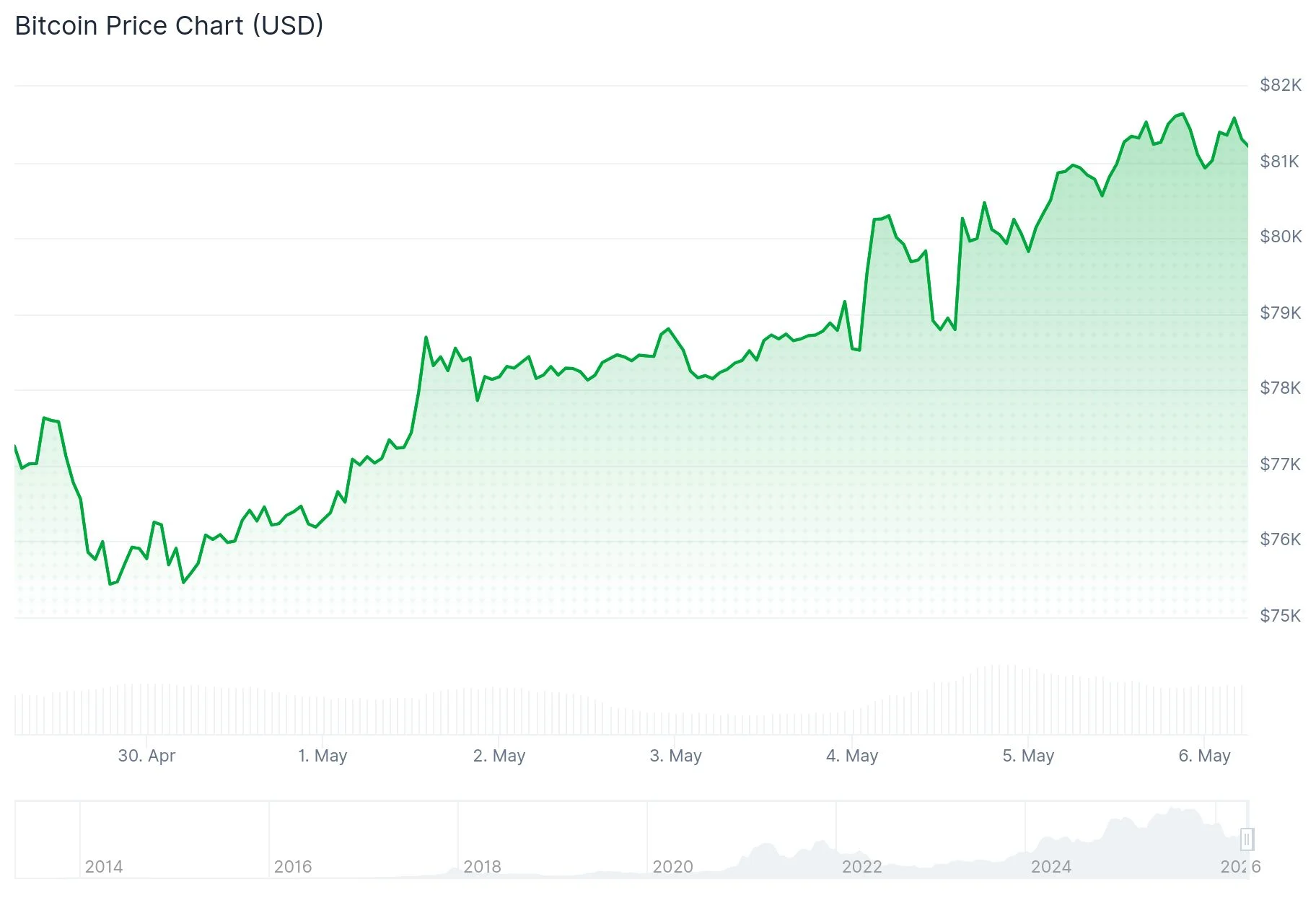
As of 17:41 ET, BTC traded at $81,392, reflecting a 1.4% gain and positioning above its 100-hour simple moving average. The psychologically important $80,000 threshold had been successfully recaptured during Monday’s trading session.
The catalyst for broader market optimism stemmed from clarification provided by U.S. Secretary of War Pete Hegseth. He emphasized that “Project Freedom,” the U.S. military initiative providing naval escorts through the strategically vital Strait of Hormuz, does not violate ceasefire terms with Iran.
“Project Freedom is defensive in nature, focused in scope, and temporary in duration,” Hegseth clarified. Contributing to the stabilizing narrative, Iranian Foreign Minister Abbas Araghchi remarked that “no military solution to a political crisis” exists.
While geopolitical developments don’t directly influence cryptocurrency fundamentals, they significantly impact investor sentiment toward risk-oriented assets. The de-escalation observed on Tuesday provided a tailwind for market confidence across multiple asset classes.
Critical Resistance Zones Under Surveillance
Iliya Kalchev, analyst at Nexo Dispatch, identified two particularly significant price thresholds currently in play. The 200-day moving average hovers around $82,000, while ETF aggregate cost-basis calculations center near $83,000.

“Reclaiming $80,000 carries psychological significance, but those upper levels represent the difference between a temporary relief bounce and a sustainable structural shift,” Kalchev explained.
Blockchain analytics from Santiment revealed accumulation patterns historically associated with major bullish moves. Throughout this month, wallets containing between 10 and 10,000 BTC added 16,622 BTC to their holdings, while smaller wallets holding under 0.01 BTC distributed 28 BTC.
Technical analyst Ted Pillows drew attention to the unfilled CME futures gap positioned near $84,000 as a plausible short-term objective. He observed that sustained trading above $80,600 could facilitate a move toward that gap. Conversely, failure to maintain the $80,000 level might trigger retracement toward the $77,000–$78,000 zone.
Corporate Holder Reports Quarterly Results
Major institutional Bitcoin holder Strategy released quarterly earnings on Tuesday, revealing a $14.5 billion operating loss that expanded from the previous year’s figure. Market analysts had largely anticipated this outcome given Bitcoin’s significant price volatility throughout the reporting period.
Near-term resistance levels are established at $81,500, with the next barrier at $81,750. Breakthrough above these points could expose $82,500 and subsequently $83,200 to testing. Downside support remains anchored at $80,150, with a more substantial foundation around $78,350.
Bitcoin’s recent peak of $81,765 represents a substantial recovery from the swing low of $74,940 established earlier in the cycle.
Get 3 Free Stock Ebooks
Discover top-performing stocks in AI, Crypto, and Technology with expert analysis.
- Top 10 AI Stocks - Leading AI companies
- Top 10 Crypto Stocks - Blockchain leaders
- Top 10 Tech Stocks - Tech giants



