



Key Takeaways
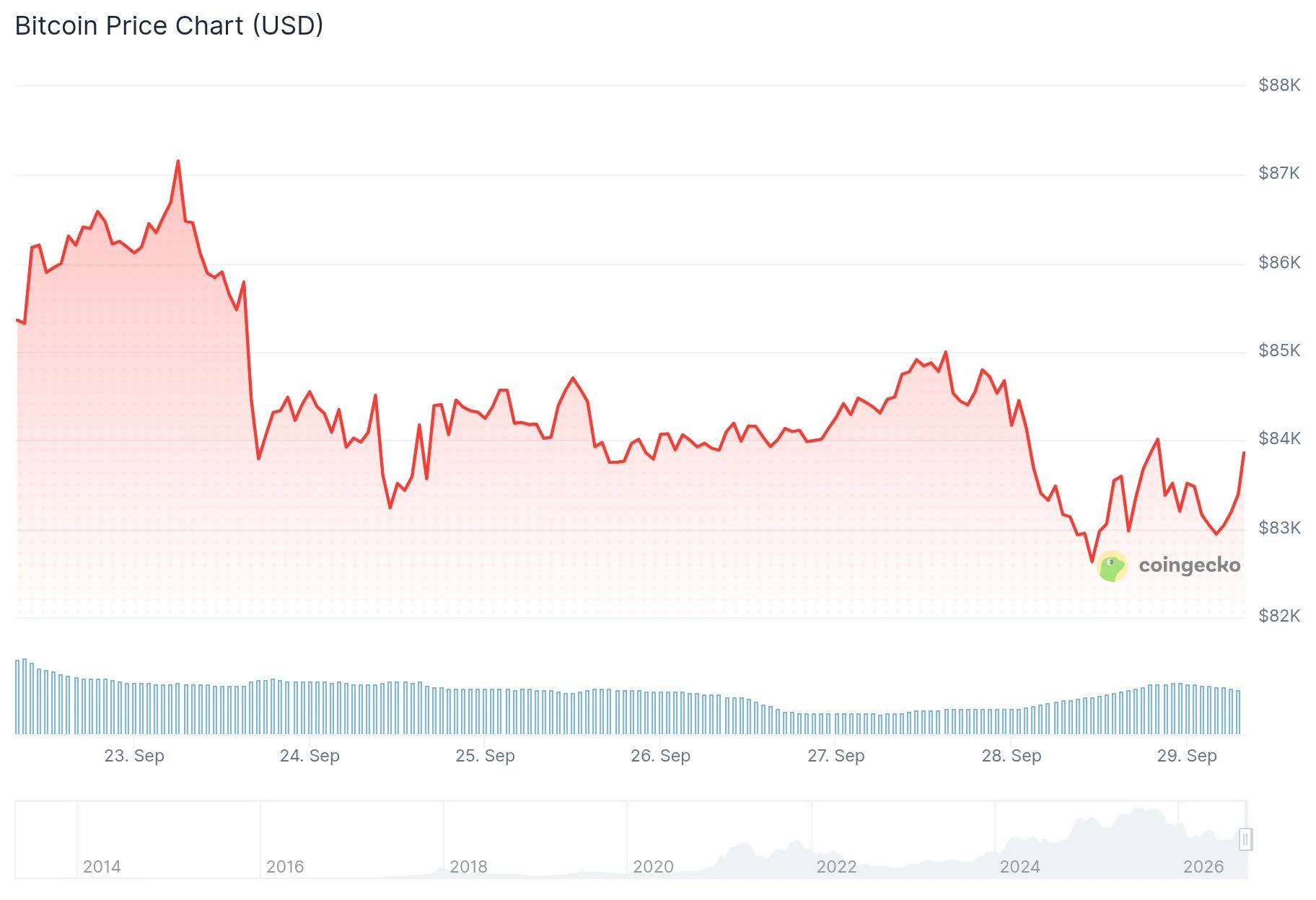
- BTC declined 1.5% to $83,416 during Monday’s session, slipping beneath $83,000 as global bond markets sold off.
- The 10-year Treasury yield surged above 5%, reaching its highest point in seventeen years.
- Geopolitical tensions persisted following President Trump’s dismissal of Iran’s ceasefire proposal.
- October Fed rate hike probability jumped to 70.3%, compared to 57.7% the previous week.
- Despite recent volatility, Bitcoin has surged over 40% in Q3, marking its strongest third quarter since 2017.
Bitcoin experienced a 1.5% decline Monday, retreating to $83,416 as market participants reduced exposure to riskier investments. The downturn came after a robust two-week rally fueled by expectations of more favorable cryptocurrency regulations in the United States.
The selloff extended beyond Bitcoin alone. Major cryptocurrencies including Ethereum, Cardano, XRP, Dogecoin, and Solana all surrendered portions of their recent advances.
Bond yields across developed markets climbed dramatically. The U.S. 10-year Treasury note breached the 5% threshold—a level unseen since 2007—while Japanese government bonds reached yields not witnessed in three decades.
Elevated yields enhance the appeal of government securities relative to higher-risk holdings such as digital currencies. The Federal Reserve and Bank of Japan both implemented rate increases in September while suggesting additional tightening may be forthcoming.
Middle East Tensions Fuel Energy and Inflation Concerns
Escalating crude prices linked to U.S.-Iran hostilities have contributed significantly to inflationary pressures throughout the year. This past weekend, President Trump refused to exclude the possibility of additional military operations against Iran following his rejection of Tehran’s peace overture.

Crude oil markets reacted by pushing prices back toward $95 per barrel, gaining 3% during Monday trading. Hamad Hussain, commodities economist at Capital Economics, informed Reuters that supply disruption fears continue to dominate despite improvements in tanker traffic through the Strait of Hormuz.
Conflicts involving Yemen’s Houthi militia and Saudi Arabia provided additional upward pressure on energy markets. Technical analyst Ali Charts commented on Bitcoin’s chart structure, noting that BTC had completed a double bottom formation and was now testing the $82,000 neckline resistance, suggesting that maintaining this threshold could present an entry point before a potential advance toward $100,000.
Notwithstanding Monday’s retreat, Bitcoin has climbed more than 40% during the third quarter. This represents its most impressive Q3 performance since 2017, significantly outpacing the average third-quarter appreciation of 8.6% recorded since 2013.
BTC also achieved its highest weekly closing price since late January at $84,450 before sliding to one-week lows around $82,557. Limited order book depth contributed to volatility, with approximately $30 million in sell orders concentrated near the $85,700 level Monday.
Federal Reserve Tightening Expectations Build Before Critical Releases
Derivative markets now indicate a 70.3% probability of a 0.25% Fed rate increase in October, elevated from 57.7% one week prior. The August PCE inflation data, the central bank’s favored inflation metric, releases Wednesday with projections pointing to 3.6% year-over-year expansion.
September’s employment situation report arrives Friday. August’s payroll figures substantially exceeded analyst predictions at 162,000 additions, while consensus forecasts for September stand at 83,000.
Trader Rekt Capital identified $82,500 as a critical support threshold for Bitcoin. He drew parallels to the 2022 bear market recovery phase, when BTC established a foundation above comparable support before initiating its subsequent upward movement.
Rekt Capital stated that sustaining $82,500 would validate an inverse head-and-shoulders formation on the weekly timeframe. He cautioned that failure to defend this zone could push Bitcoin back into the $60,000 to $80,000 trading corridor.
Above current valuations, the 2026 yearly opening price stands at $88,700, while the average acquisition cost for spot Bitcoin ETF participants hovers near $86,000. Below present levels, corporate treasury Bitcoin holders maintain an average entry price of $80,500.
Get 3 Free Stock Ebooks
Discover top-performing stocks in AI, Crypto, and Technology with expert analysis.
- Top 10 AI Stocks - Leading AI companies
- Top 10 Crypto Stocks - Blockchain leaders
- Top 10 Tech Stocks - Tech giants



