



Key Highlights
- Bitcoin declined to $79,200, shedding 2.3% over a 24-hour period following a breach of the critical $80,000 threshold.
- Among major cryptocurrencies, Solana experienced the steepest decline at 5.6% down to $90, whereas Dogecoin stood as the sole gainer.
- Consecutive inflation surprises — CPI reaching 3.8% and PPI surging 1.4% monthly — disrupted Federal Reserve rate reduction forecasts.
- Geopolitical uncertainty intensified during the Trump-Xi Beijing meeting, where Xi issued warnings about potential Taiwan-related conflicts.
- U.S. Bitcoin spot ETFs experienced $233 million in net withdrawals on May 12, with analyst Ali Charts signaling a potential decline to the 50-day SMA around $75,000.
Bitcoin experienced a significant downturn on Thursday as escalating inflation concerns combined with mounting geopolitical uncertainties pressured cryptocurrency markets. During Asian trading sessions, BTC was changing hands at $79,200, reflecting a 2.3% decline across the previous day.
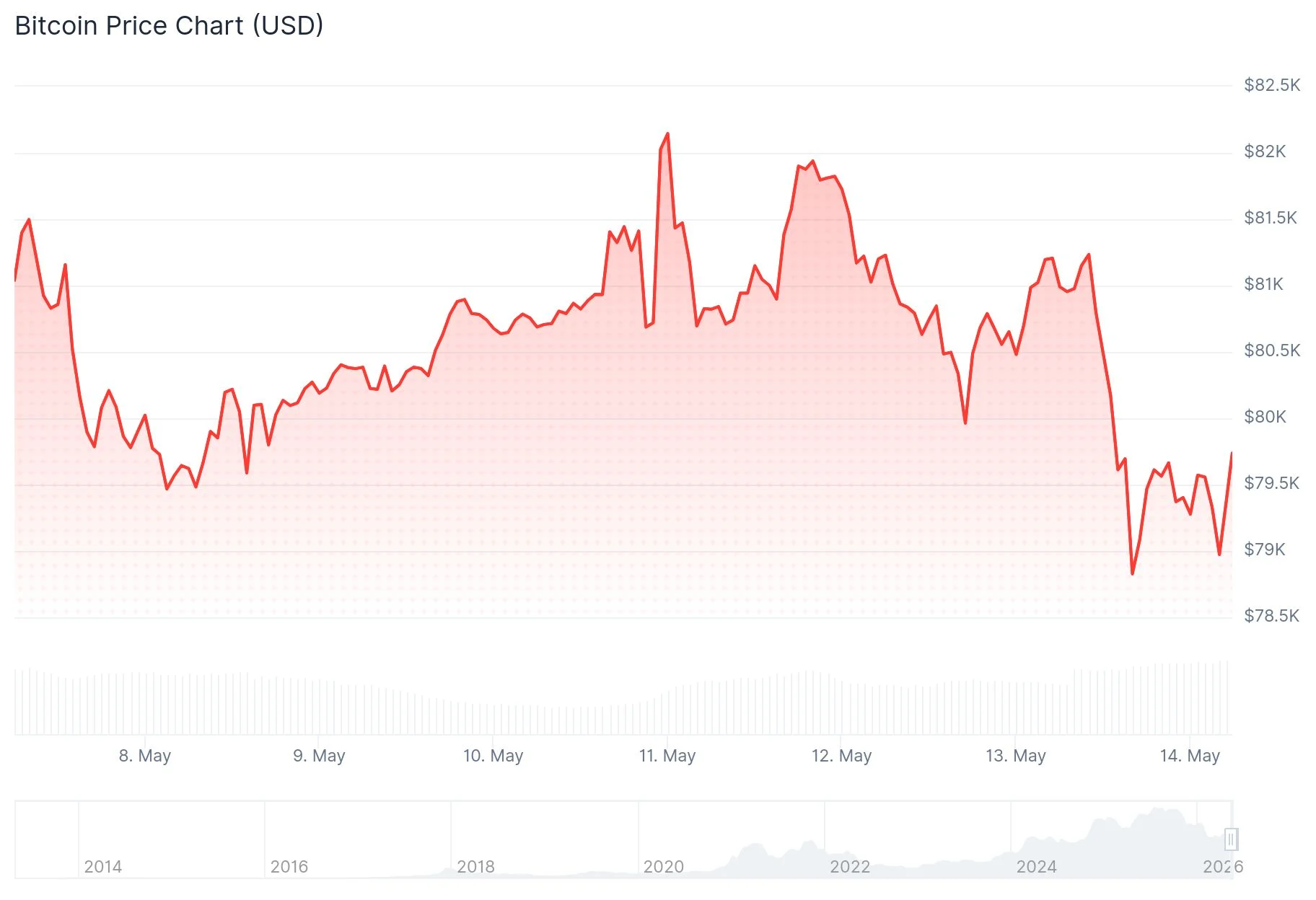
This retreat followed a period where Bitcoin had successfully defended the $80,000 mark throughout the majority of the preceding week. However, this crucial support level crumbled under mounting pressure from two sequential inflation data surprises.
Tuesday’s Consumer Price Index revealed a 3.8% annual increase — marking the most aggressive inflation reading witnessed in almost three years. The following day, the Producer Price Index compounded market anxieties by registering 1.4% on a month-over-month basis, significantly exceeding the 0.5% consensus estimate, while reaching 6% annually.
These inflationary developments create substantial obstacles for the Federal Reserve’s anticipated interest rate reduction trajectory, effectively eliminating a crucial supportive factor that cryptocurrency investors had been incorporating into their valuations.
Beijing Summit Escalates Market Uncertainty
The historic Trump-Xi meeting in Beijing, representing the first Chinese visit by a sitting American president in approximately ten years, introduced additional market volatility. During discussions at the Great Hall of the People, President Xi issued cautionary statements regarding potential “collision or even clashes” should Taiwan-related matters be mismanaged.

Notably, China’s official summary of Xi’s comments was disseminated before the diplomatic meeting concluded, generating turbulence throughout international financial markets. Asian equity indices oscillated between positive and negative territory, with mainland Chinese equities declining 1.3%.
Solana (SOL) registered the most substantial cryptocurrency losses, plummeting 5.6% to $90 and erasing the majority of its weekly advances. Ether retreated 2.1% to $2,250, accumulating a 3% seven-day loss. BNB declined 1.6% to $660, while XRP dropped 1.7% to $1.43. Dogecoin emerged as the sole major cryptocurrency posting gains, advancing 0.9% to $0.1126.
Crypto analyst Ali Charts observed on X that Bitcoin appears to have encountered resistance at its 200-day simple moving average positioned at $82,500, cautioning that this rejection “may lead to a retest of the 50D SMA at $75,000.” Such a movement would constitute an additional 5% depreciation from present price levels.
Institutional Capital Flight Through ETF Channels
Blockchain analytics provider Glassnode documented that the seven-day simple moving average of U.S. spot ETF net flows descended to negative $88 million daily — representing the most significant capital exodus since mid-February. Glassnode emphasized a critical distinction: February’s outflows coincided with price deterioration, whereas the current withdrawal wave represents “selling into strength, with BTC trading near $80k,” indicating institutional participants capitalizing on the recent price recovery to liquidate positions.
Bitcoin spot ETFs documented $233 million in aggregate outflows on May 12, with Fidelity’s FBTC leading withdrawals at $86.13 million. Ethereum spot ETFs simultaneously registered $131 million in redemptions during the identical trading session.
Critical Price Zones Under Surveillance
Matt Mena, senior crypto research strategist at 21Shares, identified the $80,000 threshold as pivotal for near-term price action. A confirmed breakdown would likely catalyze a retest of $78,000, with $75,000 representing the subsequent defensive boundary.
The $78,000 level corresponds to the early-May trough preceding Bitcoin’s advance toward $82,000. This price zone now emerges as the immediate test as macroeconomic releases and developments from the Trump-Xi diplomatic engagement continue unfolding.
Get 3 Free Stock Ebooks
Discover top-performing stocks in AI, Crypto, and Technology with expert analysis.
- Top 10 AI Stocks - Leading AI companies
- Top 10 Crypto Stocks - Blockchain leaders
- Top 10 Tech Stocks - Tech giants



