



Key Highlights
- Bitcoin slipped beneath $76,000 on Friday, declining approximately 2.3% to $75,933, marking its second consecutive week in the red
- Crypto markets witnessed $200 million in forced liquidations within 24 hours, sparked by mounting expectations of interest rate increases amid oil-fueled inflation concerns
- US-listed spot Bitcoin ETFs experienced $1.26 billion in cumulative net withdrawals across five consecutive trading days
- On-chain analytics platform Santiment characterizes these ETF withdrawals as a “contrarian indicator” that could present an accumulation window
- ETF specialist James Seyffart notes aggregate ETF inflows approach their peak at $60 billion, with new records anticipated
Bitcoin (BTC) breached the $76,000 threshold on Friday, May 22, prolonging a downturn that has pushed the leading digital asset into its second straight week of declining prices. The cryptocurrency changed hands at $75,933, representing a 2.3% daily decrease and approximately 3% weekly loss.
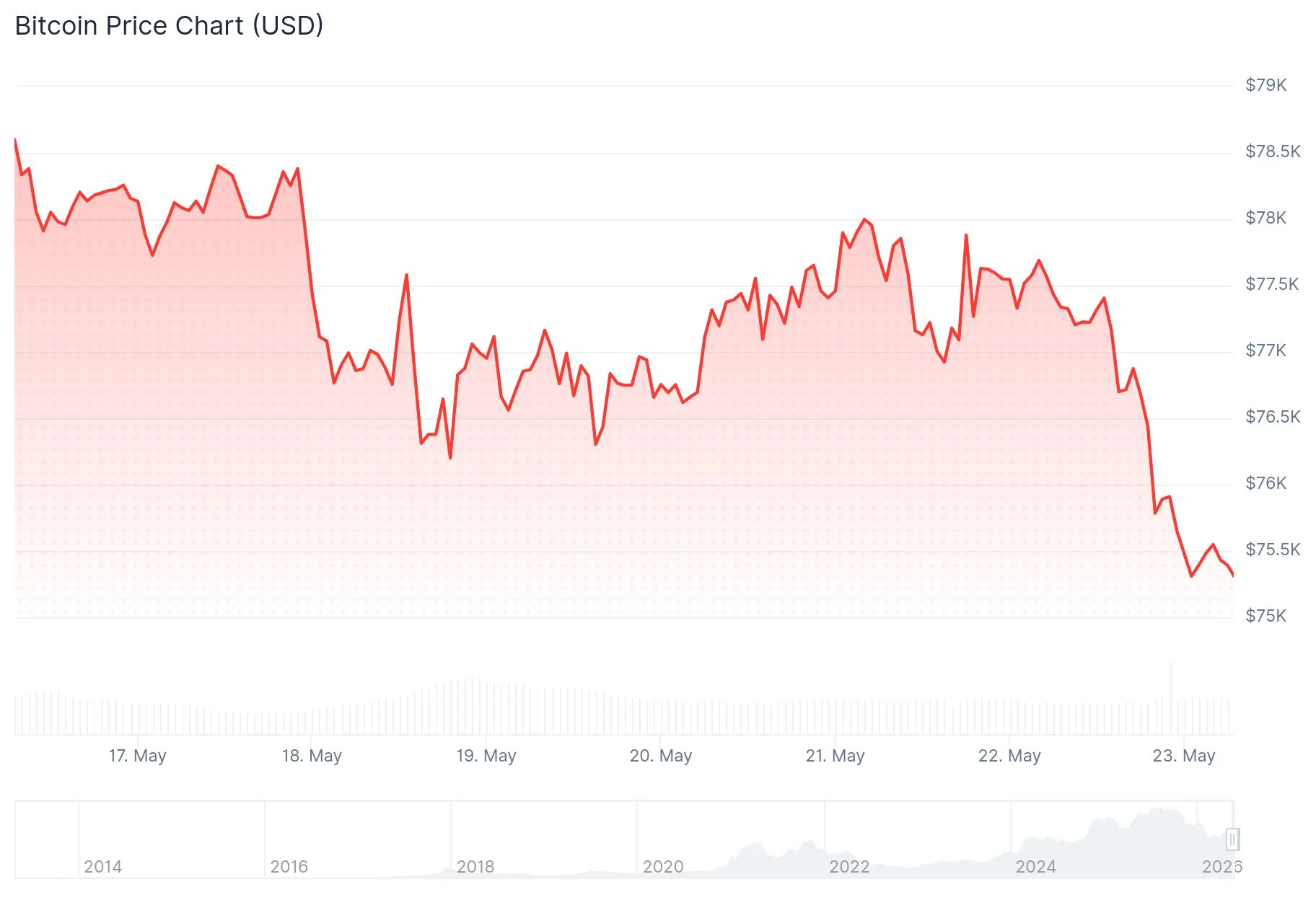
The descent stemmed from a confluence of macroeconomic headwinds and cascading leveraged trades. According to CoinGlass tracking data, the cryptocurrency market absorbed $200 million in forced position closures within a 24-hour window.
Market participants increased their wagers on potential interest rate increases throughout the week as crude oil valuations climbed due to escalating tensions in the Middle East region. Iran’s effective blockade of the Strait of Hormuz since late February has severed access to a critical shipping lane responsible for approximately one-fifth of global petroleum and natural gas transportation.
This supply disruption has intensified concerns about inflationary pressures. Documentation from the Federal Reserve’s April policy meeting revealed that a majority of committee members now stand receptive to raising interest rates should energy-related inflation persist.
Kevin Warsh assumed his duties as the new Federal Reserve chairman on Friday, inheriting the position during a particularly challenging economic period. While President Trump has advocated for rate reductions, the prevailing inflationary landscape renders monetary easing improbable.

Dessislava Ianeva, an analyst at Nexo Dispatch, observed that the multi-asset environment underwent a pronounced transformation during the middle of the week. “Headlines suggesting U.S.–Iran de-escalation drove Brent crude from above $110 down to $105.7 per barrel, while dovish commentary from the April FOMC minutes kept longer-dated yields anchored near cyclical peaks,” she explained.
Cryptocurrency market analyst Daan Crypto Trades (@DaanCrypto) shared on X that BTC maintains a discernible trajectory on technical charts. He indicated Bitcoin must overcome the lower $80K region, where horizontal resistance converges with the 200-day moving average on daily timeframes. He characterized this as the initial significant retracement following Bitcoin’s April surge, emphasizing that bulls must establish a higher low or face confirmation of a lower high within the extended downtrend that began after the October 2025 record peak.
Bitcoin ETF Withdrawals Exceed $1.26 Billion
Spot Bitcoin exchange-traded funds documented redemptions throughout six uninterrupted trading sessions. The eleven US-domiciled investment vehicles collectively shed $1.26 billion in net assets during the most recent five-day period, based on Farside Investors tracking.
Bitcoin struggled to maintain support above $80,000 throughout May, reaching a monthly peak of $79,052 on May 16 before retreating. The asset was quoted at $75,410 when Santiment published its Friday analysis.
Santiment Identifies Accumulation Opportunity
Cryptocurrency sentiment analytics firm Santiment challenged the pessimistic interpretation of these fund outflows. The organization argued that ETF capital movements predominantly mirror retail participant sentiment rather than institutional allocation strategies.
“Persistent ETF redemptions have traditionally aligned with environments conducive to strategic accumulation by patient investors rather than widespread capitulation,” Santiment stated.
ETF research analyst James Seyffart mentioned during a YouTube podcast appearance that Bitcoin ETFs have recovered the majority of the $9 billion in withdrawals observed between October and February. Aggregate inflows currently hover near $60 billion since the products’ introduction, approaching the historical maximum. Seyffart expressed confidence that this benchmark will be surpassed, particularly as additional ETF offerings enter the marketplace.
Get 3 Free Stock Ebooks
Discover top-performing stocks in AI, Crypto, and Technology with expert analysis.
- Top 10 AI Stocks - Leading AI companies
- Top 10 Crypto Stocks - Blockchain leaders
- Top 10 Tech Stocks - Tech giants



