



Key Takeaways
- BTC price declined to approximately $76,700, marking its lowest point in two weeks amid rising Treasury yields and reduced risk appetite
- Liquidations totaled over $661 million within a 24-hour window, with leveraged long positions accounting for 95% of losses
- Spot Bitcoin ETFs in the United States registered $290.4 million in net withdrawals on May 15, after a $630.4 million exodus on May 13
- ETH funds experienced similar outflows and underperformed relative to Bitcoin’s price movement
- The Senate Banking Committee passed the CLARITY Act with a 15-9 margin, marking progress toward comprehensive crypto regulation
Bitcoin tumbled to its lowest level in fourteen days, touching $76,700 last week after retreating from the $80,000 threshold. The decline coincided with surging Treasury yields and diminishing risk tolerance among investors. This downturn has left market participants questioning whether we’re witnessing a temporary retracement or the beginning of a more significant bearish phase.
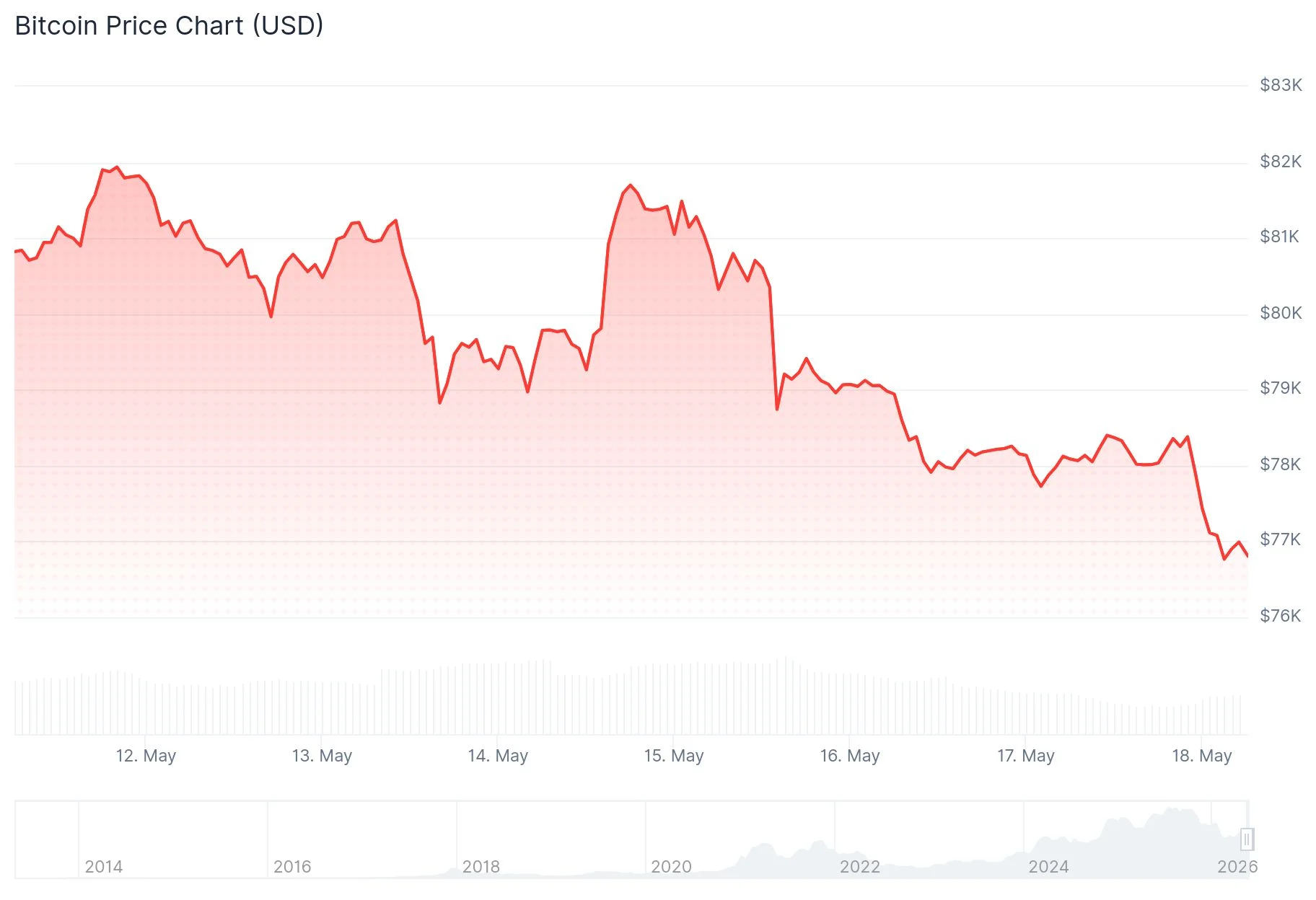
The price action triggered substantial liquidation events across the market. Approximately $661 million worth of cryptocurrency positions were forcibly closed during a 24-hour span. Notably, roughly 95% of these liquidations affected traders who had taken leveraged long positions, betting on continued price appreciation. This concentration of directional positioning created a cascading effect—when prices began falling, automatic liquidations amplified the downward momentum.
Institutional Money Flow Turns Negative
The flow of capital into and out of Bitcoin exchange-traded funds has emerged as a critical barometer for gauging institutional sentiment. Recent data suggests weakening conviction among large investors.
On May 13, U.S. spot Bitcoin ETFs experienced net withdrawals of $630.4 million. Although May 14 brought a temporary reversal with $131.3 million in inflows, the respite proved short-lived. May 15 saw another $290.4 million leave these funds, based on tracking data from Farside Investors.
This inconsistent flow pattern suggests institutional buyers are stepping back rather than accumulating aggressively. While it doesn’t signal a complete abandonment of crypto exposure, it represents a notable shift from the consistent buying pressure observed in earlier months this year.

Ethereum mirrored this negative trend. ETH-focused investment products also experienced withdrawals on May 15, and Ethereum’s price performance trailed Bitcoin’s movements. This underperformance in the second-largest cryptocurrency raises concerns about the broader altcoin market’s ability to mount a meaningful recovery in the near term.
Macroeconomic Headwinds Intensify
The rising yield environment represents a significant challenge for cryptocurrency markets. As government bond yields climb, they enhance the attractiveness of traditional fixed-income investments while simultaneously diminishing the appeal of volatile, risk-on assets like digital currencies. Bitcoin’s descent toward the $78,000 level aligned with a widespread selloff in global sovereign debt markets throughout last week.
Market participants are now closely monitoring several macroeconomic indicators: Treasury yield trajectories, upcoming inflation reports, and any policy communications from the Federal Reserve. Should yields continue their upward march, cryptocurrencies may face continued selling pressure and struggle to establish firm support levels. Conversely, any easing in the yield environment could provide the catalyst for Bitcoin and alternative tokens to regain lost ground.
Regulatory Progress Offers Silver Lining
Amid the market turbulence, there was one encouraging development on the regulatory front. The Senate Banking Committee approved the CLARITY Act with a 15-9 vote. This proposed legislation seeks to establish clear definitional boundaries for digital assets—determining whether specific tokens should be regulated as securities, commodities, or under an entirely new framework. The bill also includes provisions addressing stablecoin oversight and regulatory jurisdiction.
This represents meaningful progress for the cryptocurrency industry’s push for regulatory clarity. That said, significant obstacles remain before the legislation becomes law. Democratic committee members have expressed reservations regarding anti-money laundering provisions and potential conflicts within the regulatory framework. Approval at the committee level is merely the first hurdle; passage through the full Senate remains uncertain.
For the immediate future, Bitcoin maintains its position above critical long-term support zones, and the regulatory landscape shows gradual improvement. However, the combination of persistent ETF outflows, large-scale liquidations, and the challenging yield environment has left cryptocurrency markets in a precarious position heading into the coming weeks.
Get 3 Free Stock Ebooks
Discover top-performing stocks in AI, Crypto, and Technology with expert analysis.
- Top 10 AI Stocks - Leading AI companies
- Top 10 Crypto Stocks - Blockchain leaders
- Top 10 Tech Stocks - Tech giants



