Layer 2 networks are a core part of Ethereum’s plan to grow. They aim to lower fees and raise capacity while still relying on Ethereum for security.
This article brings together the key numbers behind these networks. It covers fees, withdrawal times, data limits and security ratings, using official documentation and independent research.
Some figures are fixed rules written into the software. Others, like the fee example, are hypothetical and are labeled that way.
Key Layer 2 Statistics at a Glance
The table below lists the main figures covered in this article. Each one comes from official project documentation or independent research.
| Statistic | Figure |
|---|---|
| OP Stack withdrawal challenge period | 7 days (168 hours) |
| Ethereum block time | 12 seconds |
| Size of one Ethereum blob | 128 KB |
| Blob target per block at Dencun launch | 3 blobs |
| Blob maximum per block at Dencun launch | 6 blobs |
| How long Ethereum keeps blob data | About 18 days |
| Dencun upgrade date | March 13, 2024 |
| L2BEAT maturity stages | 3 (Stage 0, Stage 1, Stage 2) |
| L2BEAT Stages framework update | July 2025 |
| Stages in a typical rollup transaction | 5 |
| Hypothetical saving on 20 swaps | $99 (99%) |
What Is a Crypto Layer 2 Network?
A Layer 2 network is a system built on top of a base blockchain, known as Layer 1. It processes transactions away from the base chain, then posts key information back to it.
Ethereum is a Layer 1 blockchain. Arbitrum One, OP Mainnet and Base are Layer 2 networks that run on top of it.

Ethereum’s official documentation says Layer 2 systems handle transactions away from Mainnet while drawing on Ethereum’s security. The goal is more capacity and lower costs without running every transaction on Ethereum itself.
Layer 2 is a broad label, not one technology. The two main designs on Ethereum are optimistic rollups and zero-knowledge (ZK) rollups.
Not every network sold as an Ethereum scaling tool offers the same protection. Sidechains and validiums work in different ways, which this article covers later.
Why Blockchains Need Layer 2
Blockchains must balance capacity, security and decentralisation. This is often called the scalability trilemma.
Ethereum puts security and decentralisation first. It produces a new block every 12 seconds, and users compete for limited space in each one.
When demand rises, fees rise too. A small trade can lose a large share of its value to fees, which makes everyday use harder.
Raising the base chain’s limits is not a simple fix. It can make running a node more expensive, which may push the network toward fewer, larger operators.
How a Layer 2 Transaction Works: Five Stages
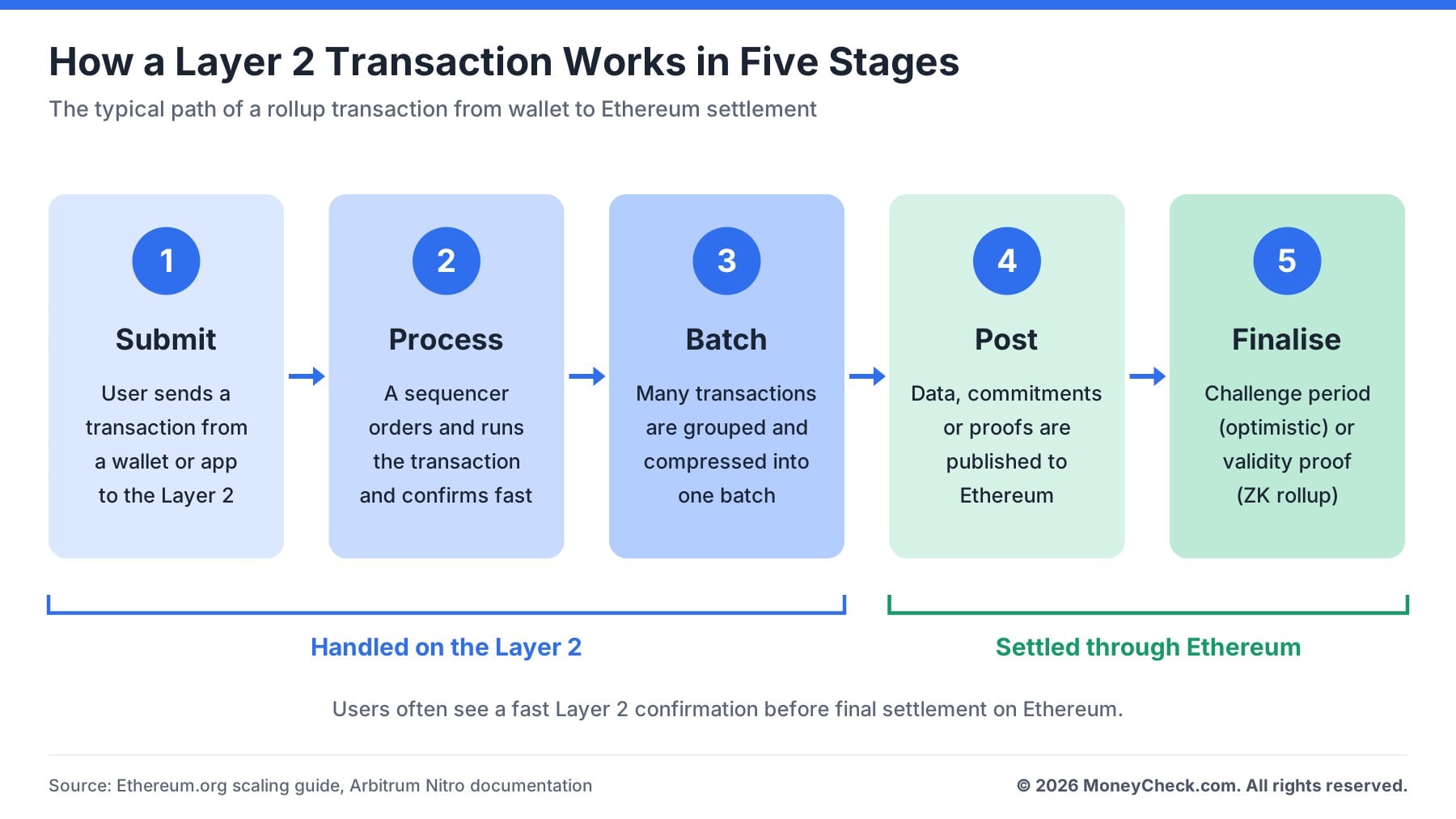
Most major Ethereum Layer 2 networks use rollups. A rollup runs transactions in its own environment and sends summaries of them to Ethereum.
The process breaks down into five stages, shown in the table below.
| Stage | What happens | Where |
|---|---|---|
| 1. Submit | A user sends a transaction from a wallet or app | Layer 2 |
| 2. Process | A sequencer orders and runs the transaction | Layer 2 |
| 3. Batch | Many transactions are grouped and compressed | Layer 2 |
| 4. Post | Data, commitments or proofs are published | Ethereum |
| 5. Finalise | A challenge period ends or a validity proof is checked | Ethereum |
The sequencer is a key part of this process. It decides the order of transactions and gives users a fast first confirmation.
That fast confirmation is not the same as final settlement. Users may see a result in seconds, but the strongest guarantees come later, once Ethereum has settled the batch.
Arbitrum’s technical documentation describes this flow for its own network. It orders transactions, publishes data to Ethereum and uses fraud proofs to protect the result.
Optimistic Rollups vs ZK Rollups
The two main rollup types differ in how they show that transactions are correct.
Optimistic rollups assume results are valid unless someone challenges them. Other participants can review a claim and dispute it during a set challenge window.
ZK rollups take the opposite approach. They create a cryptographic proof that the results follow the rules, and a contract on Ethereum checks that proof.
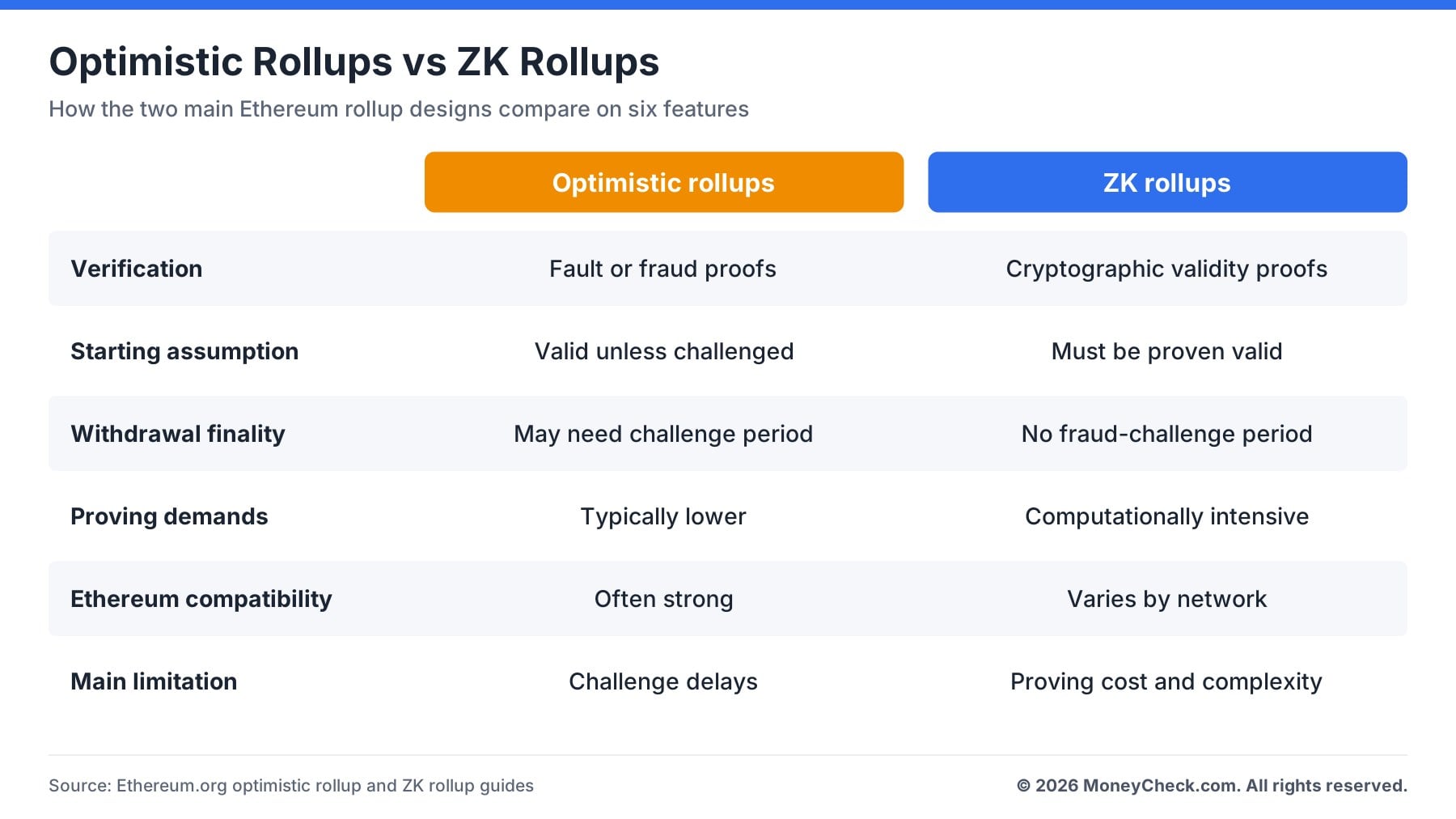
| Feature | Optimistic Rollups | ZK Rollups |
|---|---|---|
| Verification approach | Fault or fraud proofs | Cryptographic validity proofs |
| Starting assumption | Accepted unless challenged | Must be proven valid |
| Ethereum settlement | Rollup contracts and challenge system | Proof-checking contracts |
| Withdrawal finality | May need a challenge period | No fraud-challenge period |
| Proof demands | Typically lower | Computing-heavy proof generation |
| Ethereum compatibility | Often strong | Varies by network |
| Main advantage | Mature tools and EVM compatibility | Mathematical proof of correctness |
| Main limitation | Challenge delays and trust assumptions | Proving cost and complexity |
Arbitrum One, OP Mainnet and Base are all optimistic rollups. Starknet and ZKsync are examples of ZK-based networks.
Neither design wins in every case. Optimistic rollups have more time in production and work well with existing Ethereum tools. ZK rollups offer mathematical checks but need heavy computing power to build proofs.
The term zero-knowledge does not mean transactions are private. Most ZK rollups use the technology to scale, not to hide data.
Layer 2 Fee Statistics: A Hypothetical Comparison
Lower fees are the main reason people use Layer 2 networks. Rollups cut costs by running most of the work off Mainnet and splitting data costs across many transactions.
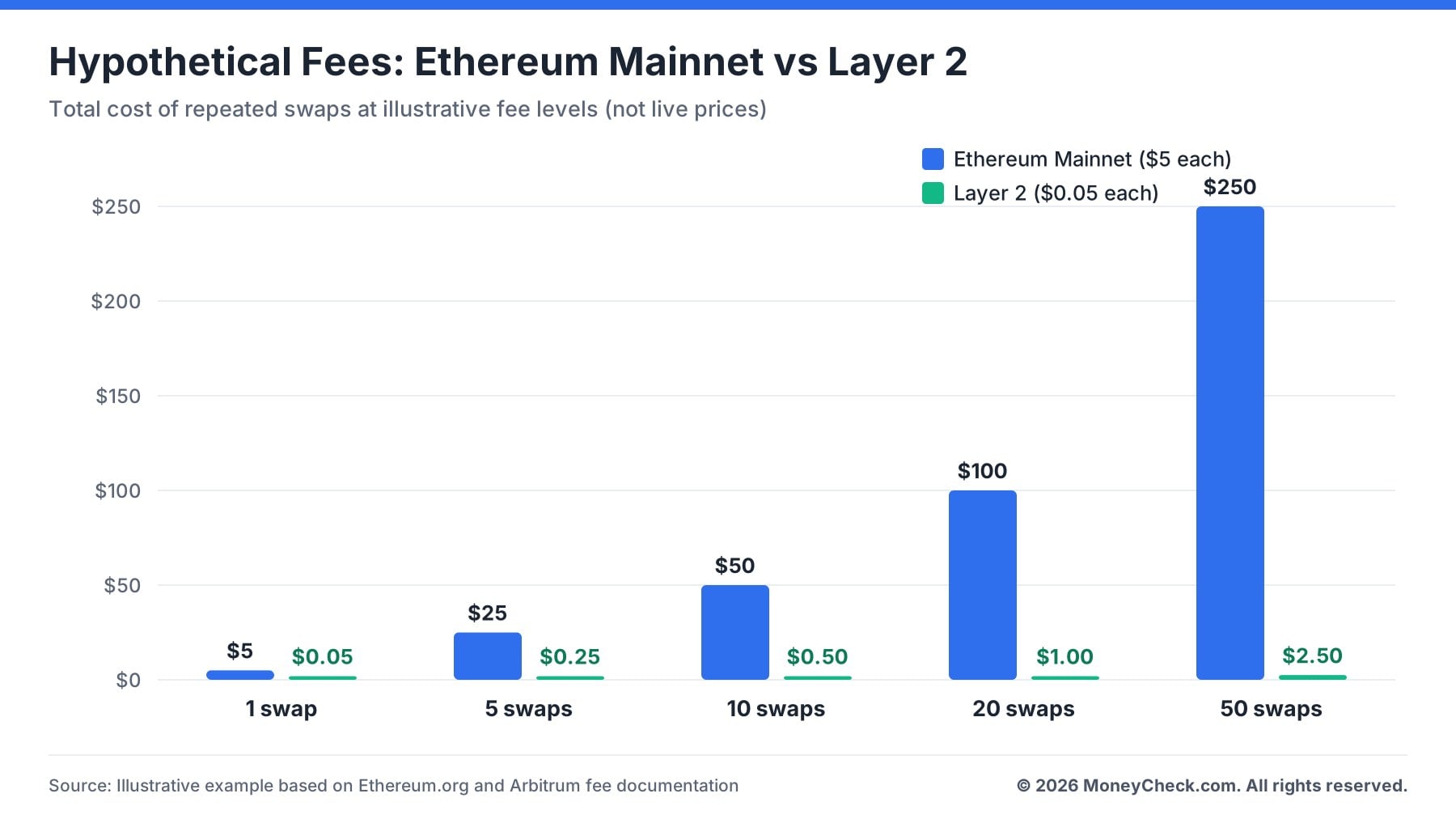
The example below uses round numbers to show the scale of the difference. It assumes a $5 fee per transaction on Ethereum Mainnet and $0.05 per transaction on a Layer 2.
| Number of swaps | Ethereum Mainnet cost | Layer 2 cost | Saving |
|---|---|---|---|
| 1 | $5.00 | $0.05 | $4.95 |
| 5 | $25.00 | $0.25 | $24.75 |
| 10 | $50.00 | $0.50 | $49.50 |
| 20 | $100.00 | $1.00 | $99.00 |
| 50 | $250.00 | $2.50 | $247.50 |
Under these assumptions, the Layer 2 user pays 1% of the Mainnet cost. Twenty swaps cost $1 instead of $100, a saving of $99.
These are not live prices. Real fees change with network demand, the type of transaction and the cost of posting data to Ethereum.
Layer 2 fees are also never zero. Arbitrum’s fee model, for example, includes a charge for running the transaction on Layer 2 and a separate charge for posting data to its parent chain.
Rollups also pay for sequencer operations and, in some cases, proof generation. During busy periods, Layer 2 fees can rise.
Ethereum Blob Statistics and Data Costs
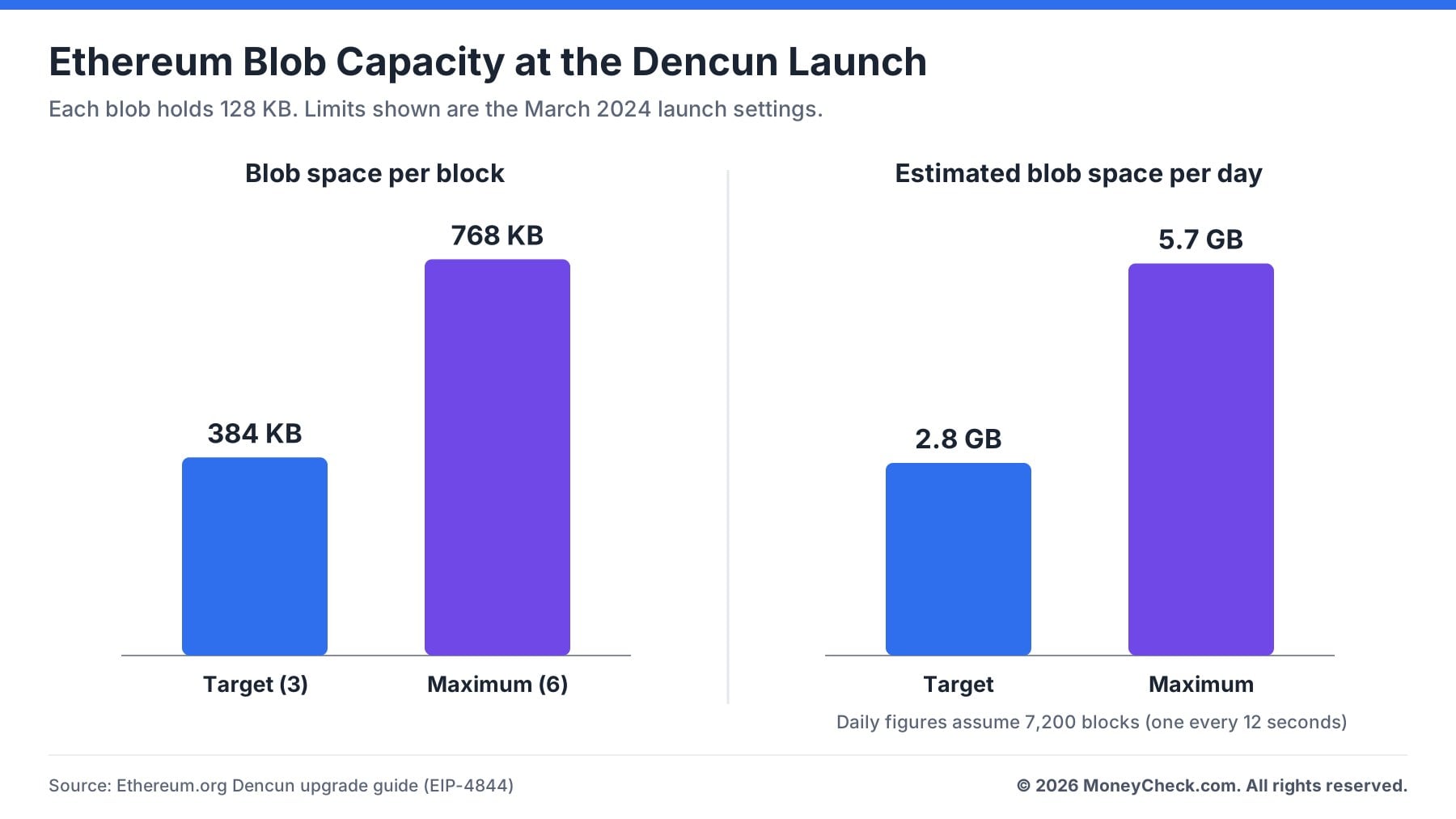
Ethereum’s Dencun upgrade went live on March 13, 2024. It introduced EIP-4844, which created a new type of data called blobs.
Before blobs, rollups posted data to Ethereum as regular transaction data, known as calldata. That was expensive.
Blobs gave rollups their own data space with a separate fee market. Cheaper data for rollups can mean lower fees for their users.
| Blob statistic (Dencun launch settings) | Figure |
|---|---|
| Size of one blob | 128 KB |
| Target blobs per block | 3 |
| Maximum blobs per block | 6 |
| Target blob space per block | 384 KB |
| Maximum blob space per block | 768 KB |
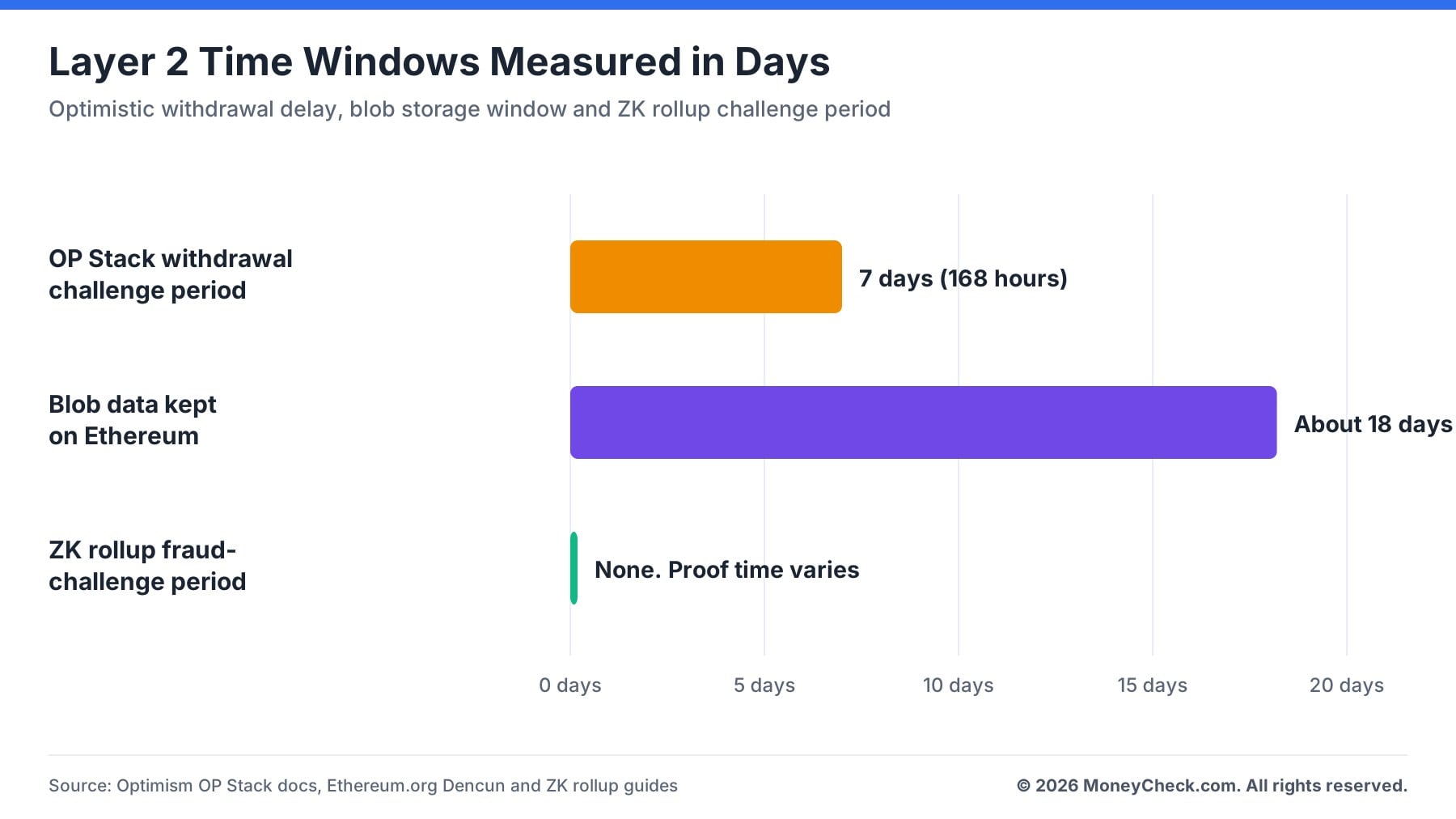
| Time blob data is kept | About 18 days |
| Estimated daily blob space at target | About 2.8 GB |
| Estimated daily blob space at maximum | About 5.7 GB |
The daily estimates assume 7,200 blocks a day, one every 12 seconds. Real totals vary because some slots are missed.
Later network upgrades, starting with Pectra in May 2025, raised these blob limits. The launch figures above show the starting point.
Blobs are not stored forever. Ethereum keeps them for about 18 days, which gives rollups and archive services time to save the data.
This matters because of data availability. A rollup that posts its data to Ethereum lets anyone check or rebuild its state, which gives stronger security than relying on an outside data provider.
Layer 2 Withdrawal Time Statistics
Moving funds from a Layer 2 back to Ethereum can take far longer than moving them in. The wait depends on the rollup design.
The OP Stack, used by OP Mainnet and Base, has a seven-day challenge period after a withdrawal is proven. That equals 168 hours, or 50,400 Ethereum blocks at 12 seconds each.
The delay is part of the security model. It gives other participants time to dispute a false claim before funds leave the system.
ZK rollups do not use a fraud-challenge period. Their proofs confirm correctness up front, though building and settling proofs can still add delays.
| Withdrawal route | Typical wait | Trade-off |
|---|---|---|
| Optimistic rollup native bridge | About 7 days | Slow, but uses the rollup’s own security |
| ZK rollup native bridge | No challenge period, depends on proof timing | Proof and settlement delays can vary |
| Third-party liquidity provider | Faster | Extra fees and added risks |
Some services offer faster exits by fronting users funds on the other side. This saves time but adds fees and new risks.
Users should know which route they are using. A native withdrawal and a third-party service are not the same thing.
Gas Tokens and Governance Tokens
Many people assume each Layer 2 has its own coin for fees. That is often not the case.
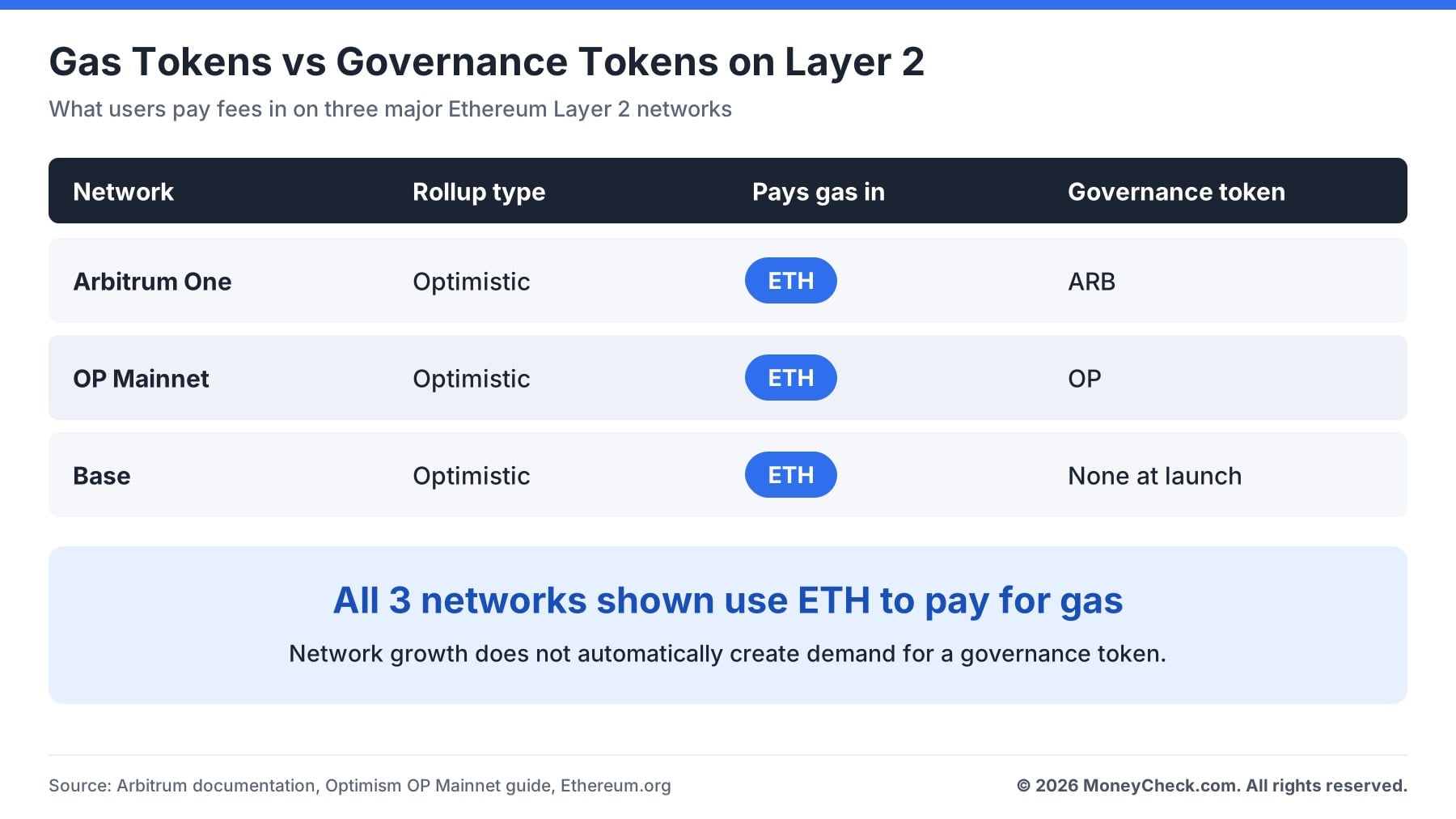
Arbitrum One, OP Mainnet and Base all use ETH to pay for gas. Arbitrum has a separate token, ARB, and Optimism has OP. Both are mainly used for governance.
Base launched without a token of its own. It was developed with Coinbase’s involvement, but it is a blockchain network, not part of Coinbase’s exchange.
| Feature | Layer 1 | Layer 2 |
|---|---|---|
| Main function | Base blockchain | Scaling and transaction execution |
| Examples | Ethereum, Bitcoin, Solana | Arbitrum One, Base, OP Mainnet |
| Security | Its own consensus | Depends on the Layer 1 and the Layer 2 design |
| Transaction costs | Depend on base network demand | Often lower |
| Settlement | Directly on the base chain | Often through the Layer 1 |
| Main risks | Consensus and protocol flaws | Extra contract, operator and bridge risks |
| Native token | Usually needed for gas or consensus | Not always needed |
This has a direct effect on investors. Growth in a network’s use does not automatically create demand for its governance token.
Holding ARB or OP does not give an enforceable claim to network fee revenue. Investors need to check what rights and uses a token actually has.
Supply also matters. Tokens with large insider allocations or upcoming unlocks can expose buyers to dilution, and a small circulating supply can hide a large fully diluted value.
Layer 2 Security Statistics and L2BEAT Stages
Layer 2 networks are built to borrow Ethereum’s security. In practice, their protections vary from one network to the next.
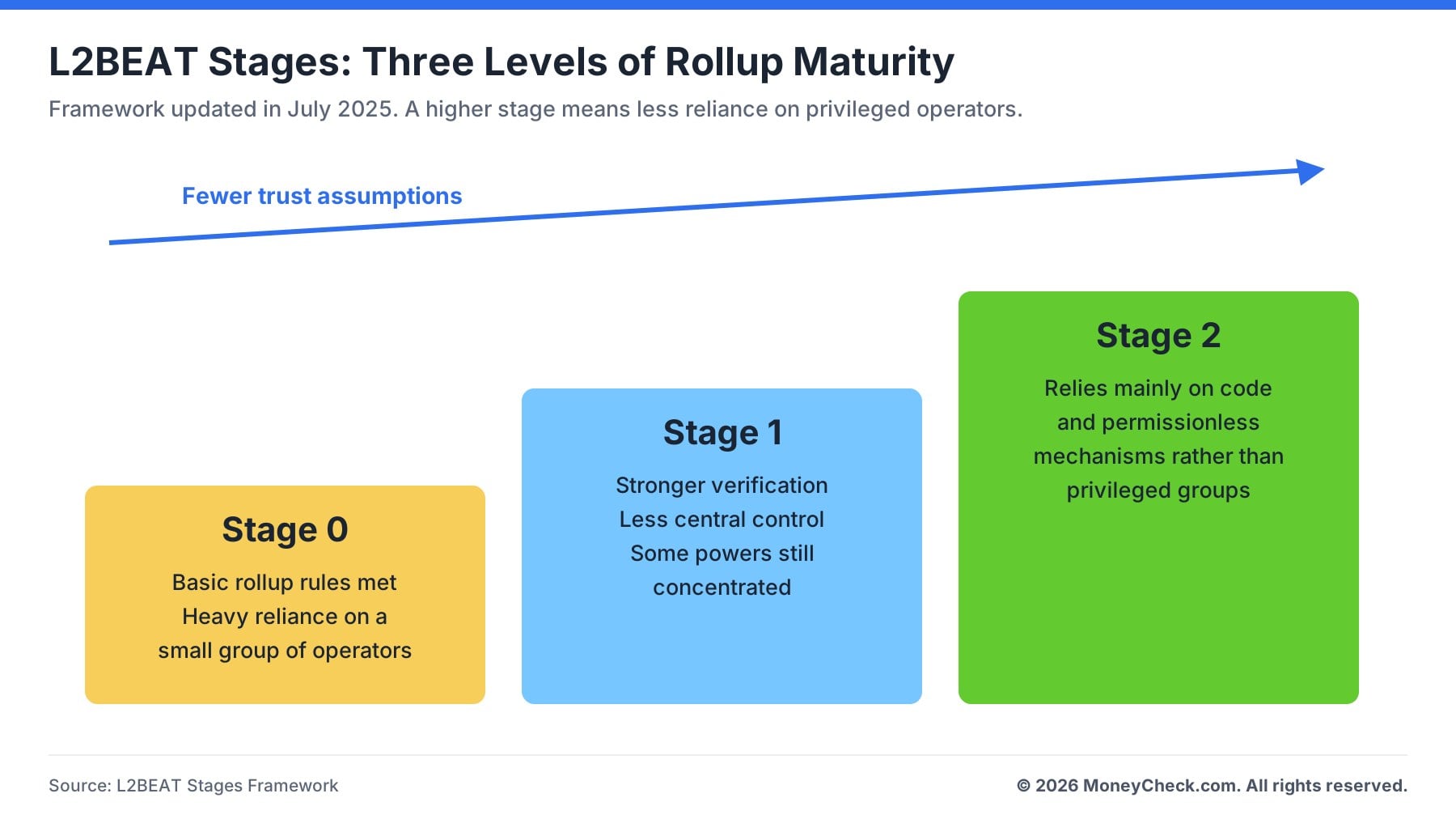
L2BEAT, an independent research site, rates rollups with a framework of three stages. It updated the framework in July 2025.
| Stage | What it means |
|---|---|
| Stage 0 | Meets basic rollup rules but relies heavily on a small group of operators or admins |
| Stage 1 | Stronger checks and less central control, though some security powers stay concentrated |
| Stage 2 | Relies mainly on code and permissionless mechanisms rather than privileged groups |
A Stage 2 rating does not mean a project is free of bugs. A Stage 0 rating does not mean a project is a fraud or poorly built.
Ratings change over time. Readers should check L2BEAT directly for the current list.
Three Common Risks
The first is sequencer risk. Many rollups use one central sequencer, and if it goes offline, users may face delays.
The second is smart contract risk. Audits help, but a serious bug could still put funds at risk.
The third is upgrade risk. On some networks, a small group can change contracts, and users may not always get time to exit first.
Bridges add another layer of risk. Ethereum’s documentation lists smart contract flaws, counterparty risk and software failures as the main dangers.
Layer 2 vs Sidechains vs Validiums
Not every Ethereum-linked network is a rollup. The main difference is where data is kept and who checks the results.
| Type | How results are checked | Where data is kept | Security depends on |
|---|---|---|---|
| Optimistic rollup | Fraud proofs | Ethereum | Ethereum plus the challenge system |
| ZK rollup | Validity proofs | Ethereum | Ethereum plus the proof system |
| Validium | Validity proofs | Off Ethereum | Proofs plus an outside data provider |
| Sidechain | Its own consensus | Its own chain | Its own validators |
Polygon PoS is a long-running example of a sidechain. It works with Ethereum tools but has relied on its own validator set.
Validiums use the same kind of proofs as ZK rollups but keep data off Ethereum. That allows more capacity, but users rely on outside parties to keep the data available.
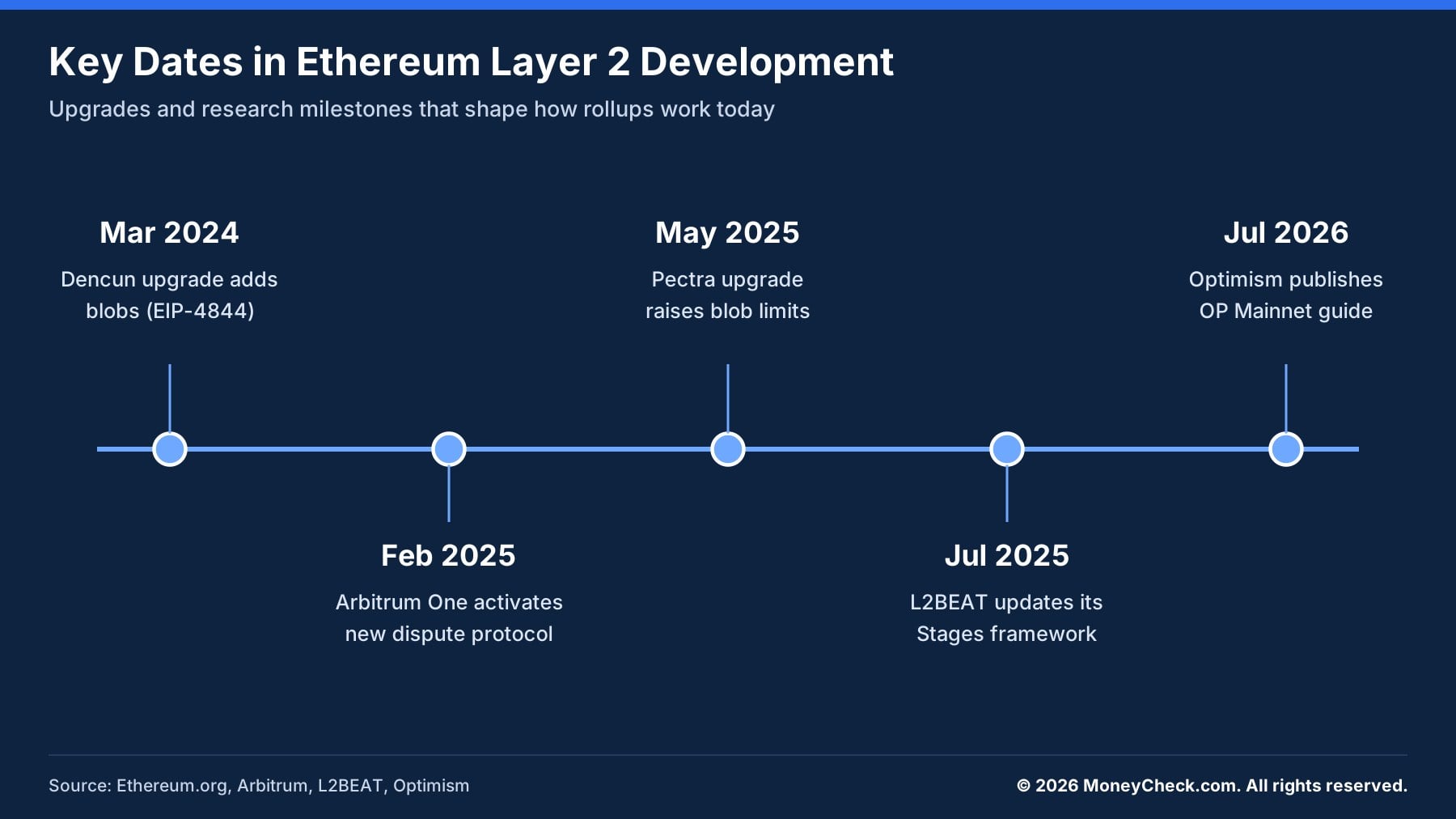
Key Dates in Layer 2 Development
Several events in recent years have shaped how Layer 2 networks work today.
| Date | Event |
|---|---|
| March 13, 2024 | Dencun upgrade adds blobs through EIP-4844 |
| February 2025 | Arbitrum One activates its new dispute protocol |
| May 2025 | Pectra upgrade raises Ethereum’s blob limits |
| July 2025 | L2BEAT updates its Stages framework |
| July 2026 | Optimism publishes its OP Mainnet guide |
Each step targets a different problem. Blobs lowered data costs, a new dispute protocol changed how Arbitrum settles challenges, and the L2BEAT update raised the bar for rollup maturity.
Challenges Facing Layer 2 Networks
Layer 2 networks still face open problems. Six come up most often.
Split liquidity. Assets are spread across many networks. A token on one Layer 2 may not be usable on another without a bridge.
Hard user experience. Users must track networks, token versions and withdrawal steps. Sending funds on the wrong network can make them hard to recover.
Central sequencers. Many networks still rely on one operator to order transactions. Reducing that control remains a key goal.
Competition. Many rollups chase the same users and apps. That may make steady fee revenue hard to keep.
Security complexity. Rollups depend on complex contracts and proof systems. Bugs or bad settings can create real risks.
Regulation. Layer 2 networks can host financial services and tokenised assets. The rules differ by country and business model.
There is also a question for Ethereum itself. Layer 2 networks are built to lower what users pay, so more activity on them does not mean a matching rise in Ethereum fee income.
How to Evaluate a Layer 2 Project
Investors can use the 12 questions below when researching a network.
| Category | Key question |
|---|---|
| Technology | Is it an optimistic rollup, ZK rollup or another design? |
| Security | What protections does it take from Ethereum? |
| Data availability | Where is transaction data published? |
| Governance | Who can upgrade contracts or step in during emergencies? |
| Decentralisation | How much does it depend on privileged operators? |
| Adoption | Are real users and developers active on it? |
| Revenue | Does it produce lasting economic activity? |
| Token utility | Does the token capture any of that value? |
| Tokenomics | Are large token unlocks coming up? |
| Competition | What sets it apart from other networks? |
| Valuation | Does the price reflect realistic expectations? |
| Risk | What issues have independent researchers found? |
High transaction counts can be pushed up by bots or rewards programmes. Total value secured on a network is also not the same as revenue.
Final Thoughts
Layer 2 networks lower costs and raise capacity by moving work off Ethereum’s main chain. The numbers show how: data in 128 KB blobs, fees a fraction of Mainnet levels and withdrawal windows of up to seven days.
Those numbers also show the trade-offs. Optimistic rollups trade speed of exit for simpler proofs, while ZK rollups trade computing cost for faster verification.
For investors, the key question is not whether Layer 2 technology works. It is which networks can attract lasting demand, keep credible security and pass any of that value to token holders.
Sources
- Ethereum.org: Scaling Ethereum
- Ethereum.org: Optimistic Rollups
- Ethereum.org: Zero-Knowledge Rollups
- Arbitrum: Inside Arbitrum Nitro
- Optimism: What Is OP Mainnet?
- L2BEAT: Stages Framework
- Ethereum.org: Cancun-Deneb (Dencun) Upgrade
- Ethereum.org: Blockchain Bridges
- Ethereum.org: Validium
Disclaimer: This article is for information only and is not financial or investment advice. Crypto assets and blockchain apps carry serious risks, including loss of funds, technical flaws and changing regulation. Do your own research before buying digital assets or using Layer 2 networks.