



TLDR
- Dow futures declined while Nasdaq 100 futures advanced 0.4-0.5% as markets digested Federal Reserve policy outlook
- The 10-year Treasury note yield surged to 5.33%, marking its peak level since April 2002
- Micron delivered better-than-expected quarterly results, providing a boost to technology sector optimism for October
- Brent crude surpassed $100 per barrel as diplomatic efforts between the US and Iran remained gridlocked
- Nike prepares to unveil quarterly results after market close with shares hovering near decade-low valuations
Stock futures showed divergent paths as October trading commenced, with market participants assessing the likelihood of the Federal Reserve maintaining its current interest rate stance at the next policy decision.
Early session activity saw Nasdaq 100 futures surge between 0.4% and 0.5%. S&P 500 futures registered modest advances of approximately 0.1% to 0.2%. Meanwhile, Dow Jones Industrial Average futures retreated by about 124 points, representing a 0.2% decline.
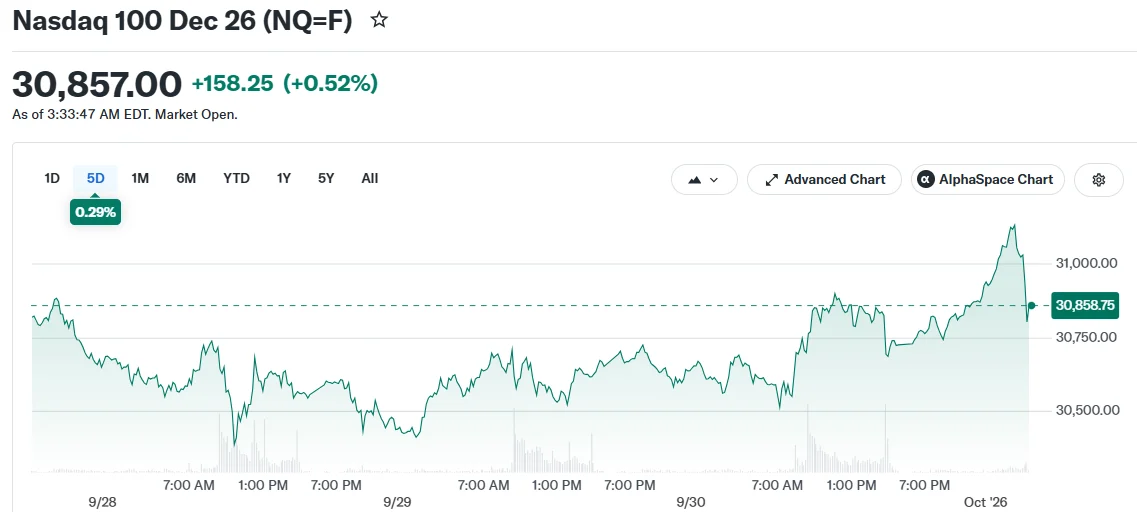
September concluded with the three benchmark indexes displaying contrasting performance. The Nasdaq delivered a respectable monthly advance, whereas the S&P 500 and Dow faced challenges maintaining momentum.
Treasury Yield Surge Explained
Early Thursday witnessed the 10-year Treasury note yield climb four basis points to reach 5.33%, a level not observed since April 2002.
The upward trajectory in yields has remained a focal concern for equity market participants throughout the year. Elevated financing costs typically exert downward pressure on equity valuations, particularly impacting growth-oriented enterprises.

Neel Kashkari, President of the Federal Reserve Bank of Minneapolis, expressed caution regarding persistent inflationary pressures. His remarks reinforced speculation that the central bank might maintain restrictive monetary policy beyond what some market participants anticipated.
Deutsche Bank’s Jim Reid observed that global economic expansion and corporate profit performance demonstrated resilience during September. However, this robust performance paradoxically provided monetary authorities with justification to sustain their hawkish stance on interest rates.
Inflation indicators this week presented a nuanced picture. Wednesday’s release of the personal consumption expenditures index—the Federal Reserve’s favored inflation metric—registered below analyst projections.
Energy markets, conversely, exhibited upward momentum. Early Thursday trading saw Brent international crude futures breach the $100 per barrel threshold.
Diplomatic negotiations between Washington and Tehran showed minimal advancement, generating anxiety in energy markets. This geopolitical uncertainty contributed to crude’s session gains.
Technology Sector Gains Momentum on Micron Performance
Micron’s stock demonstrated minimal movement following the release of its fourth quarter financial results. The semiconductor memory manufacturer exceeded Wall Street profit forecasts and provided an optimistic outlook for the upcoming first quarter.
The earnings announcement contributed to improved sentiment throughout the technology sector as October trading began. Nasdaq-100 futures advanced 0.5% in the wake of Micron’s report.
Artificial intelligence-focused technology companies have been instrumental in driving recent market gains. Nvidia shares appreciated 5% during September, while AMD delivered an impressive 30% advance over the identical timeframe.
Beyond the technology sector, markets have encountered difficulties navigating elevated Treasury yields and rising energy costs. The Dow registered declines for both September and the entire third quarter.
Employment market indicators are scheduled for release throughout the week, culminating in Friday’s comprehensive monthly employment report. Thursday morning brought the Challenger, Gray & Christmas report examining corporate workforce reduction plans.
Market participants will also receive updated manufacturing sector activity data this week. These economic indicators are anticipated to influence expectations approaching the Federal Reserve’s subsequent policy meeting.
Nike’s quarterly earnings announcement is scheduled for after Thursday’s closing bell. The results will provide insight into the athletic apparel giant’s strategic turnaround initiatives.
Nike’s equity has been trading at valuation levels last witnessed in 2014. Market observers will scrutinize the report for evidence of sales momentum recovery or improved forward guidance.
As October commences, markets confront a landscape where technology equities demonstrate vigor while elevated yields and energy prices generate obstacles across other sectors. Thursday’s employment data and Nike’s financial results represent the immediate catalysts commanding trader attention.
Get 3 Free Stock Ebooks
Discover top-performing stocks in AI, Crypto, and Technology with expert analysis.
- Top 10 AI Stocks - Leading AI companies
- Top 10 Crypto Stocks - Blockchain leaders
- Top 10 Tech Stocks - Tech giants



