



Key Highlights
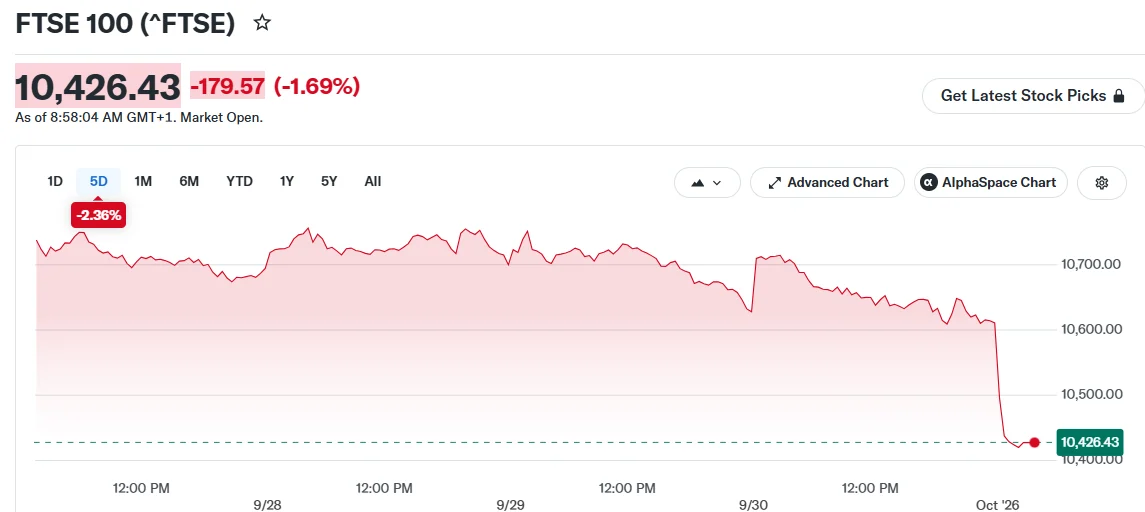
- The FTSE 100 declined more than 1% during early October trading, continuing the previous day’s downward momentum.
- British 30-year government bond yields touched 6%, marking the steepest level since February 1998.
- American 10-year Treasury yields surged to 5.306%, reaching heights unseen since 2007.
- Gold climbed past $4,200 per ounce as market participants moved toward safe-haven assets.
- Annual UK property price appreciation decelerated to its weakest pace in nine months during September.
British stocks experienced significant declines on Thursday as escalating government bond yields worldwide applied downward pressure on equity valuations. The FTSE 100 declined over 1% during the morning session, extending the previous trading day’s retreat.
Around mid-morning, the benchmark index had surrendered approximately 120 points, settling near 10,486. The FTSE 250, representing more domestically-oriented businesses, similarly retreated by nearly 1%. The broad-based selling indicated widespread market weakness beyond just multinational corporations.
Understanding the Global Bond Market Turbulence
The primary catalyst behind equity market weakness was an international selloff in sovereign debt instruments. Yields on UK 30-year gilts climbed to 6%, representing the most elevated reading since February 1998.
This movement came after a government bond auction conducted earlier in the week. Fresh 10-year British government securities were offered with the steepest yield for that maturity since 1999.
The phenomenon extended well beyond the United Kingdom. American 10-year Treasury yields advanced to 5.306% on Wednesday, matching levels previously observed in 2007.

Market participants attributed the turmoil to concerns surrounding persistent inflation, expanding fiscal deficits, and increasing bond issuance volumes. One market commentator characterized the situation as a buyers’ strike in the bond market, suggesting insufficient demand for newly issued debt at prevailing price levels.
Elevated bond yields present challenges for equity markets because they affect discount rates applied to future corporate earnings. Additionally, they push borrowing expenses higher for both companies and consumers.
Continental European markets experienced similar pressure, with Germany’s DAX declining 1.33% and France’s CAC 40 retreating 1.46% during the same trading period. Sterling also weakened, dropping 0.24% versus the US dollar.
FTSE 100 Performance Across Sectors
Despite the broader decline, certain stocks bucked the negative trend. Rolls-Royce advanced 1.9%, while Polar Capital Technology Trust climbed 1.1%.
Precious metals mining firms delivered strong results. Fresnillo and Endeavour Mining both registered gains as gold prices traded north of $4,200 per ounce.
Within the mid-cap space, XPS Pensions surged 4.8% and AO World jumped 4.7%. Ferrexpo and Raspberry Pi similarly recorded positive movements.
Conversely, British American Tobacco tumbled 3.2%. Weir declined 2.7%, positioning it among the session’s most significant underperformers.
Beyond equity markets, the British property sector displayed cooling dynamics. Nationwide, a prominent mortgage provider, indicated that year-over-year house price appreciation moderated to 0.8% in September, down from 1.6% recorded in August.
Monthly prices contracted 0.2% versus the prior period. Nationwide attributed the slowdown to escalating energy costs and anticipation of elevated interest rates dampening purchaser enthusiasm.
Price growth decelerated across the majority of UK regions.
In commodity markets, Brent crude advanced 1.4% to $99.44 per barrel. West Texas Intermediate gained 1.35% to $91.64.
Gold futures appreciated 0.25% to $4,196 per ounce, while spot gold increased 0.22% to settle at $4,165.95.
Market observers are now focusing on the final UK manufacturing PMI figure for September, scheduled for release later Thursday. The indicator could reveal whether the British economy maintains resilience despite tightening financial conditions. Unless bond yields stabilize, strength in selective sectors such as mining and defense may prove insufficient to counterbalance broader downward pressure on UK equity prices.
Get 3 Free Stock Ebooks
Discover top-performing stocks in AI, Crypto, and Technology with expert analysis.
- Top 10 AI Stocks - Leading AI companies
- Top 10 Crypto Stocks - Blockchain leaders
- Top 10 Tech Stocks - Tech giants



