



TLDR
- September saw the Nasdaq Composite climb 1.8% to a fresh high on September 22, while the S&P 500 slipped 0.4%.
- Blue-chip and small-cap indexes suffered, with the Dow Jones declining approximately 4.3% and the Russell 2000 dropping 5.4%.
- Bond markets witnessed dramatic moves as 2-year, 10-year, and 30-year Treasury yields jumped to levels not seen in decades.
- According to UBS analysis, AI-linked investments and stock appreciation now represent 80% or more of overall US GDP expansion.
- September’s top Nasdaq performers included Intel, Advanced Micro Devices, and Meta platforms.
September delivered a tale of two markets on Wall Street, with artificial intelligence stocks providing crucial support to technology indexes while broader markets faltered. The S&P 500 finished the month down 0.4% as government bond yields surged higher. The benchmark index now sits 1.9% beneath its August all-time high.
Historically, September ranks as one of the market’s most challenging months. Data going back to 1950 shows the S&P 500 typically posts a 0.6% loss during this period.
The Nasdaq Composite, however, bucked the trend entirely. The tech-heavy index advanced 1.8% and established a new record on September 22, ending the month at 26,861.06 points.
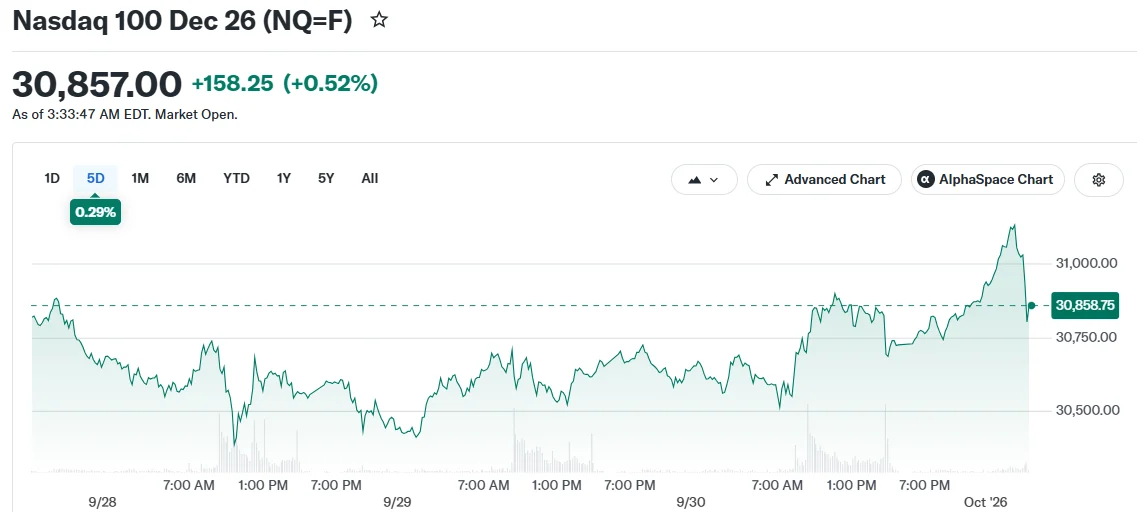
Technology behemoths such as Meta and AMD provided significant upward momentum for the Nasdaq. Multiple chip manufacturers also delivered strong contributions to the index’s performance.
Blue Chips and Small-Caps Lag as Technology Sector Dominates
The positive performance wasn’t universal across market indexes. The Dow Jones Industrial Average tumbled approximately 4.3% throughout September.

Meanwhile, the Russell 2000 index, representing smaller-capitalization companies, declined 5.4%. Steve Sosnick, chief strategist at Interactive Brokers, characterized the market dynamic succinctly. “It’s AI or bust,” he remarked.
Sosnick further noted that even though the Nasdaq and S&P 500 demonstrated superior performance relative to other benchmarks, underlying weaknesses remain a concern.
Government bond yields emerged as a significant factor driving September’s market turbulence. Both the 2-year and 10-year Treasury yields increased by roughly half a percentage point.
The 30-year Treasury yield jumped nearly 40 basis points from August’s close. The last occurrence of all three maturities experiencing such simultaneous increases was in September 2022.
The surge in yields has created headwinds for the initial public offering pipeline. Oura, the smart-ring manufacturer, delayed its anticipated stock market debut this week.
Additional companies, including Holtec Nuclear and Bamboo Insurance, have attributed unstable market conditions as reasons for postponing their respective public offerings.
Anthropic has allegedly shifted its planned IPO from October to November. The offering had been anticipated as the fourth quarter’s most significant market debut.
Artificial Intelligence Investment Now Powers Majority of Economic Expansion
Arend Kapteyn, chief economist at UBS, indicated that AI-connected investment and wealth generation from appreciating AI equities currently comprise 80% or more of American economic expansion.
“It just looks like AI is neutralizing everything, at least on an aggregate level,” Kapteyn stated.
UBS increased its projection for AI-focused capital expenditure in the coming year by $200 billion, elevating the total forecast to $1.4 trillion. Kapteyn emphasized that spending in non-AI sectors is “running at zero.”
This heavy concentration presents notable vulnerabilities. Kapteyn observed that climbing AI stock valuations have bolstered consumer expenditures, particularly among affluent households.
Should the AI investment theme falter, the economic impact could manifest through two channels: declining corporate investment and diminished consumer spending.
UBS has identified indicators suggesting the expansion is beginning to extend beyond technology. Kapteyn explained that each dollar allocated to AI capital during a given quarter typically generates approximately $1.50 in investment the subsequent quarter, with only one-third returning to the technology sector.
Examining individual equity performance, Intel surged 34.32% in September, claiming the top spot on the Nasdaq. AMD advanced 29.96%, while Meta appreciated 26.70%.
Marvell Technology and Astera Labs similarly recorded double-digit percentage increases during the month.
Several stocks experienced significant declines. Axon Enterprise plummeted 25.42%, representing the steepest drop among major losers.
Intuit, Paychex, DoorDash, and Autodesk similarly suffered double-digit percentage losses throughout September.
Market analysts anticipate continued volatility in October. The Federal Reserve’s upcoming rate policy announcement and persistent US-Iran geopolitical tensions both represent potential catalysts.
Expectations for an additional interest rate increase have diminished following comments from New York Fed President John Williams indicating no urgency to implement further rate hikes.
Get 3 Free Stock Ebooks
Discover top-performing stocks in AI, Crypto, and Technology with expert analysis.
- Top 10 AI Stocks - Leading AI companies
- Top 10 Crypto Stocks - Blockchain leaders
- Top 10 Tech Stocks - Tech giants



