



Key Highlights
- Brazil’s Petrobras developed dual blockchain applications on Cardano infrastructure for sustainability monitoring of aviation fuel and renewable diesel products.
- The sustainable aviation fuel tracker employs Book-and-Claim methodology preventing duplicate environmental credit usage.
- A companion application monitors Diesel R renewable blend throughout its entire production and distribution lifecycle.
- Both blockchain solutions remain in experimental development without confirmed deployment timelines.
- Technical analyst identifies defended weekly support level on ADA chart, projecting price milestones at $1, $3, and $5.
Petrobras, Brazil’s government-controlled petroleum corporation, has developed a pair of blockchain-powered applications utilizing the Cardano network. These digital solutions aim to monitor and verify sustainability metrics associated with sustainable aviation fuel and renewable diesel offerings.
The Cardano Foundation made the announcement public this Wednesday. The initial application was developed in partnership with Ledger Labs at PUC-Rio.
This solution converts environmental attributes associated with sustainable aviation fuel (SAF) into blockchain-based digital tokens, preventing duplicate accounting of identical environmental benefits.
The framework operates on a Book-and-Claim methodology, which decouples the environmental credit from the physical fuel consumption location.
This enables airlines, corporations, or individual travelers to claim environmental benefits regardless of where the physical fuel gets consumed. These digital assets are designated as CS-SAF tokens and contain metadata conforming to CORSIA international aviation emissions standards.

Individual travelers can also acquire CS-SAF tokens via a mobile application, receiving certification documentation connected to their journey and corresponding environmental impact reduction.
Diesel R Supply Chain Monitoring System
The companion blockchain application monitors Diesel R, Petrobras’ renewable diesel offering manufactured from sustainable feedstocks including vegetable oils and animal fat derivatives.
The Cardano blockchain establishes digital verification points throughout the fuel’s journey from production facilities through transportation networks to end users, creating an immutable audit trail spanning the complete supply chain.
Organizations can leverage this information for Scope 3 emissions documentation requirements, which encompass indirect emissions generated throughout supplier networks and distribution channels.
The Cardano Foundation has not disclosed fuel quantities managed through either application, nor provided schedules for broader commercial implementation.
Rafael Fraga, Cardano Foundation’s Latin American business development director, provided commentary on the initiative. “The energy transition depends equally on establishing trust and developing alternative fuels,” Fraga stated.
The partnership between Petrobras and Cardano Foundation originated in 2023, initially focusing on blockchain training programs for Petrobras personnel before extending into energy sector research initiatives with PUC-Rio’s Ledger Labs during 2025.
Market Analyst Perspectives on ADA
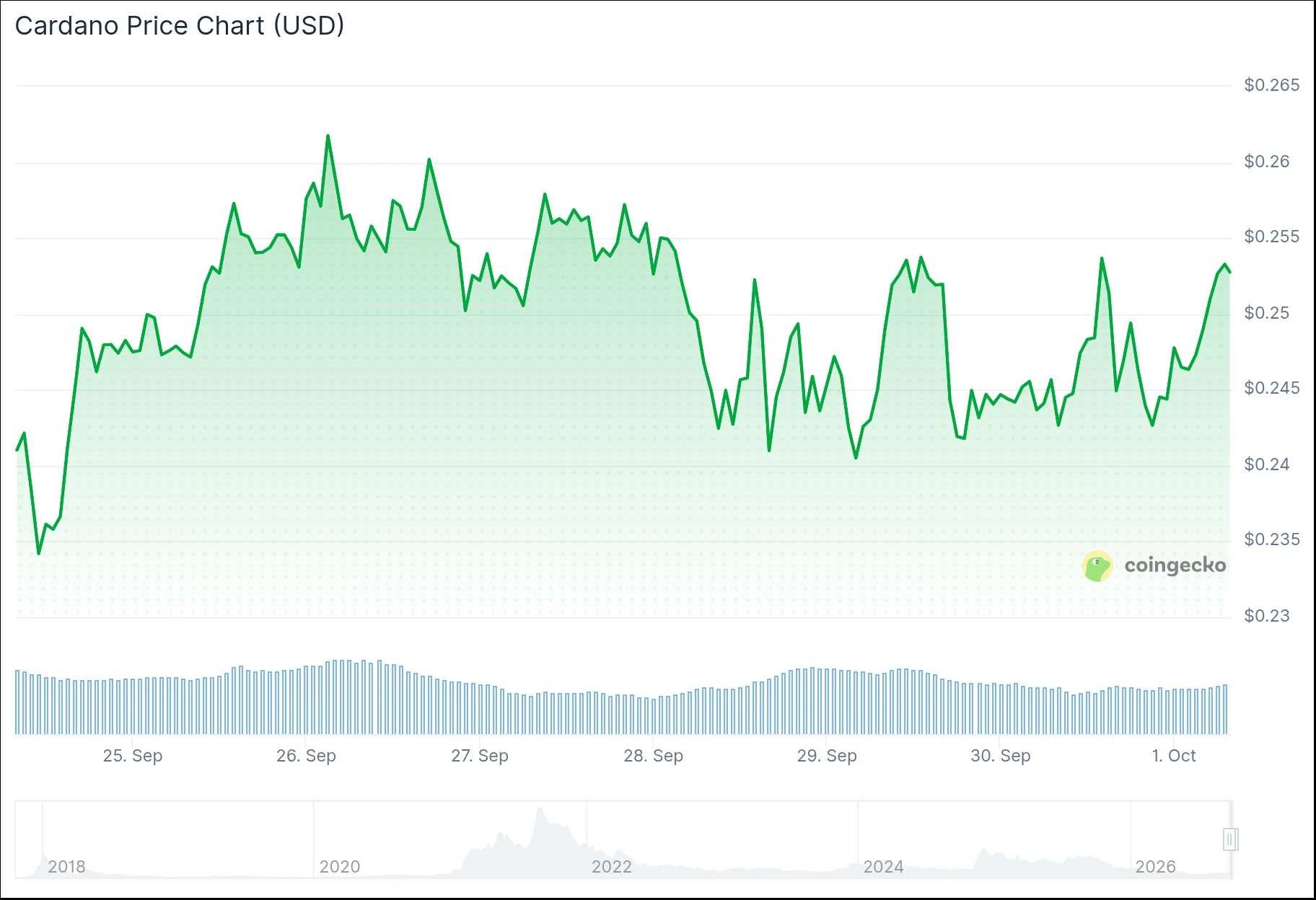
Although the Petrobras announcement focuses on blockchain implementation rather than token valuation, market analyst Crypto Patel shared insights on ADA’s technical position. The trader, who publishes market commentary on X, indicated that most sellers have exited positions near recent lows.
Patel noted that the weekly order block maintains support and the $0.235 threshold has been successfully recaptured. He drew comparisons between the current trading zone and the demand region preceding ADA’s 2021 price surge.
Patel established price objectives at $1, $3, and $5 for ADA, noting that a weekly candle close beneath $0.137 would invalidate the bullish scenario.
Energy corporation Shell has operated a comparable sustainability verification platform called Avelia since 2022. Shell disclosed in September that Avelia has facilitated over 84 million gallons of SAF integration into worldwide fuel supply networks.
This volume has generated more than 780,000 tonnes of CO₂e reduction through June 2026, per Shell’s reporting. Australia’s Viva Energy established a distinct partnership with NoviqTech in January exploring similar Book-and-Claim frameworks for aviation fuel applications.
Both Petrobras blockchain initiatives continue operating in research and development phases, with no announced transition dates for commercial deployment.
Get 3 Free Stock Ebooks
Discover top-performing stocks in AI, Crypto, and Technology with expert analysis.
- Top 10 AI Stocks - Leading AI companies
- Top 10 Crypto Stocks - Blockchain leaders
- Top 10 Tech Stocks - Tech giants



