



Key Takeaways
- Bitcoin stabilized around $83,453 on Tuesday as crude oil prices declined and Treasury market volatility subsided.
- After peaking at $85,128 on Sunday, BTC slipped beneath $83,000 on Monday before finding its footing.
- Geopolitical concerns surrounding the US-Iran standoff at the Strait of Hormuz and elevated bond yields continued to weigh on risk assets.
- The cryptocurrency surged 43.1% during Q3 2026, marking its strongest quarterly performance since the end of 2024, according to The Kobeissi Letter.
- Data from Glassnode and CoinGlass indicates significant long-term holder supply concentrated around $85,000, forming a key resistance zone.
Bitcoin maintained its position near $83,453 during Tuesday’s trading session, registering a modest 0.3% increase. The stabilization occurred alongside declining crude prices and reduced selling pressure in the Treasury market.
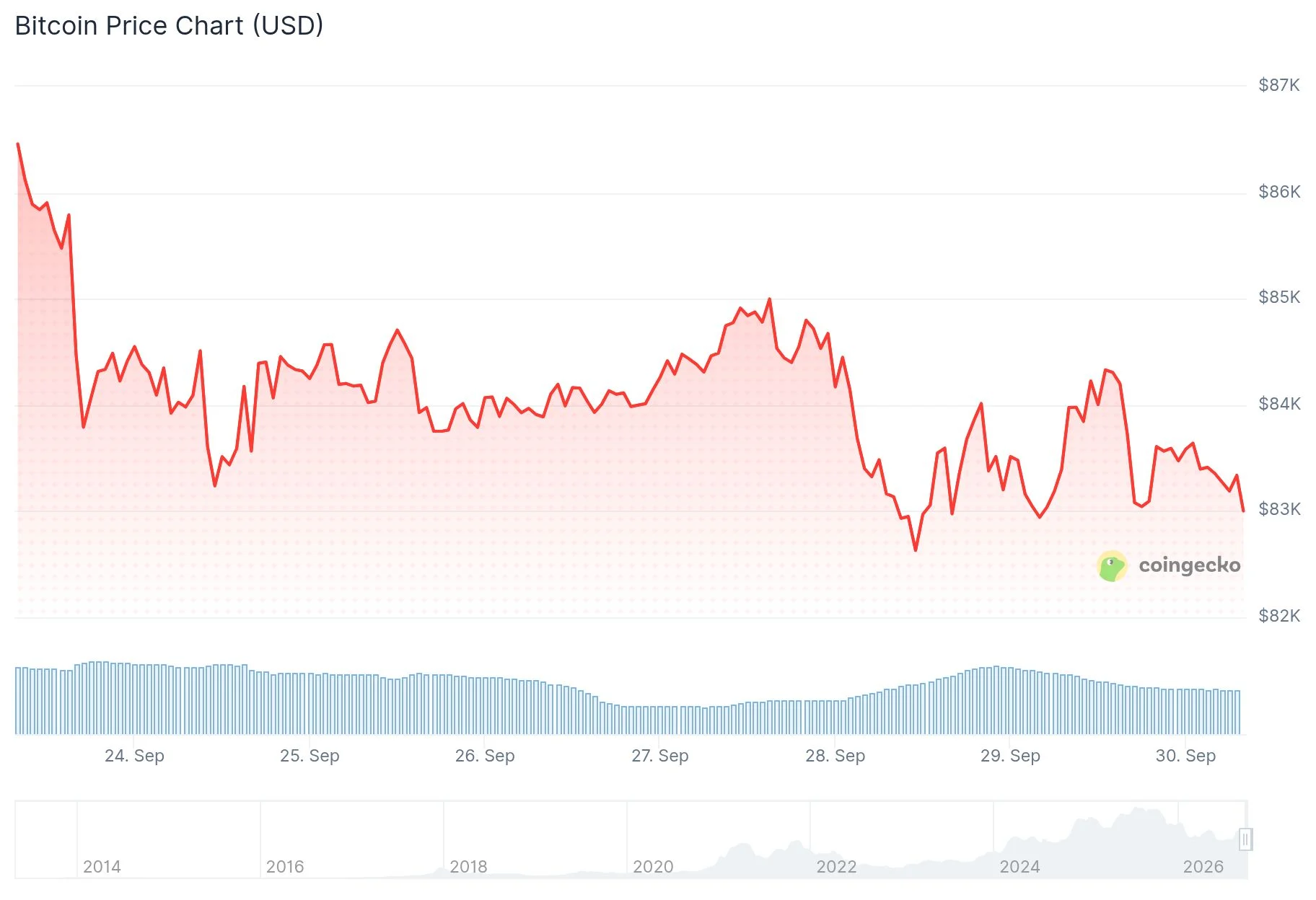
After touching $85,128 over the weekend, the digital asset experienced a pullback, dipping below $83,000 on Monday before regaining equilibrium.
Iliya Kalchev from Nexo Dispatch identified $82,000 as a critical support threshold. According to his analysis, a decisive breach below $80,000 would indicate deteriorating bullish momentum, whereas sustained strength could propel prices toward $90,000.
Kalchev highlighted a notable divergence in market psychology. While cryptocurrency sentiment indicators register “extreme greed,” traditional equity markets have remained in fear territory for three consecutive weeks.
Meanwhile, Citi announced the expansion of its digital asset offerings into Japan and the United Arab Emirates, adding institutional validation to the sector.

Crude Prices and Treasury Dynamics Influence Crypto Markets
Brent crude dropped to its weakest price in almost seven days. Middle Eastern oil exports surged to 12.8 million barrels daily in September, representing the highest volume since February.
Diplomatic friction between Washington and Tehran persisted. Former President Trump dismissed an Iranian proposal to reopen shipping lanes through the Strait of Hormuz and refuted suggestions that sanctions relief was under consideration.
Qatari intermediaries remained engaged in shuttle diplomacy with both nations. However, Reuters sources suggested a breakthrough before the upcoming US midterm elections appears improbable.
Treasury markets experienced significant volatility. The benchmark 10-year yield climbed to levels not witnessed since April 2002, while the 30-year yield reached heights last seen in June 2002.
The bond market selloff moderated following comments from New York Federal Reserve President John Williams, who stated the central bank faces no urgency in implementing its next policy adjustment.
Bitcoin oscillated within a range of $82,807 to $84,545 before establishing equilibrium around $83,150. Total liquidations approached $78 million, with short positions accounting for $44 million of that figure.
Utkarsh Ahuja of Moon Pursuit Capital attributed the decline below $83,000 to broader macroeconomic forces rather than crypto-specific factors. He emphasized elevated Treasury yields, US dollar strength, and geopolitical instability as primary drivers.
Ahuja noted that high leverage ratios in crypto markets can amplify broader financial market movements into more pronounced selloffs, though he expects rapid repricing once external pressures dissipate.
Kyle Rodda from Capital.com suggested that escalating oil prices are constraining bitcoin’s upward momentum. Nevertheless, he maintained that technical indicators continue to support a near-term bullish trajectory.
The Kobeissi Letter shared on X that bitcoin’s 43.1% gain in Q3 2026 represents its strongest quarterly showing since late 2024, with spot exchange-traded funds attracting $2.4 billion in inflows during the week concluded September 25.
Critical Resistance Zone Emerges at $85,000
According to CoinGlass order book analysis, substantial resistance has materialized near $85,000 on major exchanges, mirroring patterns observed earlier in the week.
Glassnode reported on X that coins held by long-term investors are concentrated in the $84,000-$85,000 range. The analytics firm emphasized that breaking through this accumulation zone is essential for the rally to extend further.
Gold plummeted 3.6% to $4,115 per ounce before bouncing back to $4,166. The Kobeissi Letter characterized this volatility as “highly unusual” in a separate X post, attributing the disruption to yield-driven pressures affecting precious metal markets broadly.
Mosaic Asset Company noted that equity markets are displaying oversold conditions comparable to those last observed in late March, suggesting that robust August employment figures could support a rebound despite expectations of Fed rate increases in October.
Get 3 Free Stock Ebooks
Discover top-performing stocks in AI, Crypto, and Technology with expert analysis.
- Top 10 AI Stocks - Leading AI companies
- Top 10 Crypto Stocks - Blockchain leaders
- Top 10 Tech Stocks - Tech giants



