



Key Takeaways
- The Dow Jones Industrial Average extended its losing streak to three consecutive sessions amid surging Treasury yields.
- The benchmark 10-year Treasury yield surged to 5.223%, marking its highest point since June 2007.
- Crude oil markets rallied sharply, with Brent crude surpassing $106 per barrel while WTI crude approached $94.61 per barrel.
- Market pricing now reflects nearly 71% probability of the Federal Reserve implementing another rate increase in October.
- Oracle experienced a 3.5% decline following news regarding potential delays at a New Mexico data center facility.
US stocks faced another challenging session this week as escalating bond yields continued to weigh on investor sentiment. The Dow Jones Industrial Average extended its downward trajectory for a third consecutive day on Thursday, shedding 161.61 points, equivalent to a 0.31% decline, to settle at 51,349.98.
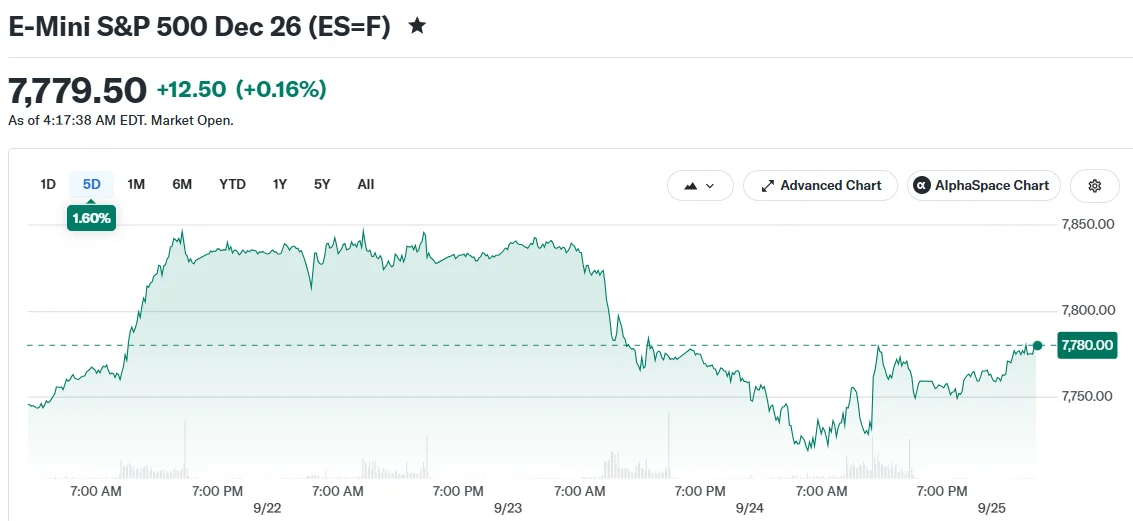
The S&P 500 experienced a marginal decrease of 0.02%, finishing at 7,704.13. Meanwhile, the Nasdaq Composite eked out a modest advance of 0.01%, ending the session at 26,939.37.
Treasury Yields Climb To Levels Not Seen In Nearly Two Decades
The primary catalyst behind recent market weakness has been dramatic movement in the fixed income market. The 30-year Treasury bond yield surged to 5.501%, representing its loftiest reading since June 2004.
The 10-year Treasury yield, a critical benchmark influencing mortgage rates nationwide, advanced to 5.223%. This marks the steepest level recorded since June 2007. Meanwhile, the 2-year Treasury yield also pushed higher, touching 4.941%.
Elevated yields translate to increased borrowing costs for both consumers and corporations. This development arrives as numerous American households are simultaneously contending with escalating fuel expenses.

Concurrent with rising yields, market expectations for additional Federal Reserve monetary tightening have intensified. Data from the CME FedWatch tool indicates traders are now assigning nearly 71% probability to another rate hike in October. This represents a significant increase from approximately 55% just one week prior.
Jason Stephens, founder of Evertern Wealth, emphasized that the bond market may currently represent the most critical market to monitor. He noted that the fundamental question extends beyond whether the Fed implements another rate increase, focusing instead on the duration rates remain at elevated levels.
Stephens observed that a 10-year Treasury yield exceeding 5% could generate lasting impacts across housing markets, corporate financing, private equity, and equity valuations.
Energy Markets Rally While Economic Indicators Show Resilience
Oil prices experienced substantial gains throughout the week. Brent crude, serving as the global benchmark, advanced more than 3% to finish above $106 per barrel. US West Texas Intermediate crude rallied 2.7%, settling at $94.61 per barrel.
Stephens identified energy as among the most significant variable factors in current market conditions. He indicated that rapid oil price movements connected to Middle Eastern geopolitical tensions directly influence inflation expectations and interest rate projections.
Notwithstanding market headwinds, economic activity has maintained robust momentum. Recent data from S&P Global’s manufacturing and services purchasing managers’ indexes released this week demonstrated ongoing expansion in the US economy.
Stephens characterized the present environment as somewhat paradoxical. Market participants are expressing concern about interest rates precisely because economic performance remains solid, rather than showing signs of deterioration.
Oracle emerged as one of Thursday’s most significant decliners. Shares dropped 3.5% following a Bloomberg News report indicating the company was invoking force majeure provisions to protect itself against potential delays at a New Mexico data center project.
By Friday morning, US equity futures displayed stability. Contracts linked to the Dow and S&P 500 registered modest gains, while Nasdaq-100 futures advanced 0.2%.
Oil prices retreated slightly on Friday, with WTI crude futures declining to $92 per barrel and Brent crude trading around $105 per barrel. Nationwide average gasoline prices hovered near $4.50.
A consumer sentiment report from the University of Michigan is scheduled for release Friday. This data will provide updated insights into American perspectives on inflation as the autumn season begins.
Get 3 Free Stock Ebooks
Discover top-performing stocks in AI, Crypto, and Technology with expert analysis.
- Top 10 AI Stocks - Leading AI companies
- Top 10 Crypto Stocks - Blockchain leaders
- Top 10 Tech Stocks - Tech giants



