



Key Highlights
- Crude markets declined to their weakest point since mid-September as market participants anticipated potential diplomatic breakthroughs between Washington and Tehran.
- Brent crude declined approximately 1.7% to reach $102.09 per barrel, with WTI decreasing nearly 2% to $98.33.
- Donald Trump indicated willingness to engage with Iranian President Masoud Pezeshkian during the upcoming UN General Assembly.
- Regional security concerns persist following recent Houthi missile and drone strikes targeting Saudi infrastructure.
- Saudi crude exports via the Strait of Hormuz have surged significantly even as the country’s East-West pipeline faces disruption.
Crude oil markets experienced their steepest decline in over a week on Monday as market participants shifted focus toward potential diplomatic developments between the United States and Iran.
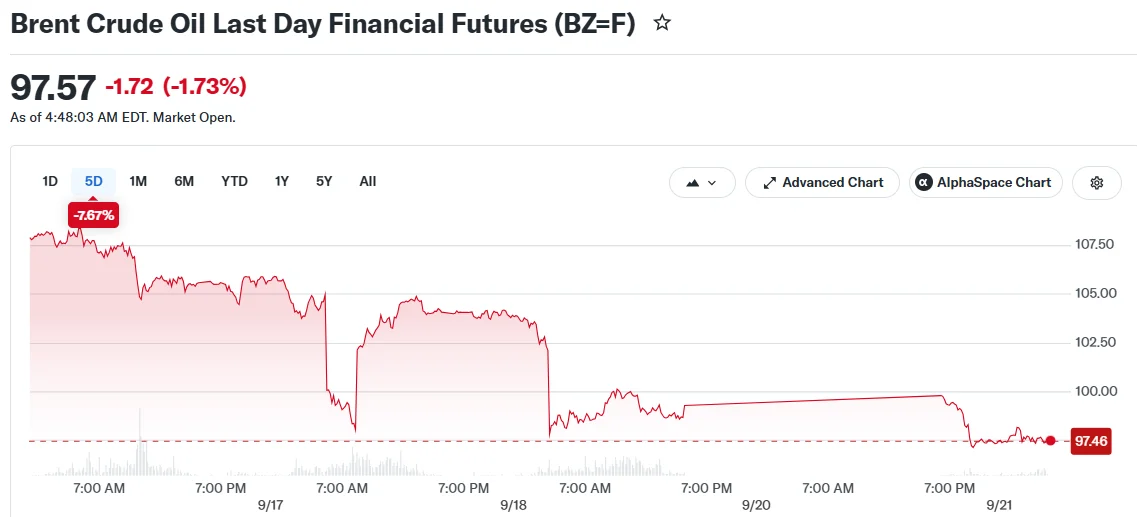
November Brent crude futures declined approximately 1.7% to settle at $102.09 per barrel during early market hours.
West Texas Intermediate crude experienced a nearly 2% drop to $98.33 per barrel, falling beneath the psychologically significant $100 threshold.
The downturn continued Friday’s momentum as portions of the geopolitical risk premium embedded in crude valuations started dissipating.
Potential Trump-Pezeshkian Dialogue Weighs on Crude Markets
Market observers are closely monitoring this week’s United Nations General Assembly convening in New York for indications of potential dialogue between American and Iranian officials.

President Trump expressed openness to a possible encounter with Iranian President Masoud Pezeshkian at the international gathering.
Tehran has reportedly transmitted stipulations through intermediaries regarding a potential return to diplomatic negotiations, based on Reuters reporting.
Tim Waterer, chief market analyst at KCM Trade, noted that portions of the risk premium appeared to be exiting oil valuations due to expectations that diplomatic engagement might mitigate the conflict.
Any meaningful advancement toward negotiations could alleviate worries about extended interruptions to crude extraction and maritime transport throughout the Middle East.
The diplomatic prospects emerge even as Washington and Tehran maintain an exchange of hostile rhetoric.
Iranian officials have cautioned they might deploy previously unused weaponry and strike targets not previously engaged should the United States initiate additional military operations.
Houthi Military Operations Maintain Supply Uncertainty
Security threats have not vanished from the regional landscape.
Yemen’s Iran-aligned Houthi forces claimed responsibility for striking locations in Riyadh on Saturday utilizing missiles and unmanned aerial vehicles.
The militia also reported targeting a Saudi Aramco installation in Yanbu, a critical Red Sea petroleum export terminal.
Strikes against Saudi Arabia’s East-West pipeline infrastructure have interrupted certain crude transportation routes toward the Red Sea.
Saudi Aramco has compensated by escalating shipment volumes through the Strait of Hormuz.
JPMorgan analysts indicated that Middle Eastern petroleum flows maintained greater resilience than anticipated despite the infrastructure challenges.
Regional crude movements averaged approximately 17.1 million barrels daily throughout the preceding ten-day period, according to the financial institution.
Satellite tracking revealed Saudi petroleum transiting the Strait of Hormuz averaged roughly 2.9 million barrels per day across a six-day span, contrasting with approximately 700,000 barrels daily during August.
Indications that Saudi Arabia has extended additional crude supply offers to Asian refineries have further diminished immediate shortage anxieties.
WTI Slips Beneath $100 Threshold
The descent below $100 for WTI marks a significant shift from earlier phases of the Middle East tensions, when supply disruption fears propelled crude valuations sharply upward.
Portions of Monday’s pullback may additionally reflect position adjustments as traders migrated holdings from October WTI contracts into November agreements preceding Tuesday’s contract expiration.
Both Brent and WTI touched their weakest valuations since September 10 during Monday’s trading session.
Declining petroleum prices are simultaneously reducing pressure across global financial markets, as elevated energy expenses have fueled renewed inflationary apprehensions.
European equity markets and U.S. stock index futures advanced Monday as crude valuations retreated.
Oil market participants will now focus attention on UN proceedings, U.S.-Iran diplomatic relations, and Saudi export volumes for signals regarding whether the recent downturn can sustain momentum.
Get 3 Free Stock Ebooks
Discover top-performing stocks in AI, Crypto, and Technology with expert analysis.
- Top 10 AI Stocks - Leading AI companies
- Top 10 Crypto Stocks - Blockchain leaders
- Top 10 Tech Stocks - Tech giants



