


Key Takeaways
- XRP experienced a 7.3% decline on Tuesday, breaking below the $1.30 threshold
- A prominent Dubai-based crypto investor, Royal Kane, dismissed XRP investment opportunities citing its $81.68B valuation
- The Federal Reserve implemented a 25 basis point rate increase on September 16
- Senate procedural vote blocked the CLARITY Act with a 50-49 tally on September 15
- Futures market interest in XRP contracted from $1.128B to $871.22M within a month
The cryptocurrency XRP has fallen beneath the $1.30 mark following Tuesday’s 7.3% selloff, representing approximately a 23% retreat from its recent peak around $1.68. The asset recorded $4.12 billion in trading activity across the previous 24-hour period, while maintaining a market capitalization of roughly $81.68 billion.
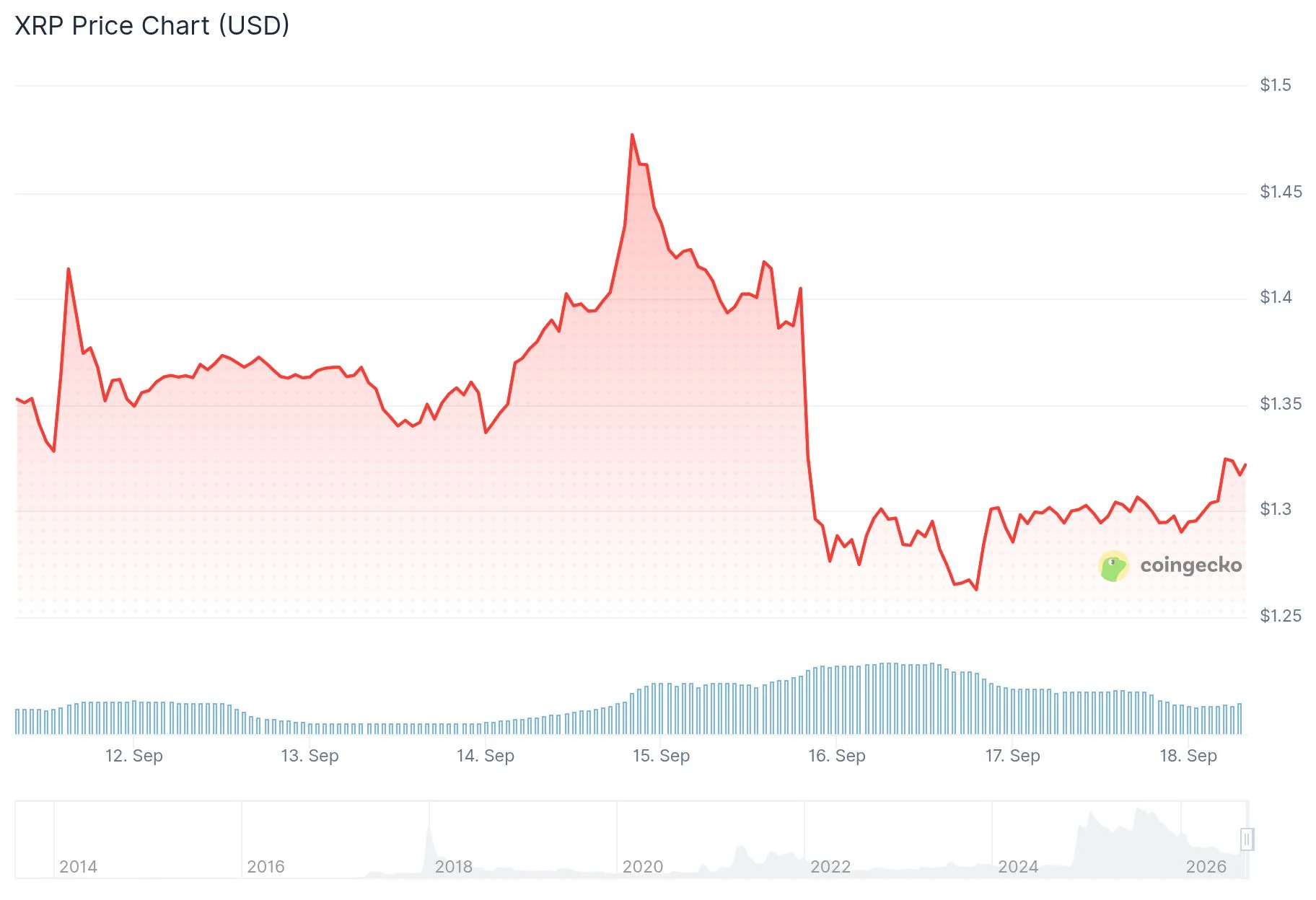
This downturn arrives after a robust performance throughout August, when the token rallied from approximately $1 to nearly $1.70, achieving a 28.5% monthly increase. Spot XRP exchange-traded funds in the United States accumulated $153.55 million during August, with $150.28 million of that total arriving in the month’s final two-week period.
Market analyst Cryptollica shared on X that XRP recently recorded its weakest two-week RSI (Relative Strength Index) measurement across its complete 13-year existence—surpassing the lows of 2018, the 2020 pandemic crash, and the 2022 bear market. Nevertheless, Cryptollica observed that the price continues to maintain support above the long-term ascending trend line that has provided stability through numerous market cycles, commenting: “Everyone wants XRP after the breakout. Almost nobody wants it when RSI is printing a 13 year low.”
Royal Kane, a cryptocurrency investor operating from Dubai, announced publicly via X that he would avoid investing in XRP given its present market valuation. His reasoning: the $81.68 billion market capitalization has already grown too substantial to deliver the returns possible from smaller-cap assets featuring more compelling growth narratives. He referenced Solana, Pepe, and Zcash as illustrations of tokens with persuasive storylines that generated significant early gains.
Kane additionally asserted that Ripple possesses “no products or revenue.” Ripple, which remains privately owned, actually maintains multiple operational divisions including Ripple Payments, the RLUSD stablecoin initiative, and Ripple Prime, its institutional brokerage platform established following the Hidden Road acquisition.

Federal Reserve Rate Increase Pressures Speculative Assets
On September 16, the Federal Reserve elevated its benchmark interest rate by 25 basis points, moving the target corridor to 3.75%–4%. This marked the first U.S. rate elevation since 2023. Twelve among 18 Federal Reserve officials forecasted additional increases ahead. Elevated interest rates enhance the appeal of U.S. Treasury securities relative to speculative holdings such as cryptocurrencies.
U.S. inflation measured 3.4% on an annual basis in August, with gasoline costs climbing 3.9%. Prediction markets had assigned an 81% probability to the rate increase before its official announcement.
Senate Blocks CLARITY Act Advancement
On September 15, the Senate recorded a 50-49 vote against proceeding with the Digital Asset Market CLARITY Act, missing the required 60-vote threshold by 11 votes. The proposed legislation would have distributed cryptocurrency regulatory authority between the SEC and CFTC, potentially providing definitive clarity on XRP’s legal classification.
XRP maintains its 2023 legal victory from Judge Analisa Torres, who determined that programmatic XRP transactions on public exchanges did not constitute securities offerings. Seven Democratic senators have subsequently resumed discussions regarding the CLARITY Act, declaring the unsuccessful vote represents “not the end.”
Within the derivatives sector, XRP open interest decreased from $1.128B to $871.22M. Franklin Templeton’s XRPZ ETF attracted $3.5 million on September 16, continuing a ten-day positive flow sequence even while Bitcoin ETFs experienced $295 million in withdrawals during the identical trading session.
Get 3 Free Stock Ebooks
Discover top-performing stocks in AI, Crypto, and Technology with expert analysis.
- Top 10 AI Stocks - Leading AI companies
- Top 10 Crypto Stocks - Blockchain leaders
- Top 10 Tech Stocks - Tech giants



