


TLDR
- The Federal Reserve implemented a 0.25% rate increase to 3.75%-4%, marking its first hike since 2023
- Chair Kevin Warsh emphasized inflation remains “too high” and current monetary conditions lack sufficient restriction
- The Dow Jones plummeted 631 points, the S&P 500 declined 0.45%, while the Nasdaq remained essentially unchanged
- Financial sector stocks including Bank of America, Wells Fargo, American Express, and Goldman Sachs experienced significant losses
- Stock futures rebounded the next day amid optimism over potential Middle East de-escalation and declining crude prices
The Federal Reserve implemented its first interest rate increase since July 2023 on Wednesday, elevating the federal funds rate by 25 basis points to establish a new target range of 3.75% to 4%.
The rate adjustment received unanimous support from voting members. Federal officials also indicated the possibility of an additional rate increase before year-end.
Wall Street’s initial reaction to the announcement appeared measured. However, equities experienced a sharp downturn following Fed Chair Kevin Warsh’s remarks during his post-decision press briefing.
Warsh emphasized that inflation continues to run “too high” and that recent summer economic data failed to demonstrate significant progress in core price trends. His commentary struck a more aggressive tone than market participants had anticipated.
The Dow Jones Industrial Average tumbled 631 points, representing a 1.21% decline, to settle at 51,461.90. Goldman Sachs registered the steepest loss among Dow constituents.

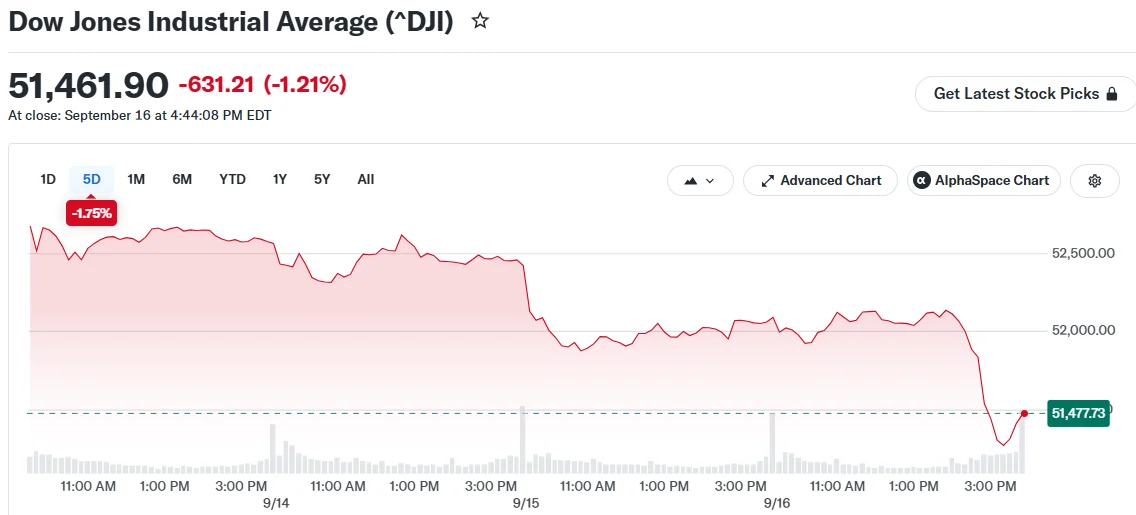
The S&P 500 retreated 0.45% to finish at 7,551.81. The Nasdaq Composite closed virtually unchanged, slipping just 0.01% to 25,978.42.
Financial Sector Bears the Brunt
Major banking institutions experienced substantial selling pressure amid concerns that elevated interest rates could dampen credit demand and hamper broader economic expansion.
Bank of America and Wells Fargo shares each retreated approximately 3%. Goldman Sachs and American Express registered declines approaching 4%.
The benchmark 10-year Treasury yield climbed back above the 5% mark, a threshold many investors view as psychologically significant. Art Hogan from B. Riley Wealth characterized this yield movement as a possible “headwind for markets in the near term.”
President Donald Trump criticized the Fed’s decision through social media platforms, advocating for rates at 1% or lower. He subsequently told journalists that current rate levels were “not appropriate,” while maintaining his support for Warsh.
Energy Markets Create Volatility, Then Retreat
Domestic diesel prices reached $6 per gallon on Friday for the first time on record, propelled by supply disruptions connected to ongoing conflicts in Ukraine and Iran. Benchmark crude oil maintained levels above $100 per barrel.
Declining oil prices the subsequent day provided market relief. A Reuters investigation disclosed that American diplomats had conducted confidential negotiations with Yemen’s Houthi faction in Oman. The Houthis reportedly confirmed they had no intention of targeting American or Israeli vessels.
Additional reports indicated Saudi Arabia might restore operations on a critical pipeline at 50% capacity, alleviating some supply apprehensions.
Intel stock advanced 4% following disclosure of negotiations with SK Hynix regarding domestic semiconductor manufacturing, helping contain technology sector losses.
US equity futures rallied Thursday morning. S&P 500 futures advanced 0.68%, Nasdaq futures increased 0.7%, and Dow futures climbed 0.7% to reach 52,284 points.
Snap gained 2.5% during premarket hours after unveiling a collaborative initiative with Nvidia, Amazon, and Salesforce to distribute its augmented reality eyewear to corporate clients.
Get 3 Free Stock Ebooks
Discover top-performing stocks in AI, Crypto, and Technology with expert analysis.
- Top 10 AI Stocks - Leading AI companies
- Top 10 Crypto Stocks - Blockchain leaders
- Top 10 Tech Stocks - Tech giants



