



TLDR
- BTC currently trades near $77,327, showing a modest 0.1% daily gain while posting over 3% weekly losses
- According to CryptoQuant analysis, bitcoin needs to breach $81,700 to validate a fresh bull market cycle
- Key resistance barriers identified between $77,100–$80,200 with additional obstacles extending to $88,700
- Last week witnessed $463 million in net withdrawals from spot Bitcoin ETFs, breaking a three-week positive flow pattern
- Research from Bitcoin Suisse demonstrates how a 2.5% BTC portfolio weighting could boost traditional returns from 6.2% to 8.6%
Bitcoin continues to consolidate around the $77,327 mark, posting a marginal 0.1% gain on Sunday while facing a weekly decline exceeding 3%. Rising interest rate projections remain a headwind for the cryptocurrency, as they enhance the relative appeal of dollar-based investment vehicles.
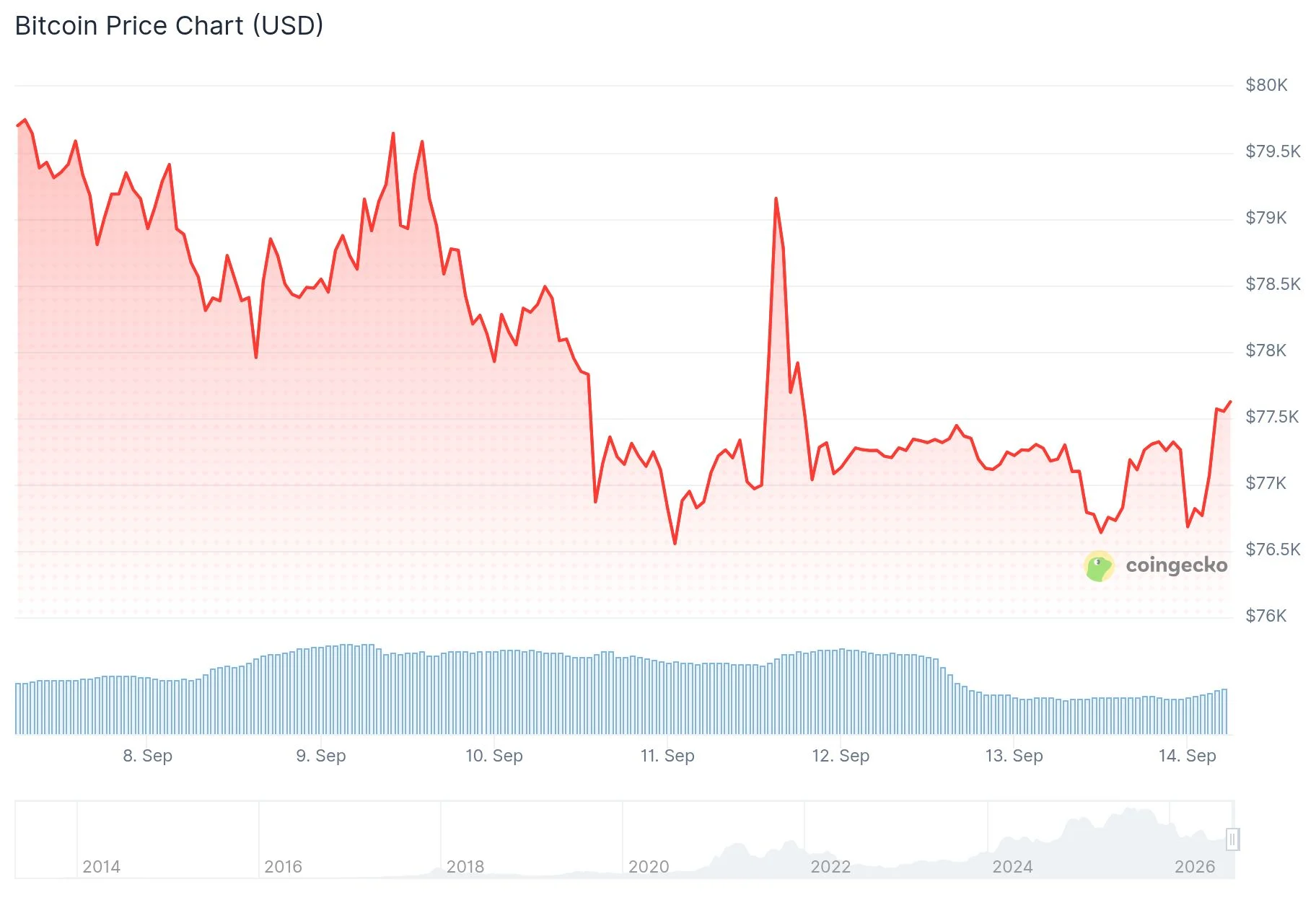
According to onchain intelligence provider CryptoQuant, bitcoin’s impressive 24% surge during the preceding fortnight has lost momentum. The digital asset has been confined to a trading corridor between $76,000 and $82,000 without establishing a definitive directional move.
CryptoQuant’s research director, Julio Moreno, pinpointed a critical resistance band spanning $77,100 to $80,200. During a 30-day window this year, long-term holders distributed approximately 539,000 BTC within this price range, establishing it as the most significant supply concentration above present levels.
Beyond this zone, the 365-day moving average currently rests around $81,700. Historical patterns indicate that bitcoin bull cycles have typically commenced when price sustains closes above this technical marker. Moreno suggests that a decisive penetration of this threshold could validate the onset of a fresh bullish phase.
Additional overhead resistance emerges at $83,600 according to CryptoQuant’s 3x Metcalfe band metric, which derives value estimates from network engagement metrics such as active address counts. The $88,700 mark corresponds to the upper boundary of the trader realized price framework, a level where profit realization has traditionally materialized.

Market analyst Daan Crypto Trades (@DaanCrypto) offered his perspective on X, observing that $BTC remains “still chopping around right at its major high timeframe resistance level.” He acknowledged that a sweep toward the $83K threshold remains logical from a liquidity standpoint, though he emphasized that maintaining the $73,000–$74,000 range is essential for his bullish outlook on extended timeframes.
ETF Flows Shift Into Reverse
Between September 7 and September 11, spot Bitcoin ETFs registered $463 million in net withdrawals, terminating a three-week sequence of positive inflows, as reported by Wu Blockchain (@WuBlockchain). This reversal contributes to the measured market sentiment preceding Wednesday’s Federal Reserve FOMC policy announcement.
For potential downside scenarios, Moreno identifies support at the $70,000 level, which aligns with the 200-day moving average. Should a more substantial correction unfold, buyer interest could emerge in the $62,000 to $65,000 corridor, where long-term holders accumulated roughly 476,000 BTC during the current year.
The Portfolio Case for Bitcoin
In its Crypto Wealth Management Report 2026, Bitcoin Suisse presented the argument for BTC serving as a portfolio diversification tool. With U.S. federal debt surpassing $40 trillion and hyperscaler companies projected to deploy over $800 billion toward AI infrastructure this year, conventional stock-bond diversification strategies face mounting challenges.
Their analytical modeling revealed that incorporating a 1% BTC allocation financed from bond holdings elevates annualized portfolio returns from 6.2% to 7.2%. Expanding the allocation to 2.5% pushes returns to 8.6%.
CryptoQuant’s Moreno captured the current market dynamics: “Bitcoin simply needs to digest the overhead supply and break its valuation ceilings before a new leg up can develop.”
Get 3 Free Stock Ebooks
Discover top-performing stocks in AI, Crypto, and Technology with expert analysis.
- Top 10 AI Stocks - Leading AI companies
- Top 10 Crypto Stocks - Blockchain leaders
- Top 10 Tech Stocks - Tech giants



