


Quick Overview
- The precious metal advanced 0.4% to approximately $4,418 per ounce Thursday, benefiting from U.S. dollar weakness
- Climbing 10-year Treasury yields limited upward movement, as elevated yields diminish gold’s attractiveness
- Brent crude reached the $100 per barrel mark for the first time since July, intensifying inflation worries
- Traders are assigning approximately 65% odds to a Federal Reserve interest rate increase at the upcoming September 14-15 policy meeting
- International gold-backed ETFs recorded $18 billion in inflows during August, marking the second-highest monthly intake ever documented
Gold continues to maintain its position near the $4,400 per ounce threshold while market participants await crucial U.S. inflation reports that may shape the Federal Reserve’s monetary policy decision later this month.
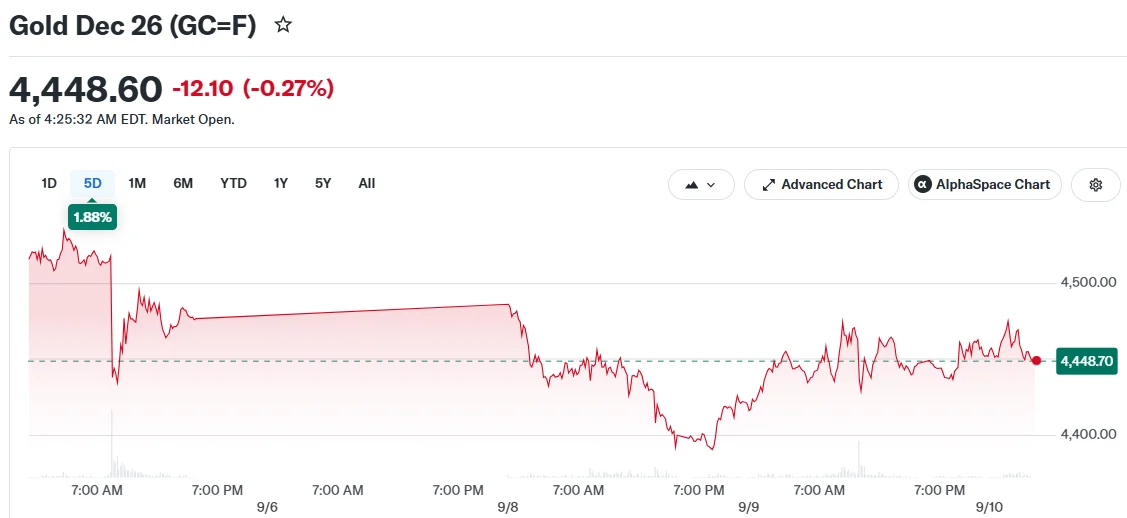
Spot gold prices climbed 0.4% to reach $4,418.87 during Thursday’s trading session. Gold futures contracts edged up 0.03% to settle at $4,461.82. This uptick followed the precious metal’s break from a three-session decline.
The primary catalyst behind gold’s advance was U.S. dollar softness. The U.S. Dollar Index declined to 98.74, enhancing gold’s affordability for international purchasers using alternative currencies.
Bond Market Dynamics and Energy Costs Create Headwinds
Escalating bond yields continue to constrain gold’s performance. Yields on 10-year U.S. Treasury notes climbed higher following a government initiative to purchase up to $6 billion in longer-maturity debt that failed to generate significant market response.
Since gold generates no yield, increasing interest rates diminish its comparative appeal against income-producing assets like bonds. This dynamic has established a resistance level for gold prices throughout recent weeks.

Energy market developments compounded the situation. Brent crude touched the $100 per barrel threshold for the first occasion since July. This development sparked renewed inflation anxieties, potentially encouraging the Fed toward implementing another rate increase.
Current swaps market pricing reflects roughly 65% probability of a rate hike during the Fed’s September 14-15 policy gathering. Market participants are closely monitoring Thursday’s producer price index release and Friday’s consumer price index report for additional guidance.
Tony Sycamore, a senior market analyst at IG, observed that gold continues trading substantially beneath its 200-day moving average positioned around $4,537. The metal would need to surpass this technical threshold to indicate that its retreat from the $4,697 peak has concluded.
Geopolitical Tensions Remain Market Factor
The Middle East situation, now entering its seventh month, continues casting uncertainty across financial markets. Iran has indicated readiness for escalated confrontation should the United States maintain strikes against its territory and critical infrastructure.
The persistent regional tensions are elevating risks of energy supply chain disruptions originating from the area. This concern is sustaining investor interest in gold as a strategic hedge over extended timeframes, despite near-term headwinds.
After rebounding from support levels near $4,000 in July, gold has predominantly consolidated within a trading band centered around $4,400.
Exchange-Traded Fund Appetite Reaches Milestone Levels
Investment appetite through fund vehicles has demonstrated remarkable strength. International gold-backed ETFs absorbed $18 billion throughout August, representing their second-highest monthly inflow ever recorded, per World Gold Council data.
Total holdings expanded by 121 tonnes to achieve a new peak of 4,189 tonnes. Assets under management increased 16% to reach $615 billion.
North American-domiciled funds documented their third-largest monthly intake on record. European-listed fund products registered their largest-ever monthly inflow.
Silver prices advanced 0.5% to $67.62. Platinum declined 0.6% to settle at $1,889.34.
Get 3 Free Stock Ebooks
Discover top-performing stocks in AI, Crypto, and Technology with expert analysis.
- Top 10 AI Stocks - Leading AI companies
- Top 10 Crypto Stocks - Blockchain leaders
- Top 10 Tech Stocks - Tech giants



