


Key Takeaways
- Leading chipmakers TSMC and Samsung have officially pledged to deploy ASML’s advanced High NA EUV lithography systems, each valued at approximately $400 million, alongside existing customer Intel.
- Samsung intends to implement High NA EUV technology in DRAM memory manufacturing operations beginning in 2028, while TSMC has targeted a 2030 rollout timeline.
- A collaborative agreement among ASML, Intel, Samsung, and TSMC will transition photomask sizes from 6-inch to 12-inch standards, potentially increasing throughput by approximately 40%.
- ASML shares have surged roughly 120% year-over-year, with analysts maintaining a Strong Buy rating and average price targets suggesting $2,468 per share.
- Investment bank Barclays characterized these developments as favorable, noting they enhance clarity around High NA technology adoption rates.
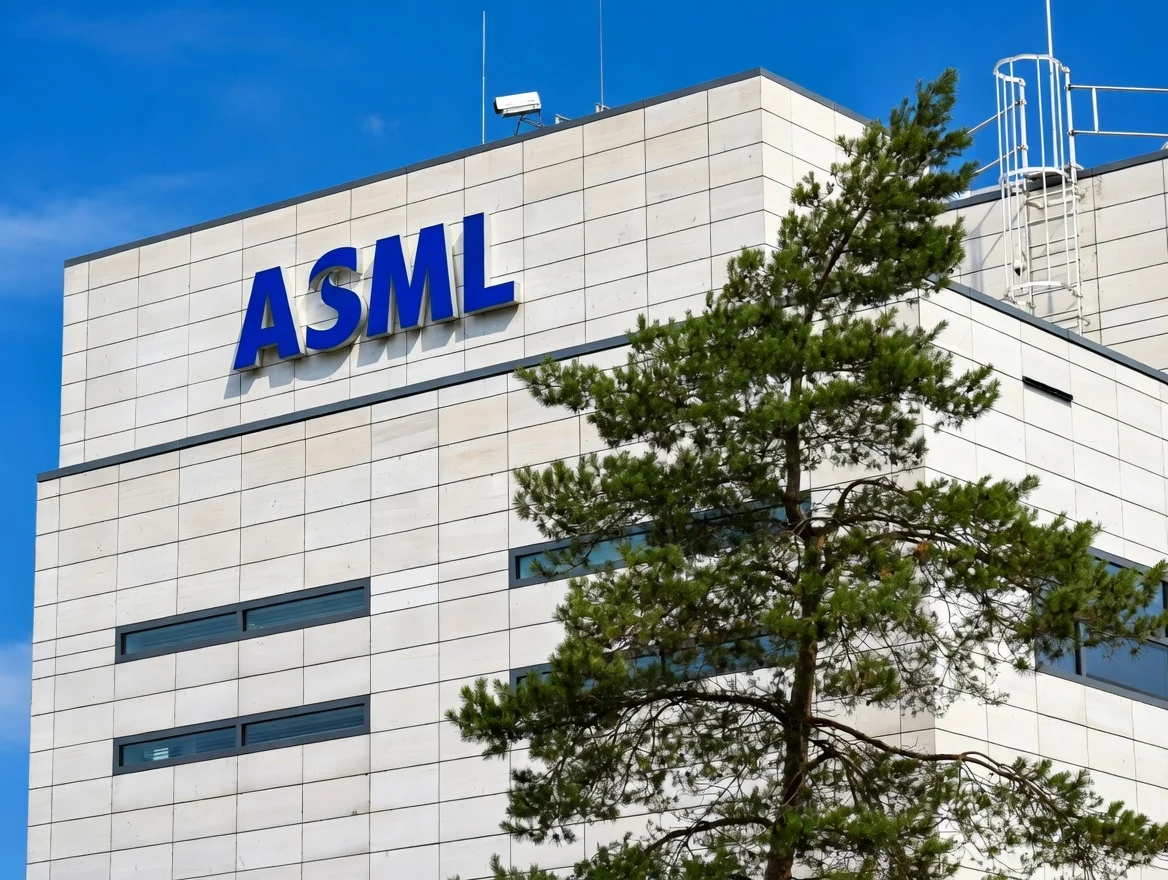
ASML secured significant endorsements from two semiconductor industry titans on Tuesday, with both Samsung and TSMC announcing their intention to integrate High NA extreme ultraviolet (EUV) lithography equipment into upcoming chip manufacturing operations.
Shares of ASML advanced approximately 1.6% during early market hours following these announcements, extending an impressive 120% rally witnessed over the trailing twelve months.
These advanced High NA systems carry a hefty price tag of roughly $400 million per unit and employ expanded optical systems to etch circuit patterns up to three times finer onto silicon substrates in single exposures. Such capabilities are becoming essential as semiconductor manufacturers advance toward increasingly sophisticated architectures required for artificial intelligence applications.
Samsung disclosed plans to deploy these systems for DRAM memory chip fabrication commencing in 2028, seeking to advance its memory scaling trajectory while enhancing manufacturing productivity. TSMC has established a 2030 implementation target, focusing on cutting-edge processors where transistor complexity continues expanding due to AI processing demands.

TSMC’s Chief Executive C.C. Wei emphasized the company’s philosophy of addressing technical obstacles proactively before they escalate into financial burdens. With TSMC representing approximately 16% of ASML’s overall revenue according to Bloomberg data, this commitment delivers a critical endorsement for investors monitoring High NA technology penetration.
Larger Photomask Standard Promises Efficiency Gains
Complementing the equipment commitments, all four industry players—ASML, TSMC, Samsung, and Intel—have reached consensus on transitioning from today’s 6-inch photomask specification to an expanded 12-inch configuration.
Photomasks function as precision templates, utilizing light projection to transfer intricate circuit designs onto silicon substrates. According to ASML Chief Technology Officer Marco Pieters, the expanded mask dimensions could enhance High NA system productivity by 40% while simultaneously simplifying chip architecture development.
Intel has invested over three years developing the 12-inch mask initiative as part of its expanding production infrastructure. TSMC’s roadmap calls for initial High NA deployment using conventional 6-inch masks in 2030, followed by establishing a pilot production facility for 12-inch masks by 2031.
Analyst Perspectives
Barclays characterized Tuesday’s announcements as beneficial, stating they “should provide more visibility on adoption which has been a key debate” and representing “a positive” catalyst for the stock.
The financial institution also highlighted that ASML confronts strategic decisions regarding potential EUV capacity expansion beyond previously established objectives, observing that market demand appears “clearly strong.”
Company guidance indicates plans to increase overall EUV manufacturing capacity by approximately 30% through 2027, though specific High NA production volume forecasts have not been recently updated.
The analyst community maintains a Strong Buy consensus rating on ASML stock, supported by six Buy recommendations issued during the past three months. The consensus 12-month price objective stands at $2,468 per share, representing approximately 44% appreciation potential from present trading levels.
ASML shares trading on the Amsterdam exchange showed minimal movement with slight declines during early European market activity before U.S. trading commenced.
Get 3 Free Stock Ebooks
Discover top-performing stocks in AI, Crypto, and Technology with expert analysis.
- Top 10 AI Stocks - Leading AI companies
- Top 10 Crypto Stocks - Blockchain leaders
- Top 10 Tech Stocks - Tech giants



