


Key Highlights
- Bottomline has chosen Chainlink infrastructure to bridge its massive $16 trillion yearly payment network with both public and private blockchain systems.
- More than 600 banking institutions can now leverage onchain settlement capabilities without abandoning their current ISO 20022 messaging frameworks.
- The integration utilizes Chainlink’s CCIP protocol and CRE framework to manage cross-chain value transfers and payment processing coordination.
- Following an approximately 50% price surge, LINK has developed a bullish pennant formation on daily charts, with technical targets ranging from $12 to $27.
- Notable financial giants like Swift, JPMorgan, UBS, ANZ, and BNY Mellon have already deployed Chainlink technology in their operations.
In a significant development for blockchain adoption in traditional finance, Bottomline—ranking among the top three Swift service providers globally—has announced its selection of Chainlink to integrate blockchain capabilities into its payment infrastructure. The financial technology firm handles over $16 trillion in transactions each year, serving a client base exceeding 600 banking institutions, 1,200 financial service providers, and 10,000 corporate entities across the globe.
This collaboration enables Bottomline’s banking clientele to utilize blockchain-based settlement mechanisms while maintaining their existing operational infrastructure. Financial institutions will continue processing payment directives through the ISO 20022 messaging protocol, the industry-standard communication format already embedded in their systems.
The technical backbone relies on Chainlink’s Cross-Chain Interoperability Protocol (CCIP), which manages the movement of tokenized assets between different blockchain ecosystems. Meanwhile, the Chainlink Runtime Environment (CRE) orchestrates the complete payment execution flow, bridging legacy banking platforms with distributed ledger technology.
Financial institutions leveraging this solution gain access to numerous public and private blockchain networks via a unified integration point, eliminating the need to construct separate technical frameworks for each individual chain.
International payment processing represents a primary application focus. The partnership materials highlight that cross-border transactions frequently require multiple days for final settlement, with transaction fees often exceeding 5% of the transferred amount. The Chainlink integration provides participating institutions with an alternative settlement pathway to address these inefficiencies.

The announcement did not reveal specific transaction volume projections, deployment schedules, or identify which banking institutions will initially participate in the program.
Expanding Institutional Adoption of Chainlink Technology
The Bottomline partnership extends Chainlink’s growing roster of enterprise-level implementations. Major financial players including Swift, JPMorgan, UBS, ANZ, BNY Mellon, and the Abu Dhabi Digital Identity Foundation currently operate systems built on Chainlink infrastructure.
JPMorgan achieved a milestone in May 2025 by executing its inaugural public blockchain settlement transaction powered by Chainlink technology, involving tokenized U.S. Treasury securities through the Ondo Finance platform. Decentralized finance protocol Aave integrated CCIP as its primary cross-chain solution in July, while BitGo announced in August its exclusive adoption of CCIP for the Wrapped Bitcoin platform, which managed approximately $7.3 billion in assets at that time.
Analysis from Standard Chartered’s digital asset division indicated in August that non-crypto native clients are projected to contribute an increasing proportion of Chainlink network fees as real-world asset tokenization initiatives transition from pilot phases to full-scale deployment.
The Chainlink oracle ecosystem currently safeguards roughly $33.1 billion in aggregate value locked across 505 decentralized protocols, while CCIP has processed more than $18 billion in cross-chain value transfers spanning over 70 distinct blockchain networks.
Technical Analysis and LINK Price Movement
Market analyst Jesse Olson shared on X that LINK is executing a breakout pattern with an emerging buy signal visible on 4-hour timeframes, noting that daily chart indicators continue displaying bullish characteristics.
Following an approximate 50% rally, LINK is currently consolidating within a bullish pennant structure on the daily timeframe. Technical analysts have identified potential resistance levels at $12, $15.5, $20, and $27, contingent upon continued accumulation and buying pressure.
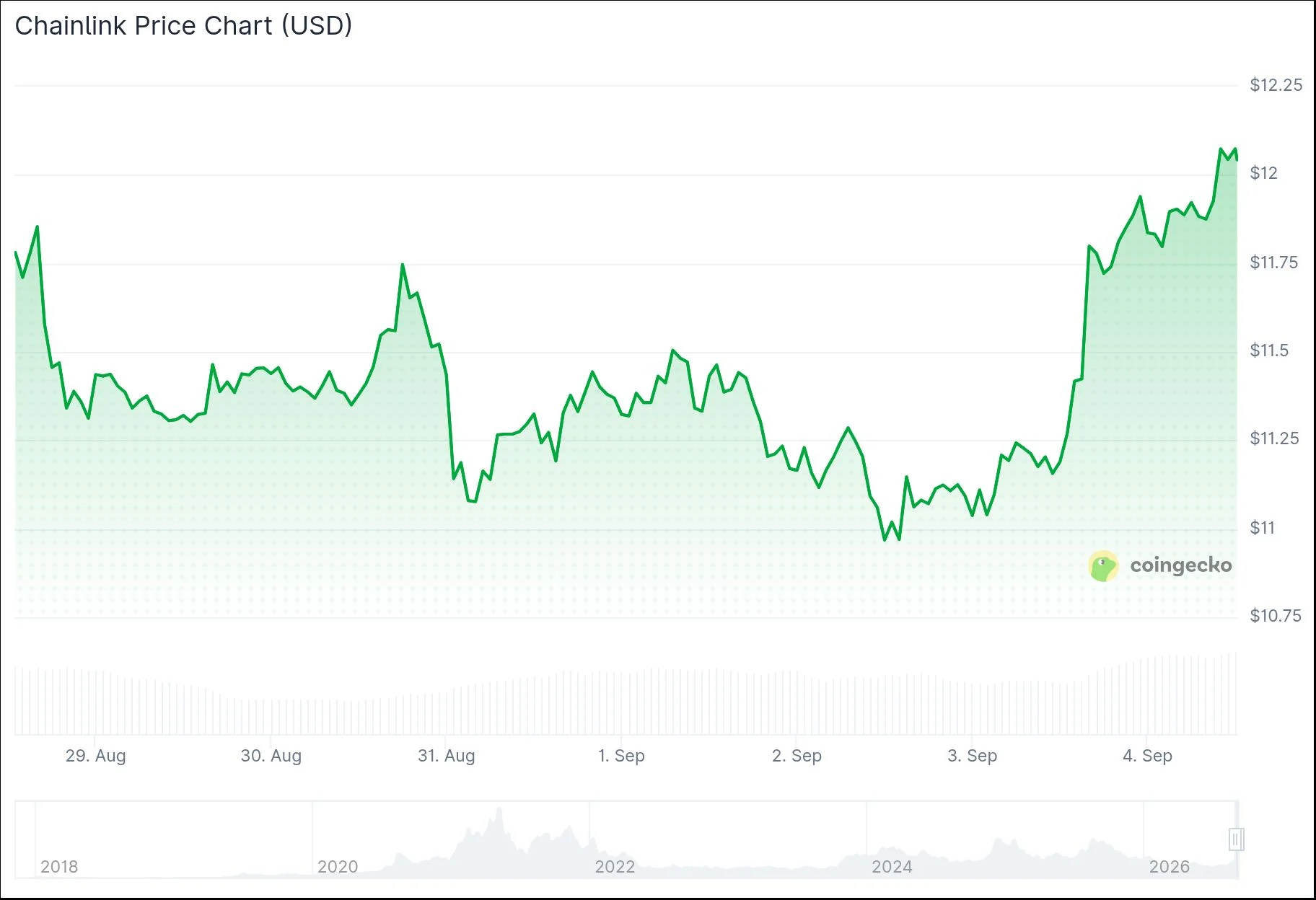
The LINK token currently maintains a market capitalization exceeding $8 billion. At press time, LINK trades at $12.08, representing a 7.36% increase over the past 24 hours.
Get 3 Free Stock Ebooks
Discover top-performing stocks in AI, Crypto, and Technology with expert analysis.
- Top 10 AI Stocks - Leading AI companies
- Top 10 Crypto Stocks - Blockchain leaders
- Top 10 Tech Stocks - Tech giants



