


Key Highlights
- Solana has climbed above $94, recording a 27% gain over the past seven days and reaching its strongest position in two months.
- ETFs tracking SOL have seen four consecutive days of positive flows, accumulating $28.34M in fresh capital.
- Network validators are currently voting on three governance measures (SGP 1, 2, 3) with results due Thursday.
- Two of the proposals aim to accelerate supply reduction through faster disinflation and increased token burns from transaction fees.
- A confirmed daily close above the $100 mark would position SOL to test resistance around $112.52.
Solana is currently changing hands above $94 on Monday morning, showing approximately 1% gains in the past day and a robust 27% climb across the previous seven days. This price level represents SOL’s strongest performance in a two-month timeframe.
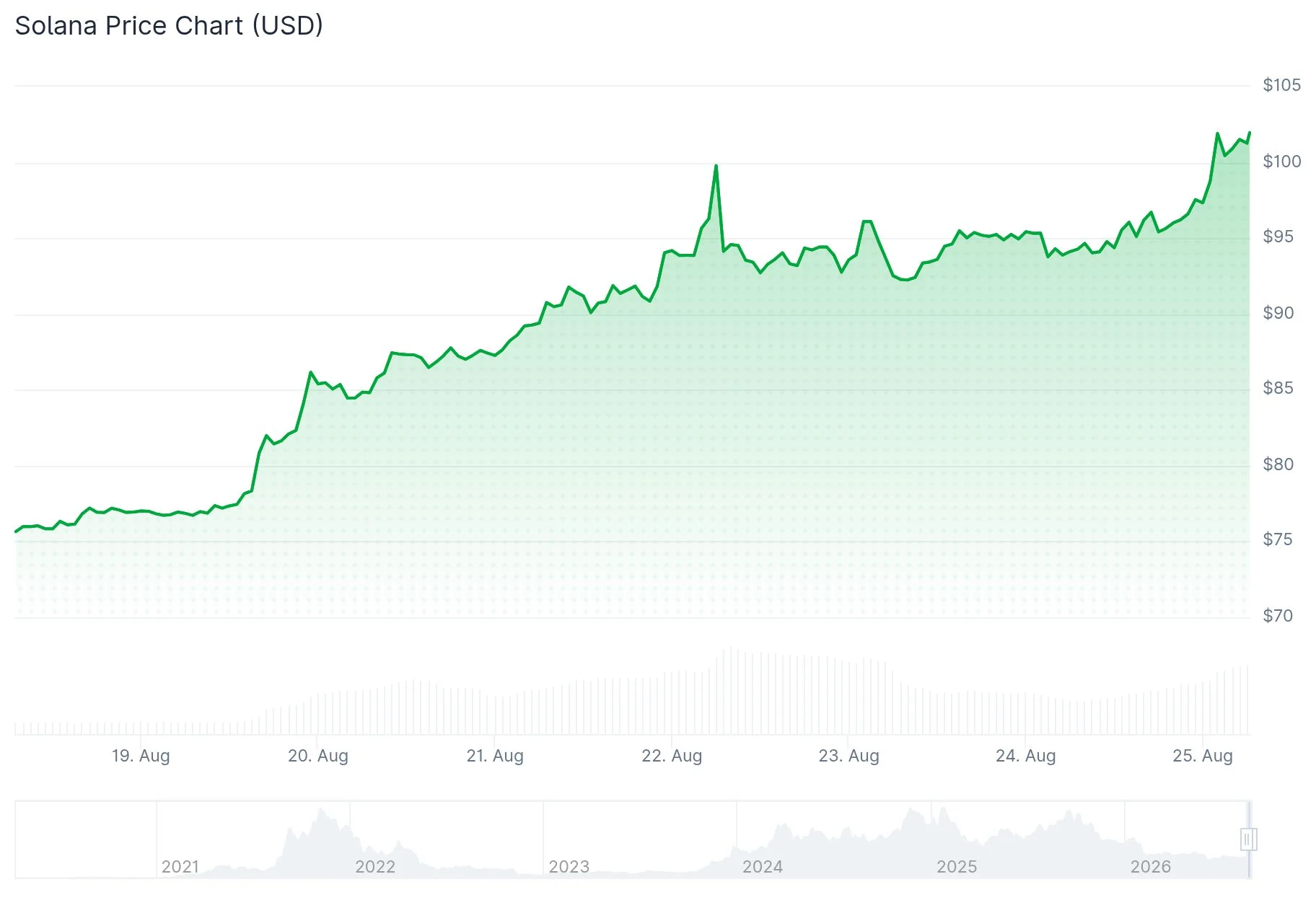
The recent upward momentum has carried the token beyond both its 50-day exponential moving average at $79.04 and its 200-day exponential moving average at $92.67. These technical levels have now flipped to serve as support zones.
The nearest overhead barrier lies at $98.41, which marks the May 11 peak, with the psychological $100 threshold just beyond. Successfully closing above $100 on a daily basis would clear the way for a move toward the $112.52 resistance zone.
On the 4-hour timeframe, the Relative Strength Index reads near 64, approaching territory typically considered overbought. Meanwhile, the MACD indicator continues to flash positive signals, confirming buyer dominance, though the intensity of the recent advance suggests potential near-term consolidation.
Governance Proposals Could Reshape Token Economics
Network validators initiated voting on Sunday across three governance measures, with final tallies expected by approximately 15:30 UTC on Thursday. Voting power is determined by the amount of staked SOL each participant holds.

The first measure, SGP-0001, formally adopts the “Solana Constitution,” establishing a structured framework for network governance decisions. Passage of this proposal activates the infrastructure needed to conduct subsequent on-chain votes.
SGP-0002 seeks to accelerate the disinflation schedule by doubling the annual rate from 15% to 30%. This change would decelerate new token issuance significantly, allowing the network to reach its minimum inflation floor more rapidly.
SGP-0003 introduces a revised fee structure for transactions. Under this model, block producers receive a predetermined portion of fees, while a flexible component tied to computational resources used would be permanently removed from circulation. Implementation could elevate daily token burns from roughly 650 SOL to a range of 7,500 to 9,000 SOL — valued at up to $846,000 based on current market prices.
A noteworthy procedural quirk exists: SGP-0001 officially establishes the governance framework itself, yet SGP-0002 and SGP-0003 are being voted upon concurrently using that very same system before its formal ratification.
Institutional Demand Strengthens Through ETF Channels
Exchange-traded funds focused on SOL registered four straight sessions of net positive inflows during the previous week, accumulating a combined $28.34 million. This marked their most robust weekly performance in eight weeks, based on tracking data from CoinGlass.
The timing of these capital flows aligned precisely with Solana’s 27% price recovery. Continued institutional accumulation through these vehicles could provide additional upward momentum, although a single week of inflows doesn’t necessarily establish a durable trend.
Prominent cryptocurrency analyst Ivan on Tech weighed in on the price action, noting on X that SOL had “flipped bullish for the first time since Q4.” He characterized this as a positive technical development and suggested the breakout might catalyze gains across smaller tokens built on the Solana ecosystem.
SOL was trading above $96 in early Monday trading, posting a 1.6% increase over the preceding 24-hour period.
Get 3 Free Stock Ebooks
Discover top-performing stocks in AI, Crypto, and Technology with expert analysis.
- Top 10 AI Stocks - Leading AI companies
- Top 10 Crypto Stocks - Blockchain leaders
- Top 10 Tech Stocks - Tech giants



