



Key Highlights
- Fidelity submits SEC filing to introduce staking capabilities for its Ethereum ETF, which manages net assets exceeding $898 million
- Proposed structure allocates 85% of gross staking income to the fund, distributing remainder to service providers and operators
- Controversy surrounds EIP-8363 proposal within Ethereum’s community, potentially capping staking yields when participation surpasses 50%
- Institutional accumulation persists as Bitmine purchases 7,391 ETH valued at approximately $14 million near the $1,850 support zone
- Technical analysis reveals consolidation pattern with immediate resistance at $1,922 and bullish flag formation pointing toward $2,500
Investment giant Fidelity has submitted documentation to the United States Securities and Exchange Commission requesting authorization to incorporate staking functionality within its Fidelity Ethereum Fund (FETH). The exchange-traded product currently manages assets totaling more than $898 million.
According to the filing details, the fund would be permitted to stake the majority of its Ethereum holdings during typical market conditions. Three qualified custodians—Anchorage Digital Bank, BitGo, and Fidelity Digital Assets—would manage the staking infrastructure and operations.
The proposed economic model allocates 85% of all gross staking income to the fund itself. Service providers, including sponsors, custodians, and node operators, would divide the remaining 15% as compensation for their services.
Proceeds from staking activities would initially be applied toward operational expenses of the fund. Any surplus rewards would subsequently be distributed to shareholders on a quarterly basis in cash form, adhering to guidelines outlined in IRS Revenue Procedure 2025-31.
EIP-8363 Sparks Heated Community Debate
This regulatory filing emerges amid intense discussion within Ethereum’s ecosystem regarding EIP-8363. The contentious proposal would implement a gradual reduction of staking yields down to zero once the network’s staking participation exceeds the 50% threshold.

Proponents contend the measure would curtail ETH token inflation while simultaneously strengthening network security parameters. Opponents warn it risks undermining decentralized finance applications and diminishing Ethereum’s attractiveness to institutional investors seeking yield-generating assets.
The quantity of staked ETH has experienced consistent growth throughout January, reaching 41.81 million ETH during the current week. An additional 2.33 million ETH currently awaits processing in the validator entry queue.
Ethereum exchange-traded funds recorded minor net outflows totaling $16.3 million during the previous two trading sessions, following the prior week’s substantial $244.9 million in net inflows. Combined net assets across all Ethereum ETF products currently stand at $10.48 billion.
Market analyst Michaël van de Poppe, recognized on X as @CryptoMichNL, indicated that ETH appears positioned for an upward breakout. He highlighted the compressed trading ranges and pattern of ascending lows as indicators suggesting an imminent volatile move to the upside, establishing an initial price objective of $2,300.
Large Holders Defend $1,850 Support Level
Bitmine, the Ethereum-focused treasury corporation under the leadership of Tom Lee, acquired 7,391 ETH tokens for approximately $14 million during Tuesday’s price decline approaching the $1,850 threshold.
Lee observed that market expectations for a Federal Reserve interest rate increase in September have declined from 70% probability to 46%. He suggested that loosening monetary conditions could provide supportive momentum for cryptocurrency markets.
From a technical perspective, Ethereum maintains trading activity above both its 20-day and 50-day moving averages, positioned at $1,884 and $1,864 respectively. The 100-day exponential moving average at $1,922 represents the primary resistance barrier.
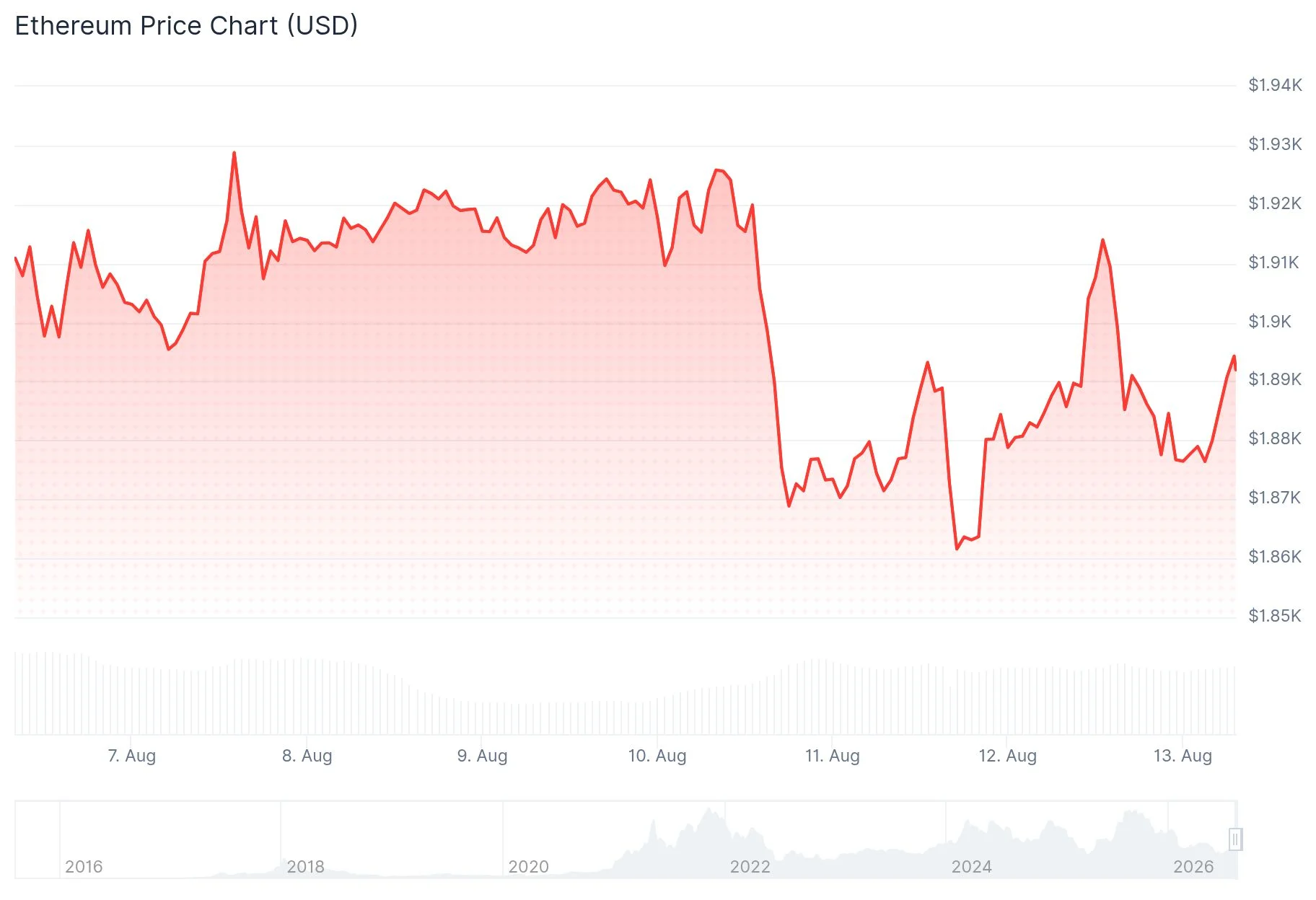
A bullish flag continuation pattern has developed on the charts since mid-July. A decisive move above the $1,950 level could propel ETH toward the $2,150 zone, with extended upside potential reaching $2,500.
Liquidation data shows $32.3 million in forced position closures during the last 24-hour period, with short positions accounting for $23.4 million of that total.
Get 3 Free Stock Ebooks
Discover top-performing stocks in AI, Crypto, and Technology with expert analysis.
- Top 10 AI Stocks - Leading AI companies
- Top 10 Crypto Stocks - Blockchain leaders
- Top 10 Tech Stocks - Tech giants



