



TLDR
- Morgan Stanley reduced its Q3 2026 Brent crude projection by $15 to reach $75 per barrel
- Daily tanker movements through the Strait of Hormuz have normalized to 30-40 vessels
- Analysts forecast a worldwide petroleum oversupply of 4.8 million barrels daily in 2027
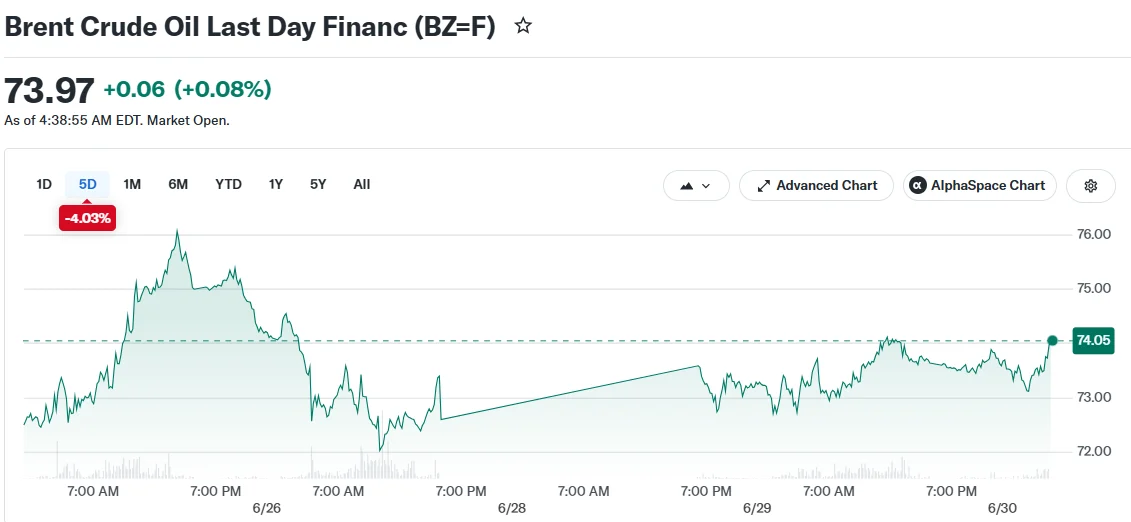
- Brent prices plummeted from April’s $126 peak to current levels below $74
- Crude markets face their steepest quarterly losses since the pandemic’s onset in early 2020
Major investment bank oil price projections have been revised downward following an unexpectedly swift recovery in maritime traffic through the Strait of Hormuz. Morgan Stanley analysts trimmed their third-quarter 2026 Dated Brent projection by $15 per barrel, establishing a new target of $75.
The revised outlook follows a four-month period of disruption that impacted petroleum shipments through this strategically vital corridor. The waterway serves as a critical artery for Middle Eastern oil exports to global markets.
Shipping Activity Returns to Normal Parameters
Morgan Stanley researchers documented 35 oil and liquefied natural gas tankers departing the Persian Gulf via the strait on Thursday. This figure aligns with the typical 30-40 vessel daily range observed prior to February’s outbreak of hostilities.
This development represents the first occasion that maritime traffic has achieved pre-conflict levels since fighting commenced. Shipping operators and maritime personnel have demonstrated renewed confidence in traversing the passage, according to bank analysts.
Weekend incidents involving two vessel strikes during renewed hostilities temporarily reduced traffic volumes. However, the broader pattern indicates sustained recovery in shipping activity.

For petroleum markets to achieve equilibrium in 2027, Hormuz throughput requires only approximately 65% of previous capacity. This translates to roughly 11-12 million barrels daily, per Morgan Stanley’s calculations.
Market Dynamics Shift from Deficit to Oversupply
Analysts now anticipate a worldwide petroleum glut reaching 4.8 million barrels per day during 2027. Prior to the conflict’s emergence, Morgan Stanley had forecast a more modest oversupply of 2-3 million barrels daily for that period.
The strait’s temporary closure had briefly transformed the projected surplus into a substantial market deficit. With export channels reopening, conditions are reverting toward excess supply.
Robust American petroleum production coupled with diminished Chinese consumption are compounding surplus risks. Morgan Stanley identified these dual factors as persistent downward pressures on valuations.
The institution also lowered its fourth-quarter 2026 projection to $75 per barrel from a previous $80 estimate. For 2027’s first six months, forecasters envision Brent at $75 per barrel, declining to $70 in the latter half.
This represents Morgan Stanley’s second forecast adjustment since Washington and Tehran announced their agreement to suspend hostilities and reopen the strategic waterway earlier this month.
Brent futures had surged beyond $126 per barrel during April’s peak conflict intensity. Those substantial gains have completely evaporated.
The September Brent contract settled at $73.91 per barrel Monday. Tuesday witnessed further declines, with August Brent futures dropping 0.9% to $72.47 per barrel.
US West Texas Intermediate crude for August delivery decreased 0.5% to $70.24 per barrel. Petroleum prices are tracking toward their third straight monthly retreat.
This would constitute the sector’s most severe quarterly downturn since the pandemic’s early 2020 period. Iranian and American negotiation delegations were anticipated to convene in Doha this week, though Tehran confirmed Monday that no session had been arranged.
Weekend rocket exchanges between both nations challenged the temporary ceasefire that concluded the four-month military engagement.
Get 3 Free Stock Ebooks
Discover top-performing stocks in AI, Crypto, and Technology with expert analysis.
- Top 10 AI Stocks - Leading AI companies
- Top 10 Crypto Stocks - Blockchain leaders
- Top 10 Tech Stocks - Tech giants



