



Key Takeaways
- Cardano’s price plummeted approximately 30% over the past week, settling near $0.163—a level not seen since late December 2020
- A cryptic social media message from founder Charles Hoskinson triggered widespread panic before he provided clarification
- Large holders controlling 10M–100M ADA tokens purchased 220 million additional coins throughout the downturn
- Futures market participation declined significantly, with Open Interest falling to $353M—the lowest reading since November 2024
- The network’s Ouroboros Leios testnet deployment is scheduled for June 2026, with ambitions to achieve transaction speeds surpassing 1,000 TPS
The past week has been particularly challenging for Cardano (ADA) investors. The cryptocurrency experienced a devastating near-30% decline, with current trading activity hovering around $0.163—a valuation not witnessed since the final weeks of 2020. Multiple factors including controversial founder statements, deteriorating derivatives metrics, and widespread cryptocurrency market weakness have combined to maintain downward momentum.
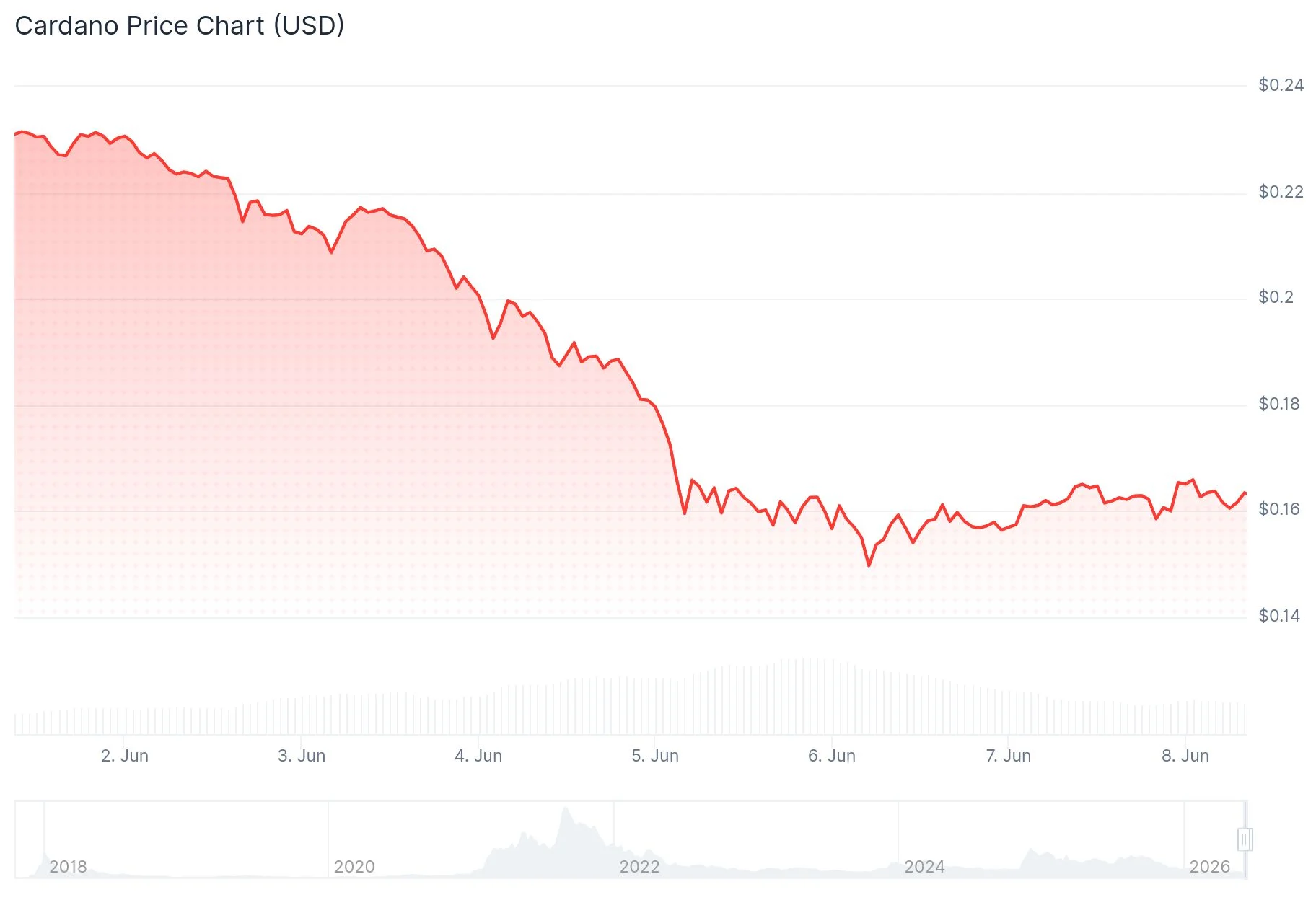
The dramatic price collapse began Thursday when Cardano’s creator Charles Hoskinson published a brief message on X stating: “I’m taking a break, TTYL.” This ambiguous statement immediately triggered alarm throughout the community, driving ADA to an intraday bottom of $0.148 by Saturday.
Hoskinson addressed the situation the next day through a live streaming session, explaining he was merely reducing his social media presence. He emphasized his ongoing dedication to Cardano’s development while making clear he doesn’t view himself as accountable for token price movements.
However, the market disruption was already underway. Investor confidence deteriorated rapidly, and price action has shown limited ability to mount a meaningful recovery.
Major Holders Increase Positions During Decline
While many investors rushed for the exits, data reveals certain market participants adopted a contrarian approach. According to Santiment analytics, wallet addresses containing 10 million to 100 million ADA tokens acquired 220 million additional coins starting June 1. This investor cohort now maintains holdings at their highest concentration in four months.

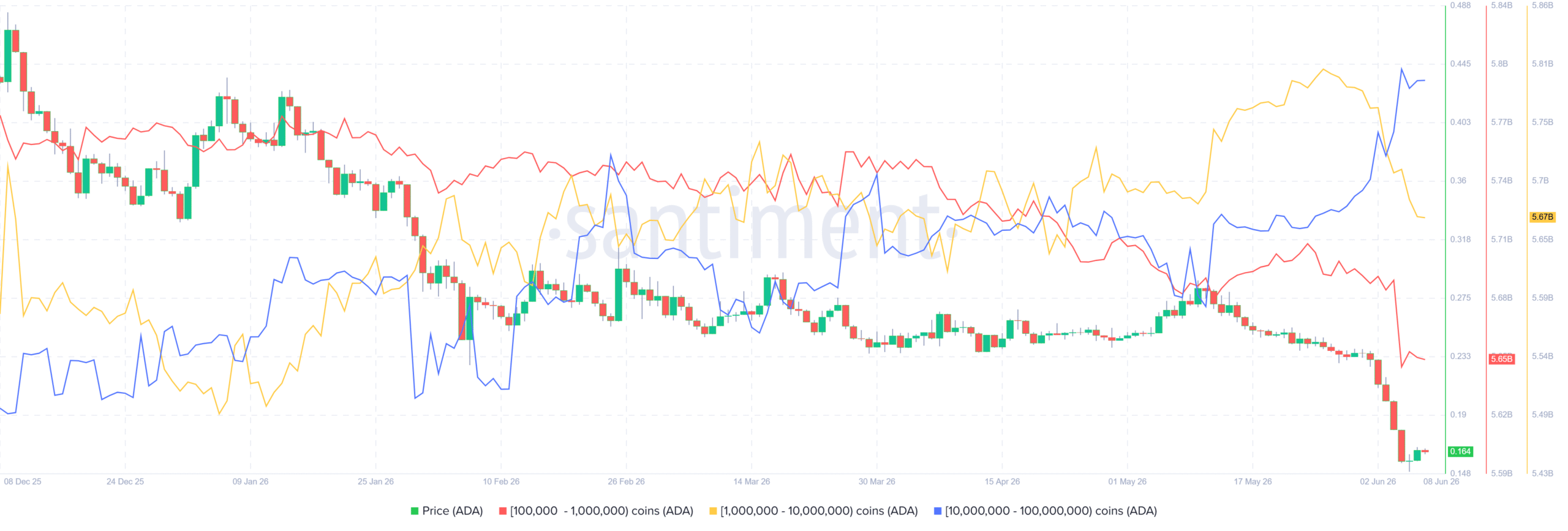
Conversely, medium-sized whale addresses holding between 100,000 and 10 million tokens reduced their positions by approximately 140 million coins during this identical timeframe. This pattern reveals a clear divergence: institutional-scale investors capitalized on discounted prices while smaller whales liquidated holdings.
Futures market indicators paint a more pessimistic picture. ADA’s Open Interest contracted to $353 million on Monday, representing a decline from May’s peak of $585 million and marking the weakest level since November 2024. The long-to-short positioning ratio currently registers at 0.80, beneath the neutral 1.0 threshold, indicating traders are predominantly betting on continued price deterioration rather than recovery.
Chart Analysis and Critical Price Zones
Cardano is currently trading substantially beneath its 50-day, 100-day, and 200-day exponential moving averages, which form a resistance cluster ranging from $0.230 to $0.332. The Relative Strength Index registers approximately 19 on the daily timeframe, indicating severely oversold conditions.
Market analyst More Crypto Online highlighted on X that ADA appears headed toward the $0.09–$0.10 zone, which corresponds with a 100% Fibonacci extension level and represents what they identify as the initial objective within a broader C-wave correction pattern. The analyst observed that price action has “repeatedly failed to show the strength required to start a sustained recovery.”
Critical support exists within the $0.140–$0.145 range. A decisive breach of this floor would expose lower targets at $0.130, $0.120, and potentially $0.100.
Regarding network development, the Ouroboros Leios testnet launch is scheduled for June 2026, designed to enhance transaction processing capacity from 10x to potentially 65x current levels, theoretically enabling speeds exceeding 1,000 transactions per second.
A spot Cardano ETF becomes eligible for regulatory review on August 9, 2026, following completion of the mandatory CME futures seasoning requirement.
Recent governance decisions rejected a 33 million ADA research funding proposal with 86% voting against, while the Cardano Summit 2026 was abandoned after its treasury allocation request failed to achieve the necessary 66.67% approval threshold.
Get 3 Free Stock Ebooks
Discover top-performing stocks in AI, Crypto, and Technology with expert analysis.
- Top 10 AI Stocks - Leading AI companies
- Top 10 Crypto Stocks - Blockchain leaders
- Top 10 Tech Stocks - Tech giants



