


Key Highlights
- First-quarter net profit reached an unprecedented 40.3 trillion won ($27.2B), marking a nearly 400% increase compared to the same period last year
- Quarterly revenue exceeded 50 trillion won for the first time ever, although falling slightly below Wall Street expectations
- The company achieved a record-breaking 72% operating margin, with operating profit climbing almost 100% from the final quarter of 2025
- SK Hynix commands a dominant 57% market share in high-bandwidth memory and expects to begin sampling HBM4E technology in the latter half of 2026
- A massive 19 trillion won investment in a new domestic production facility underscores efforts to address surging AI chip demand
SK Hynix delivered exceptional first-quarter performance in 2026. The memory chip manufacturer from South Korea announced unprecedented quarterly earnings on Thursday, propelled by escalating prices for artificial intelligence memory semiconductors.
The company’s net profit surged to 40.3 trillion won ($27.2 billion) during the first quarter, substantially exceeding analyst projections of 29.4 trillion won. Quarterly revenue reached 52.58 trillion won — marginally below the consensus estimate of 53.55 trillion won, yet representing nearly triple the figure from twelve months earlier.
Operating profit expanded fivefold year-over-year and experienced close to a twofold increase from the preceding quarter. The operating margin climbed to an unprecedented 72%.
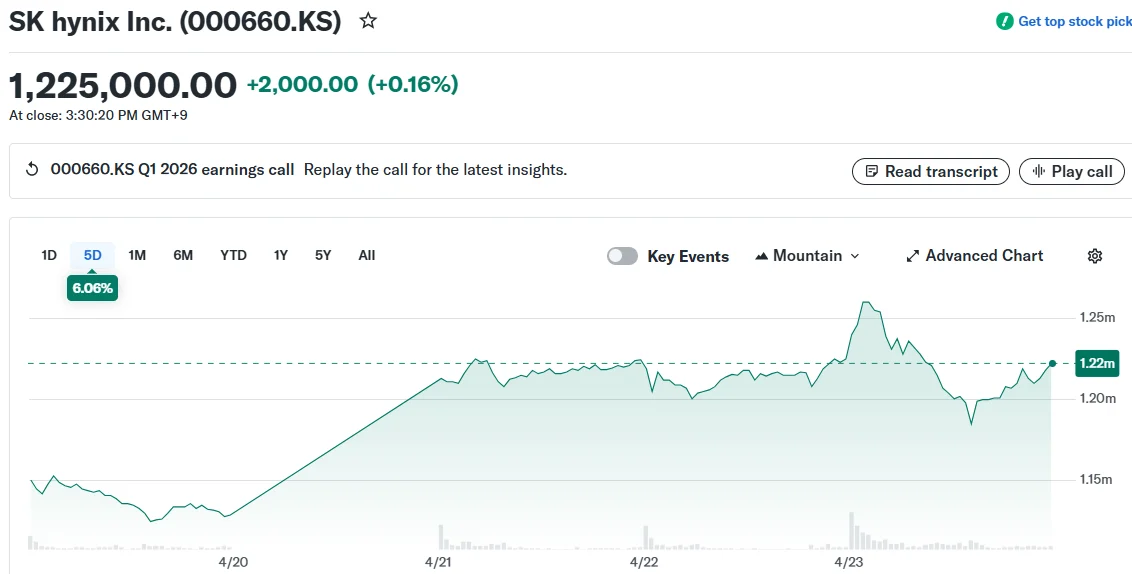
Shares of the company jumped as high as 3.6% during morning trading sessions in Seoul before moderating slightly to close down 0.9%.
SK Hynix attributed these outstanding results to increasing memory chip pricing and intensifying demand from artificial intelligence infrastructure expansion. Despite the first quarter traditionally representing a period of seasonal softness, the chipmaker reported that demand remained robust.

“Strong demand persisted due to expanded investments in AI infrastructure,” the company said in its earnings release.
High-Bandwidth Memory Leadership Fuels Performance
SK Hynix maintains its position as the global leader in high-bandwidth memory production, a critical component for AI server systems. The company controls a commanding 57% share of the HBM marketplace and serves as a principal supplier to Nvidia.
Demand for HBM has proven so overwhelming that it has created production capacity bottlenecks, which has subsequently elevated pricing for standard DRAM chips as well. According to Counterpoint Research, the DRAM sector experienced 30% sequential growth for two consecutive quarters.
The chipmaker’s DRAM marketing executive indicated that the favorable pricing environment may prove “more prolonged compared with the past,” given that manufacturers are struggling to satisfy demand levels.
Samsung regained its position as the leading DRAM revenue generator from SK Hynix during Q4 2025, based on Counterpoint statistics. However, SK Hynix has maintained its dominance in the more profitable HBM category.
Samsung revealed in February that it had commenced deliveries of its initial HBM4 products. SK Hynix had already provided HBM4 samples nearly twelve months prior, and announced Thursday its intention to distribute samples of its seventh-generation HBM4E during the second half of 2026, with volume production scheduled for 2027.
Manufacturing Expansion and Supply Chain Challenges
The company unveiled plans for a 19 trillion won investment in a new production plant located in Cheongju, South Korea.
SK Group Chairman Chey Tae-won has indicated that the worldwide semiconductor wafer shortage may continue through 2030, noting that capacity expansion projects require four to five years to become operational and that projected supply deficits could surpass 20%.
Regarding supply chain vulnerabilities, the continuing Middle East tensions have sparked concerns about availability of critical materials including helium, bromine, and tungsten. SK Hynix confirmed it has diversified its procurement sources and accumulated adequate reserves, anticipating minimal manufacturing disruptions.
The company has also secured long-term contracts for liquefied natural gas to mitigate energy cost volatility.
Counterpoint Research analyst MS Hwang told CNBC that first-quarter performance from memory manufacturers “show strong profitability and reveal that a lot more memory is needed for AI inference than expected.”
Mirae Asset Securities analyst Kim Young-gun projected that SK Hynix’s profit trajectory will maintain strength throughout 2026, highlighting multi-year procurement contracts being finalized with leading technology companies — with several clients actively pursuing contract extensions beyond originally agreed timeframes.
Get 3 Free Stock Ebooks
Discover top-performing stocks in AI, Crypto, and Technology with expert analysis.
- Top 10 AI Stocks - Leading AI companies
- Top 10 Crypto Stocks - Blockchain leaders
- Top 10 Tech Stocks - Tech giants



