



TLDR
- Chainlink says CCIP is secured by 16 independent node operators across diverse infrastructure.
- CCIP includes rate limits, attestations, and compliance tools for cross-chain token transfers.
- Swift, DTCC, UBS, ANZ, and SBI Digital Markets have used or adopted Chainlink services.
- Aave, Lido, Coinbase, Base, Ondo, and Maple Finance use CCIP for cross-chain operations.
- LINK trades at $9.24 and faces resistance between $10.25 and $10.67 on the weekly chart.
Chainlink has placed cross-chain security at the center of its latest market message. The network says CCIP is backed by 16 independent operators and built with layered safeguards. That structure comes as institutions and token issuers seek safer ways to move assets across blockchains.
The company links that security model to growing use in both institutional finance and DeFi. It also comes as LINK trades below a key weekly resistance area, while analysts track a deep support zone near $7.
Chainlink pushes security-first case for cross-chain infrastructure
Chainlink says cross-chain connectivity is now a core need for digital asset markets. It argues that weak bridge design has slowed trust. The company points to nearly $3 billion lost in bridge hacks across the sector.
CCIP is presented as a secure-by-default system. Chainlink says developers should not need deep bridge expertise for basic safety. The protocol includes built-in controls and decentralized verification from the start.
The network says its architecture uses separate committing and executing DONs. It also says 16 independent operators validate cross-chain transactions through decentralized consensus. Those operators are spread across regions and use different infrastructure setups.
Sergey Nazarov said, “You’re not building the systems for the 363 days when everything is smooth.” He added, “You’re building the system for the 2 days when everything goes crazy.” Chainlink uses that view to frame CCIP as infrastructure for stressed market conditions.

Institutional and DeFi adoption expands around CCIP
Chainlink points to several institutional projects that use its interoperability stack. Swift worked with Chainlink to connect financial institutions to public and private blockchains. The setup used existing Swift standards, including ISO 20022 messaging.
The company also said 24 financial institutions and market groups used CCIP in a DTCC-related project. Participants included Swift, Euroclear, UBS, and Wellington Management. Chainlink also cited work involving the Central Bank of Brazil and the Hong Kong Monetary Authority.
Other examples include ANZ, Fidelity International, SBI Digital Markets, Apex Group, and projects tied to Singapore’s Project Guardian. Chainlink says these efforts combine cross-chain messaging with compliance and fund lifecycle functions. It also says its Automated Compliance Engine can support checks before transactions move.
In DeFi, Chainlink lists Aave, Lido, Coinbase, Base, Ondo, xStocks, and Maple Finance among CCIP users. Those projects use CCIP for cross-chain transfers, governance, wrapped assets, and token movement. Chainlink says the Cross-Chain Token standard also helps issuers avoid vendor lock-in.
LINK price analysis shows support test as triangle tightens
LINK trades at $9.24 on the weekly timeframe, based on the provided market view. The token remains below the Bull Market Support Band. That resistance zone stands between $10.25 and $10.67.
Analyst InvestDeCrypted maps a Fibonacci retracement from the 2021 peak at $53.30. The current area aligns with the 0.887 retracement level. That places a deeper support zone near $7.
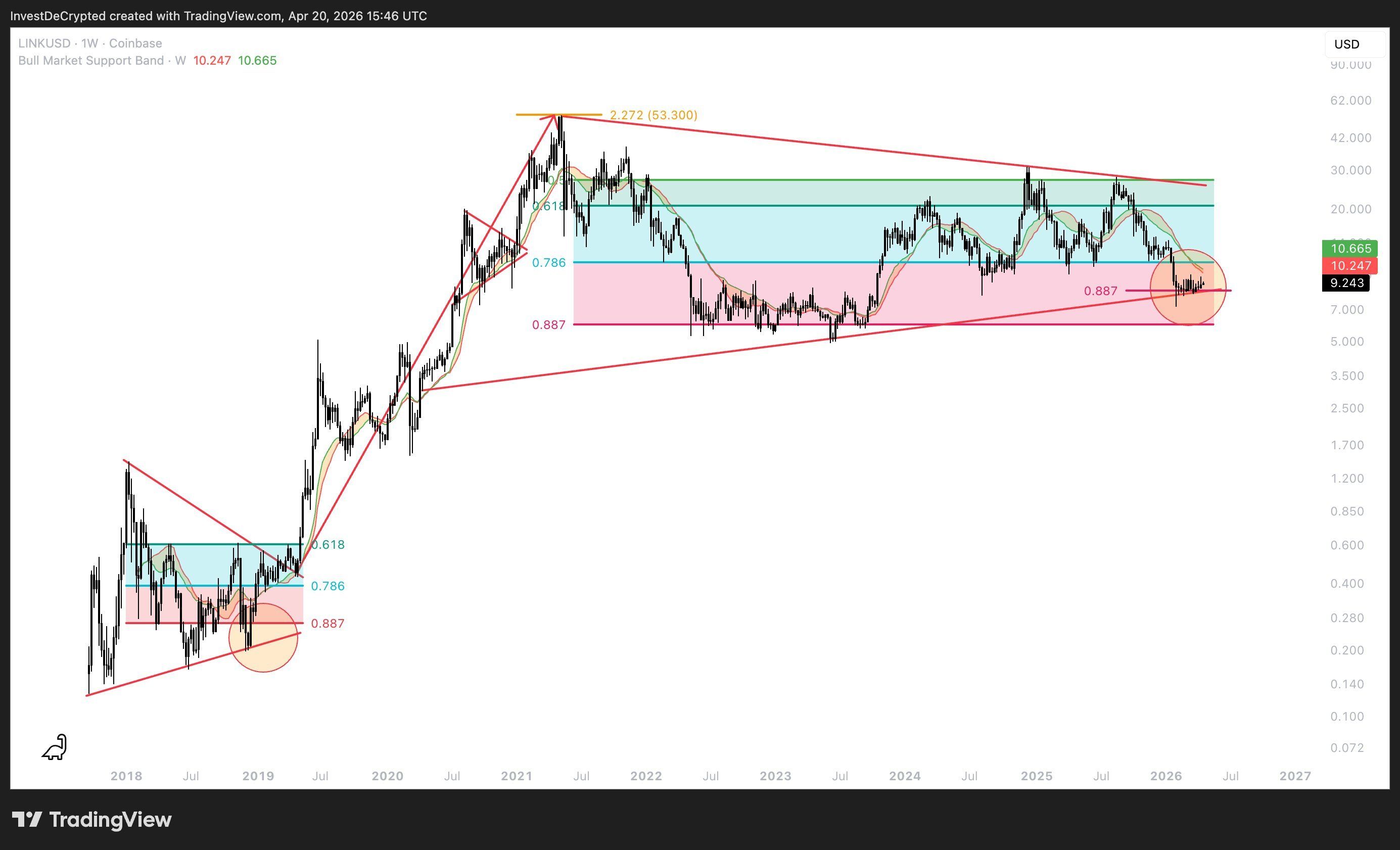
The analyst also compares the present setup with the 2018 and 2019 accumulation pattern. In that earlier cycle, LINK bottomed near a similar retracement before rising sharply. This comparison does not confirm a repeat, but it shapes the current market narrative.
Weekly trendlines have tightened into a symmetrical triangle, while volume has declined. That pattern often points to a later accumulation phase. A price break from this range may set the next direction in the months ahead.
Get 3 Free Stock Ebooks
Discover top-performing stocks in AI, Crypto, and Technology with expert analysis.
- Top 10 AI Stocks - Leading AI companies
- Top 10 Crypto Stocks - Blockchain leaders
- Top 10 Tech Stocks - Tech giants



