


Key Takeaways
- USD1 stablecoin from World Liberty Financial temporarily slipped from its dollar peg, reaching $0.994 on Monday
- World Liberty Financial attributes the incident to a synchronized assault featuring compromised accounts, paid social media campaigns, and aggressive short positions
- The stablecoin rebounded to approximately $0.999 through its direct mint-and-redeem system
- The project’s native WLFI token experienced a roughly 7% decline during the event
- Exchange giant Binance controls approximately 87% of circulating USD1, representing ~$4.7 billion
World Liberty Financial (WLFI), the cryptocurrency venture associated with President Donald Trump and his family, reported facing a synchronized market assault on Monday that temporarily knocked its USD1 stablecoin away from its dollar peg.
According to CoinGecko market data, USD1 declined to a low of $0.994, representing roughly a 0.6% deviation from its intended one-dollar value. The digital asset subsequently rebounded to the $0.998 to $0.999 range.
The platform’s governance token, WLFI, experienced similar turbulence. During the incident, its value declined approximately 7% before staging a partial rebound.
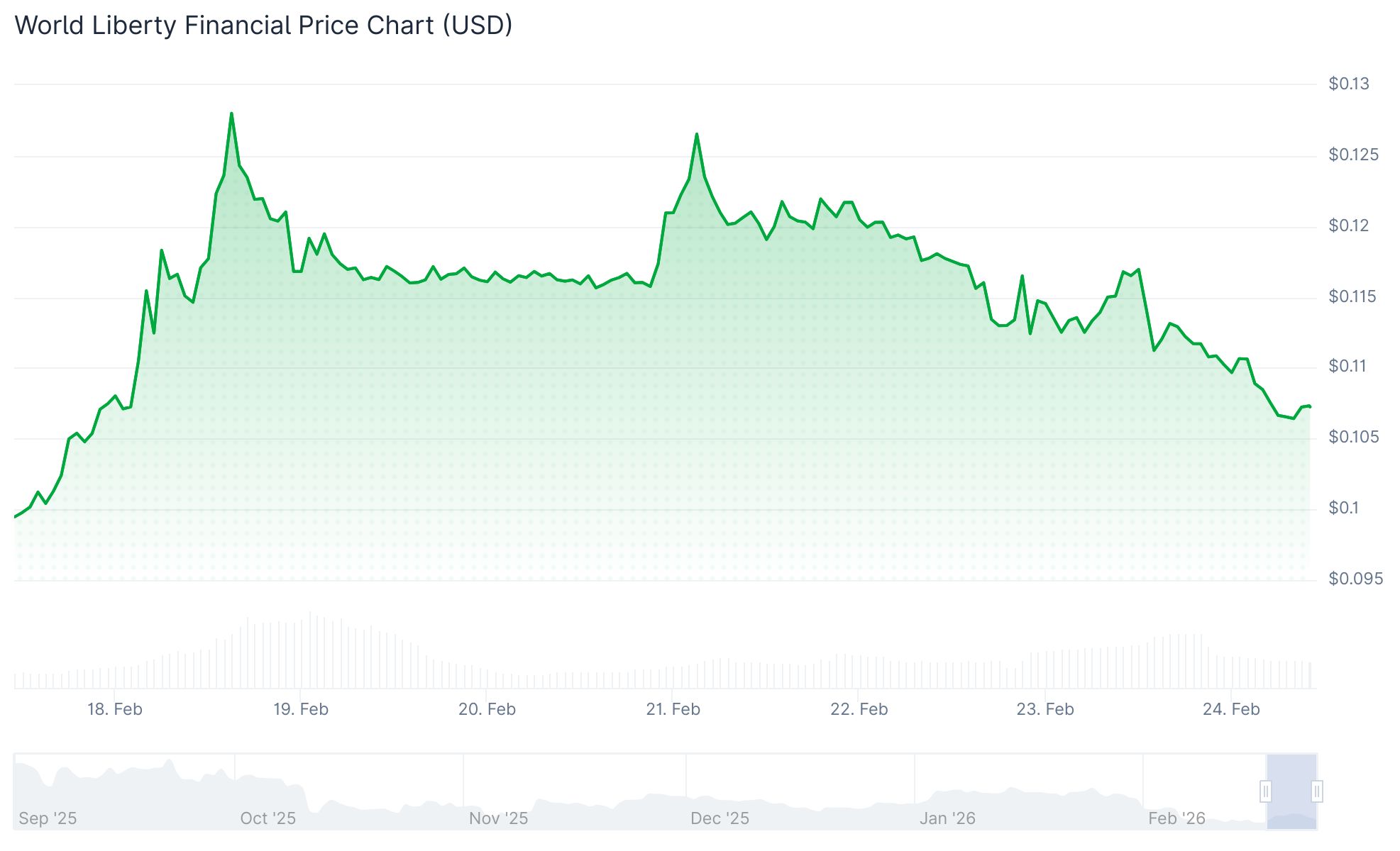
In a statement shared on X, the organization revealed that multiple co-founder accounts were breached during the assault. Concurrently, market participants established substantial short positions against WLFI, wagering on further price deterioration.
The company also alleges that paid social media personalities were deployed to disseminate negative messaging — commonly referred to in cryptocurrency circles as FUD (fear, uncertainty, and doubt) — designed to trigger panic selling among retail investors.

According to World Liberty, the operation aimed to “manufacture chaos” surrounding the platform and capitalize on the ensuing market volatility.
Stabilization Through Redemption Mechanism
World Liberty Financial attributes the limited damage to its underlying mint-and-redeem infrastructure. This framework enables token holders to convert USD1 directly into US dollars on a one-to-one basis, providing a natural price stabilization mechanism.
“Thanks to USD1’s sound mint-and-redeem mechanism and full 1:1 backing, we are trading steadily at par,” the company stated in its announcement.
USD1 maintains full reserves through a combination of short-duration US Treasury securities, dollar-denominated bank deposits, and equivalent cash instruments. Digital asset custodian BitGo oversees reserve management, while accounting firm Crowe provides monthly verification reports confirming reserve adequacy.
With a current market capitalization approaching $5 billion, USD1 remains smaller than established stablecoins like Tether’s USDT and Circle’s USDC.
Binance Relationship Raises Questions
The incident occurred mere days following a cryptocurrency conference hosted by WLFI at President Trump’s Mar-a-Lago estate in Florida. The event featured appearances from government representatives, financial sector executives, and former Binance chief Changpeng Zhao.
President Trump granted Zhao a pardon in October 2025. Zhao had completed a four-month prison sentence stemming from a 2023 settlement with American authorities that also prohibited him from Binance management roles.
Binance presently controls roughly 87% of total USD1 supply, valued at approximately $4.7 billion, per Forbes reporting.
Both Bloomberg and The Wall Street Journal have published reports indicating Binance’s involvement in USD1’s development. The stablecoin facilitated a $2 billion investment from UAE-based entity MGX into Binance during March 2025.
Certain members of Congress are now examining whether President Trump’s pardon of Zhao and World Liberty Financial’s Binance connections constitute potential conflicts of interest.
Zhao stated in January that there exist “no business relationships whatsoever” between him and the Trump family, adding that he has no intentions of resuming leadership at Binance.
As of this writing, USD1 continues trading at approximately $0.998 to $0.999, maintaining a slight discount to its dollar target.
Get 3 Free Stock Ebooks
Discover top-performing stocks in AI, Crypto, and Technology with expert analysis.
- Top 10 AI Stocks - Leading AI companies
- Top 10 Crypto Stocks - Blockchain leaders
- Top 10 Tech Stocks - Tech giants



