



TLDR
- XRP maintained support at the $1.10 threshold on June 11, trading around $1.12 following increased volume in late trading
- Elliott Wave analysis suggests a three-phase impulse pattern with recovery potential between $2.39 and $3.11
- Technical analyst Ali Charts identified a TD Sequential buy signal appearing on the 3-day timeframe, suggesting near-term bullish momentum
- Investment products tracking XRP saw $1.19 million in net inflows, bringing total assets under management close to $948.98 million
- Critical resistance levels established at $1.12–$1.13, with the mid-Bollinger Band at $1.2380 representing the next significant hurdle
XRP successfully defended the $1.10 price floor on June 11 during a choppy trading session, settling near $1.12 with approximately $1.94 billion in 24-hour trading volume. The digital asset posted a modest 0.72% daily gain while remaining underwater by 4.47% over the trailing seven days and 23.86% across the past 30 days. With a market capitalization hovering around $69.2 billion, XRP maintains its position as the sixth-largest cryptocurrency by valuation.
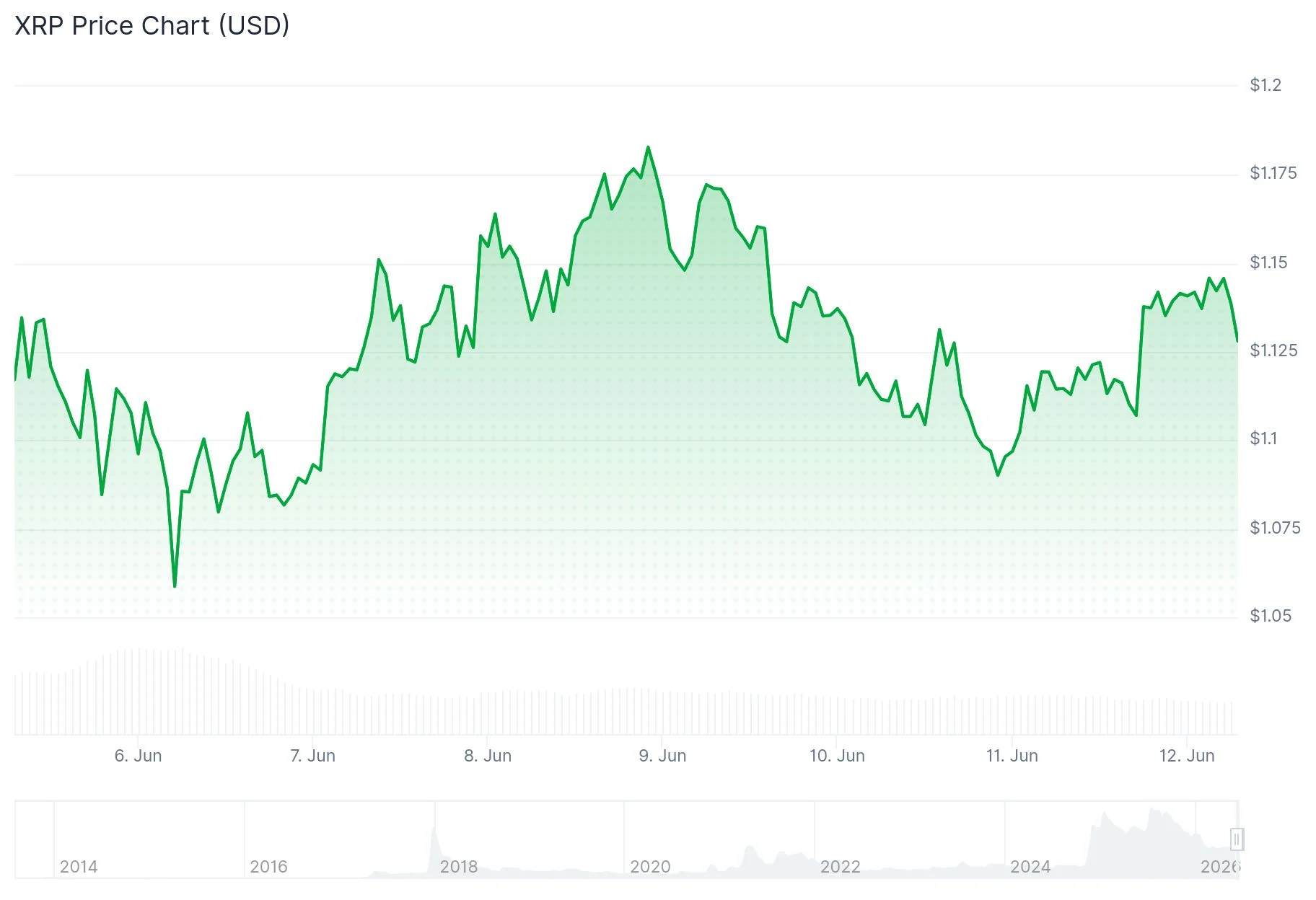
The recent price movement indicates that buyers successfully mounted a defense at the $1.10 threshold after a sharp correction last week. This level has emerged as a critical short-term floor, positioned near the most recent breakdown point.
Crypto analyst Ali Charts highlighted on X that the TD Sequential indicator has generated a buy signal on XRP’s 3-day timeframe. The analyst noted that historically, buy signals on higher timeframes like this have preceded rebounds lasting between one and four candlesticks, potentially providing near-term relief following the recent price compression.
During late-session activity, XRP momentarily breached the $1.12 level accompanied by elevated volume. Earlier during the trading day, the token consolidated around $1.11 as buyers attempted to establish a foundation.
Market participants are closely monitoring the $1.12–$1.13 resistance band as the initial obstacle. A decisive close above $1.13 supported by robust volume could pave the way toward $1.18, followed by $1.2380. Should XRP lose the $1.10 support, traders will focus on $1.09 and the lower Bollinger Band positioned near $1.04.

Elliott Wave Analysis Suggests $2.39–$3.11 Recovery Zone
A technical analysis chart published on X by analyst RWA_Investor outlines a potential three-wave Elliott Wave recovery pattern originating from the recent bottom near $1.07. The projection illustrates Wave A advancing toward $1.94, followed by a corrective Wave B retracement to approximately $1.46, culminating in Wave C targeting a band between $2.39 and $3.11.
According to the analysis, a Wave B correction toward $1.46 should not be interpreted as bearish momentum. Instead, it would represent a typical consolidation phase preceding the most powerful phase of the advance.
A confirmed breakout and sustained close above $3.10 would indicate that XRP has likely established a macro bottom around the $1.05 region. However, if the recovery loses steam below the upper projection zone, technical analysts have identified a potential downside scenario involving a retest of the $0.75–$1.00 range.
Investment Product Inflows Tick Higher Amid Subdued Momentum
XRP-tracking investment vehicles registered $1.19 million in daily net inflows based on SoSoValue data, with cumulative net assets approaching $948.98 million. While the inflows represent a cautiously positive development, total assets remain below previous peak levels.
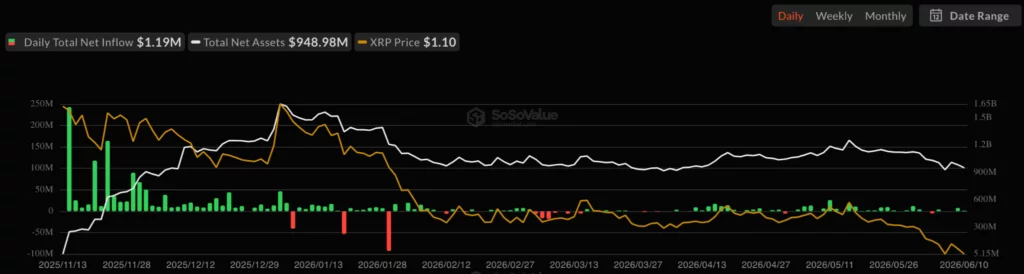
Open interest metrics remain near cycle lows, indicating that traders have yet to establish significant directional positions. Although volume has shown signs of improvement, market activity appears characterized by short-term tactical trading rather than sustained trend-following behavior.
The daily chart structure remains locked in a downtrend from January peaks above $2.30. Following a consolidation phase between March and May, XRP experienced a downside breakdown in June. Bulls must reclaim the middle Bollinger Band positioned at $1.2380 to signal that a more sustainable recovery pattern may be developing.
Get 3 Free Stock Ebooks
Discover top-performing stocks in AI, Crypto, and Technology with expert analysis.
- Top 10 AI Stocks - Leading AI companies
- Top 10 Crypto Stocks - Blockchain leaders
- Top 10 Tech Stocks - Tech giants



