


Key Takeaways
- Technical charts reveal WLFI developing a bear flag formation, suggesting a potential 20% decline toward $0.066 by late April.
- The project leveraged illiquid WLFI tokens as collateral on Dolomite—a platform operated by its own chief technology officer—to secure $75 million in stablecoin loans.
- Lending pool utilization surged to 93%, preventing several users from accessing their stablecoin withdrawals.
- Major investor Justin Sun publicly claimed the project employed an undisclosed blacklisting mechanism to freeze his 544 million token holdings.
- More than 16 billion WLFI tokens could potentially enter circulation, creating significant dilution concerns among holders.
World Liberty Financial’s native token is experiencing mounting pressure throughout April 2026. A convergence of negative technical indicators, questionable internal transactions, and a heated public confrontation with a prominent investor has created substantial headwinds for WLFI’s valuation.
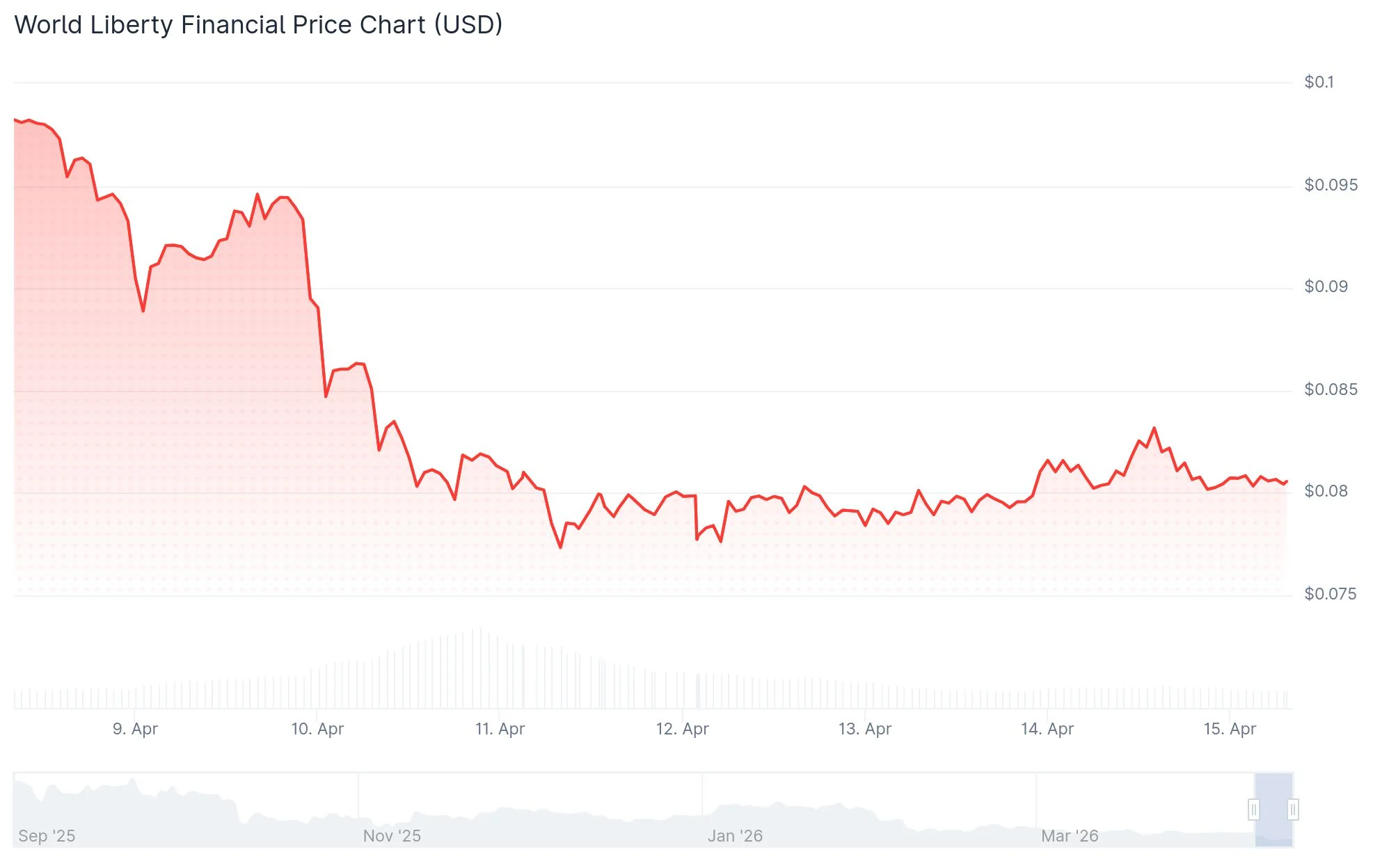
From a technical perspective, WLFI is currently consolidating within a bear flag formation—a continuation pattern typically associated with further downward movement. According to pattern measurement techniques, the projected downside target reaches approximately $0.066, representing roughly a 20% decline from present levels. Should bullish momentum unexpectedly emerge, traders should monitor the 20-day and 50-day exponential moving averages positioned at $0.081 and $0.085 as immediate overhead resistance zones.
The token’s performance against USDT displays this pattern distinctly on four-hour timeframe charts, following several weeks of pronounced weakness.
Controversial Collateral Arrangement Sparks Concerns
Beyond chart patterns, the more substantial worry stems from recent on-chain activity. Blockchain intelligence provider Arkham Intelligence identified that addresses associated with World Liberty Financial deposited approximately 3 to 5 billion WLFI tokens as collateral through Dolomite—notably, a DeFi lending protocol created by World Liberty’s own chief technology officer—to extract roughly $75 million worth of stablecoins, specifically USD1 and USDC.
Subsequently, more than $40 million of these borrowed stablecoins were transferred to Coinbase Prime accounts. This transaction sequence drove Dolomite’s pool utilization rate to approximately 93%, effectively limiting other platform participants from completely withdrawing their deposited assets.

Market observers characterized this maneuver as “circular” value extraction—essentially leveraging the project’s own low-liquidity native tokens to withdraw actual liquid capital. Should WLFI experience a significant price correction, the underlying collateral risks liquidation, potentially dumping massive token quantities onto markets while simultaneously leaving depositors exposed to uncollectible debt.
Morten Christensen, who established airdropalert.com and holds WLFI tokens, stated: “The whole taking a loan on your own token as collateral is tremendously shady.”
High-Profile Investor Raises Serious Allegations
Justin Sun, the prominent Tron blockchain founder who committed at least $75 million to WLFI and received an advisory position, publicly alleged that the project implemented a concealed backdoor mechanism to immobilize his 544 million token allocation. He further claimed governance procedures were manipulated and demanded complete transparency regarding token release schedules.
On April 12, World Liberty Financial issued a response through X: “Justin’s favorite move is playing the victim while making baseless allegations to cover up his own misconduct.” The statement concluded: “See you in court pal.”
Sun’s token holdings were initially frozen in September 2025, coinciding with the project’s 20% token unlock event. According to blockchain analytics firm Bubblemaps, these tokens have remained frozen continuously since that time.
World Liberty stated it has repurchased over $65 million worth of WLFI tokens and firmly denied liquidating any positions.
The project additionally announced plans to conduct a governance vote concerning remaining locked tokens, while confirming it would not execute a complete simultaneous release. A proposed unlock affecting more than 16 billion tokens allocated to public distribution categories remains unresolved.
Get 3 Free Stock Ebooks
Discover top-performing stocks in AI, Crypto, and Technology with expert analysis.
- Top 10 AI Stocks - Leading AI companies
- Top 10 Crypto Stocks - Blockchain leaders
- Top 10 Tech Stocks - Tech giants



