


Crypto spot trading is generally the first feature of a crypto exchange that users should get to grips with. It is the gateway to building a portfolio and selling digital assets. Most leading exchanges offer diverse spot trading markets with hundreds of trading pairs, including standard pairs like BTC/USDT alongside more niche memecoin options.
At its core, spot trading simply means buying or selling crypto at the current market price. For example, when you purchase BTC using USDT on a BTC/USDT pair, you are directly exchanging your USDT for Bitcoin, which is then credited to your wallet instantly. There is no leverage involved and no contracts. You own the asset outright and can hold it, sell it later, or transfer it elsewhere.
This guide walks you through exactly what spot trading is, how orders work, how it compares to other trading methods, and how to place your first spot trade step by step.
What Is Spot Trading? The Core Concept
Crypto spot trading is essentially the process of swapping two different assets. The most common swap often involves someone trading their stablecoins, such as USDT or USDC, for Bitcoin or altcoins.
Behind the scenes, spot trading works through an exchange’s matching engine. When you place a buy or sell order, it is matched with another trader on the order book who is willing to take the opposite side of your trade. Once matched, the exchange processes the transaction, updates both users’ balances, and records the trade in real time.
Direct ownership is one of the key advantages of spot trading. When you place a spot trade, you are buying the actual cryptocurrency, which is then held in your exchange wallet. You can withdraw it to a personal wallet, hold it long term, sell it later, or even use the asset to earn passive returns.

How Spot Trading Works: Orders and the Order Book
Although spot trading is generally considered the most basic form of crypto trading, there is still some fairly complex processing happening in the background. Furthermore, there are variations to spot trading that come in handy depending on the type of trade a user is interested in executing.
At the center of spot trading is the order book. This is a live list of buy orders (bids) and sell orders (asks), each showing the price traders are willing to accept. When a buyer’s bid matches a seller’s ask, the trade is executed.
On a centralized exchange, this matching is handled by the platform’s internal engine, which provides fast execution and deep liquidity. This differs from decentralized exchanges, where trades are processed through smart contracts and liquidity pools rather than a traditional order book.
A market order is the simplest way to trade. When you place a market order, you are telling the exchange to buy or sell immediately at the best available price. Execution is guaranteed, but the exact price may vary slightly depending on market liquidity and order size. Market orders are typically used when speed matters more than precision.
Limit orders are the second main form of spot trading. With a limit order, you choose the exact price at which you want to buy or sell. For example, if BTC/USDT is trading at $71,000 and you believe the price may dip, you could place a limit buy order at $70,000. Your order will only execute if the market reaches that price.
Traders often use limit orders instead of market orders to gain better price control, reduce slippage, and plan entries or exits in advance. While limit orders are not guaranteed to fill, they allow for more strategic trading, especially in volatile markets.
Spot Trading vs. Other Trading Types
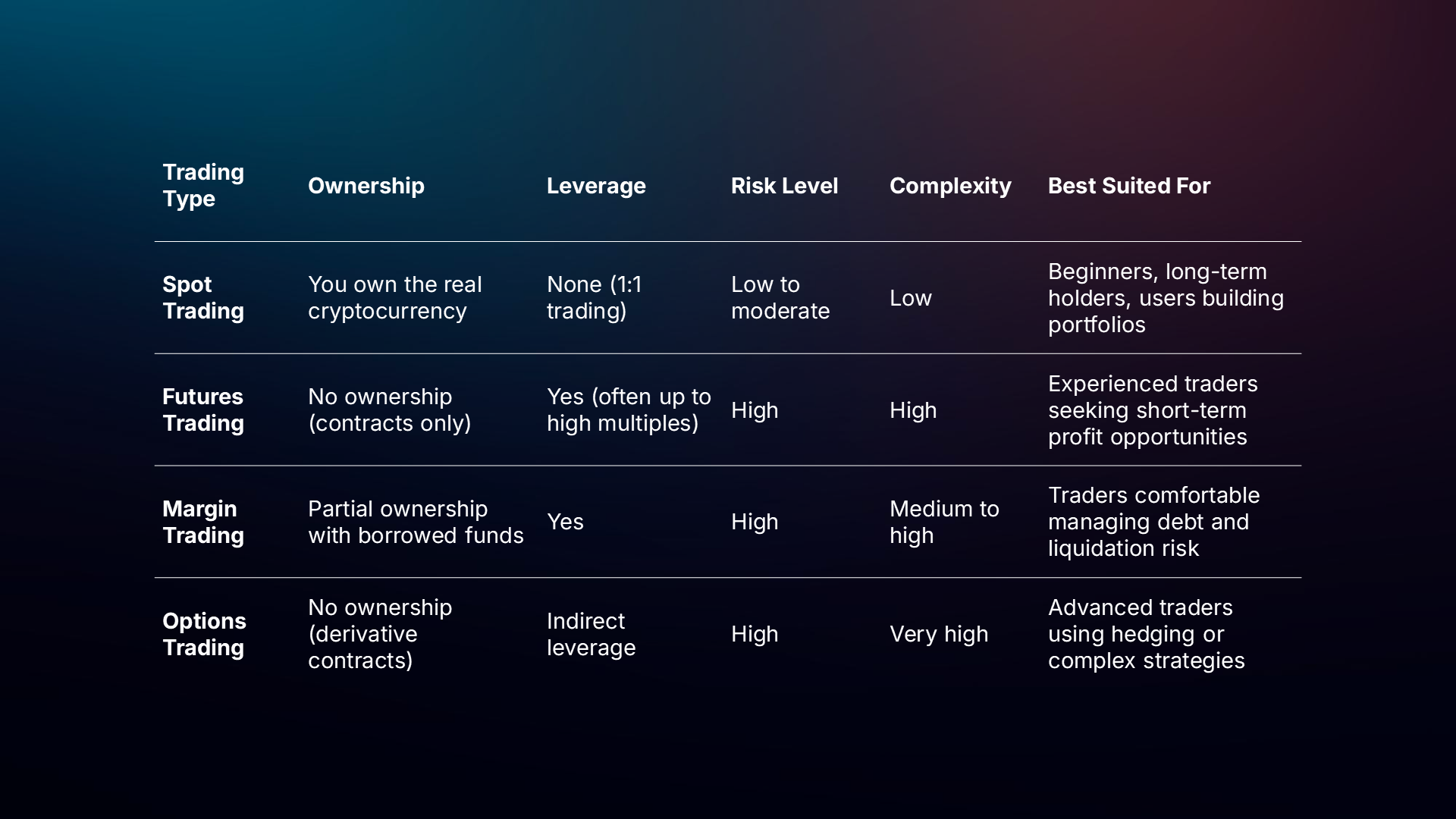
The table shows the difference between spot trading and three other popular options.
Final Thoughts on Spot Trading
So, what is spot trading? It is the process of swapping two assets at a precise moment on an exchange. It allows traders to transact at the live market price and gain access to crypto assets in a matter of seconds. Spot trading also opens the door to more advanced tools such as futures, while limit orders allow more experienced traders to base entries on market trends.
Get 3 Free Stock Ebooks
Discover top-performing stocks in AI, Crypto, and Technology with expert analysis.
- Top 10 AI Stocks - Leading AI companies
- Top 10 Crypto Stocks - Blockchain leaders
- Top 10 Tech Stocks - Tech giants



