



Key Takeaways
- Wells Fargo lowered its S&P 500 year-end projection from 7,800 down to 7,300 due to unanticipated Iran conflict risks
- Market pricing now reflects greater concern over war escalation than crude oil volatility, per the bank’s analysis
- Forward P/E multiples for the Nasdaq 100 have declined 29% from their recent highs
- The firm maintains earnings per share projections of $315 for 2026 and $365 for 2027
- Wells Fargo emphasizes it retains a positive long-term view on equities despite current headwinds
Wells Fargo strategist Ohsung Kwon has adjusted his S&P 500 price target downward to 7,300 from a previous 7,800 estimate. The adjustment comes as geopolitical tensions surrounding Iran introduce unforeseen market volatility.
Kwon explained that the escalating conflict wasn’t included in the firm’s original 2026 projections. The developing situation has introduced a risk element that wasn’t accounted for in earlier models.
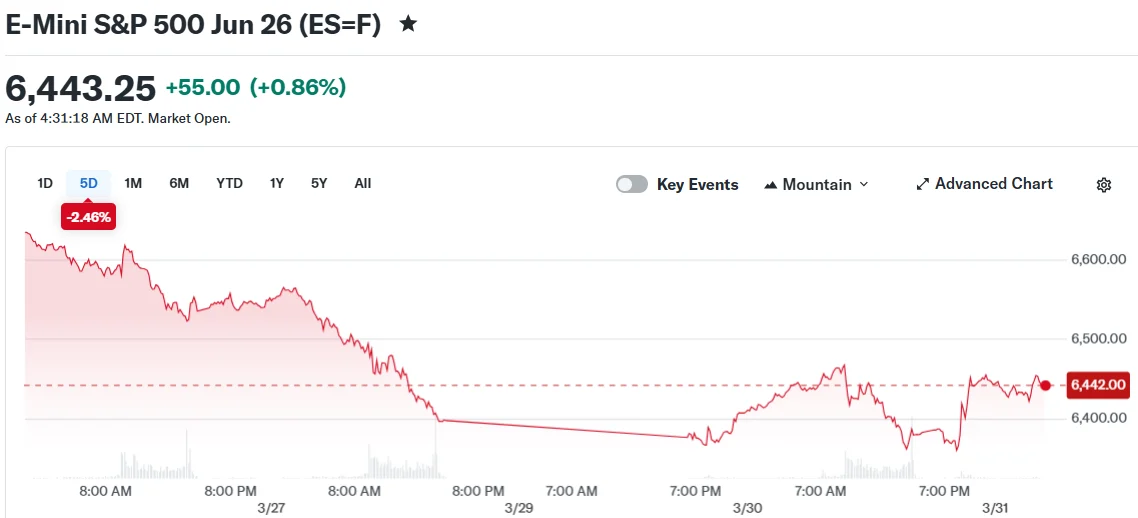
The S&P 500 currently sits near 6,343, representing a decline of approximately 7.7% for the year. Wells Fargo calculated its updated baseline using the average of closing prices from February 28 and March 30.
According to the bank’s proprietary war pricing analytics, an unprecedented pattern has emerged. Markets are now assigning more weight to direct conflict risk than to potential oil price disruptions.
The Nasdaq 100 has experienced a 29% compression in its forward price-to-earnings multiple from peak levels. Roughly one-third of companies within the S&P 500 are currently valued at least one standard deviation beneath their five-year historical averages.

Challenging Macro Environment Creates No-Win Scenario
Kwon characterized the present macroeconomic landscape as presenting a “lose-lose” dynamic in advance of critical economic releases. Robust economic indicators could reinforce the Federal Reserve’s restrictive monetary stance. Conversely, disappointing data might amplify stagflation concerns and trigger additional selling pressure.
The firm’s inventory-tracking framework has identified second-half inflation as an emerging threat. This model indicates building inflationary momentum compared to present readings.
Despite mounting short-term challenges, Wells Fargo maintains it hasn’t adopted a decisively negative stance. The bank’s PRSM framework — which evaluates Profits, Rates, Sentiment, and Macro factors — continues to indicate potential 14% gains over the coming year.
Earnings forecasts remain unchanged, with the bank projecting $315 per share for 2026 and $365 for 2027. Wells Fargo anticipates corporate profitability will prove durable despite increasing macroeconomic complexity.
Capital Flows Into Stocks Remain Positive
A notable observation from Kwon’s research: equity funds have continued receiving net inflows following the conflict’s outbreak. This pattern diverges from historical geopolitical disruptions that typically triggered capital flight.
Kwon interpreted this behavior as evidence that investors are implementing hedging strategies rather than liquidating positions. This suggests market participants expect any economic disruption to be temporary.
Additionally, March data showed analyst upgrades surpassing downgrades across the broader market. This trend reinforces continued optimism regarding corporate earnings performance despite the ongoing conflict.
Wells Fargo outlined five factors supporting its constructive long-term view. These include limited oil market disruption, valuation normalization, domestic energy self-sufficiency, robust free cash flow generation among major technology firms, and accelerating inventory restocking activity.
“We believe a lot has been priced into stocks already,” Kwon wrote. “However, other than a firm resolution, we don’t see many upside catalysts.”
The S&P 500 stands at 6,343 as of March 31, 2026, with the market down 7.7% year-to-date.
Get 3 Free Stock Ebooks
Discover top-performing stocks in AI, Crypto, and Technology with expert analysis.
- Top 10 AI Stocks - Leading AI companies
- Top 10 Crypto Stocks - Blockchain leaders
- Top 10 Tech Stocks - Tech giants



