


Key Highlights
- Tron’s Justin Sun publicly exposed what he calls a concealed blacklisting mechanism within World Liberty Financial’s smart contract code
- Sun alleges his wallet containing approximately $9 million in WLFI was restricted in September 2025 following a token transfer
- World Liberty Financial secured approximately $75 million in stablecoin loans against its native governance tokens
- WLFI’s price crashed to historic lows between $0.07–$0.08, representing a 21%+ decline over 30 days
- World Liberty Financial issued a legal threat to Sun, stating “See you in court pal”
Justin Sun, the founder of Tron, has leveled explosive allegations against World Liberty Financial, a cryptocurrency venture associated with the Trump family. According to Sun, the project covertly integrated backdoor capabilities into its token’s smart contract, granting administrators the power to blacklist, freeze, and control investor holdings without proper disclosure.
Sun positioned himself as “the first and single largest victim” of this alleged functionality. According to his account, administrators blacklisted his wallet in September 2025 immediately after he transferred approximately $9 million in WLFI tokens across different addresses. While he initially characterized the restriction as “unreasonable,” he now frames it as evidence of systematic abuse.
“What was never disclosed is that World Liberty embedded a backdoor blacklisting function in the smart contract,” Sun stated on X. He characterized it as “a trap door marketed as an open door.”
Sun initially committed $30 million to WLFI in the final months of 2024 and accepted an advisory position with the project. He subsequently expanded his holdings to approximately $75 million. The roughly 545 million WLFI tokens currently locked in his frozen wallet have depreciated by over $80 million since the freeze was implemented.
Sun further challenged the legitimacy of a March governance vote concerning token vesting schedules. He claimed that over 76% of voting power originated from merely 10 wallet addresses, suggesting “outcomes were predetermined.” He accused project leadership of deliberately concealing critical information from the voting community.
Controversy Surrounding WLFI’s $75 Million Lending Strategy
Independent of Sun’s allegations, World Liberty Financial has encountered significant criticism regarding its treasury management practices. Blockchain data reveals that the project deposited approximately 5 billion of its native WLFI tokens on Dolomite, a decentralized lending platform, as collateral to secure roughly $75 million in stablecoins, including USDC and USD1.

Notably, Dolomite co-founder Corey Caplan simultaneously holds the position of chief technology officer at WLFI. World Liberty Financial now accounts for approximately 55% of all assets supplied to Dolomite. The USD1 lending pool operates at roughly 93% utilization, triggering concerns about liquidity constraints.
Over $40 million of the borrowed capital was subsequently transferred to Coinbase Prime. WLFI defended its actions by describing itself as an “anchor” borrower that produces yield and ecosystem value. The project dismissed criticism as “FUD” and emphasized it remains “nowhere near liquidation.”
World Liberty Financial Issues Legal Warning to Sun
Within hours of Sun’s public statement, World Liberty Financial countered on X, dismissing his accusations as “baseless allegations to cover up his own misconduct.” The official account declared: “See you in court pal.”
Sun responded by challenging whoever controlled the account to reveal their identity rather than “hiding in the shadows.”
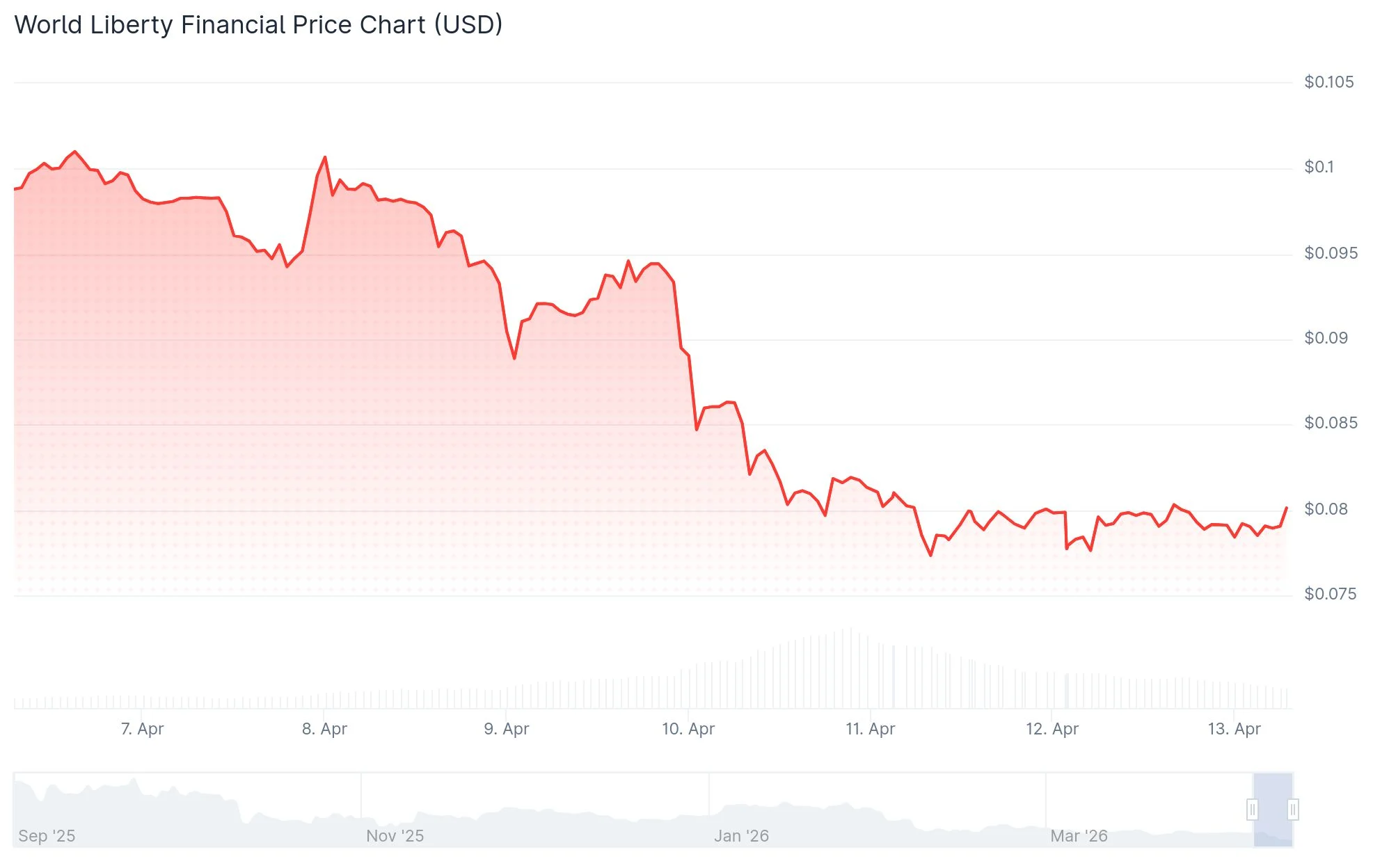
The WLFI token plummeted to a record low of $0.07 this week and currently hovers around $0.08. Its market capitalization stands at approximately $2.5 billion. Project representatives announced intentions to submit a governance proposal establishing a graduated unlock timeline for early retail participants, approximately 75% of whose tokens remain restricted.
During the first week of April, the team relocated 3 billion WLFI tokens, intensifying scrutiny of the project’s operational activities.
Get 3 Free Stock Ebooks
Discover top-performing stocks in AI, Crypto, and Technology with expert analysis.
- Top 10 AI Stocks - Leading AI companies
- Top 10 Crypto Stocks - Blockchain leaders
- Top 10 Tech Stocks - Tech giants



