



TLDR
- Military operations by the U.S. and Israel against Iran resulted in the death of Supreme Leader Khamenei and sparked concerns over major disruptions to oil supply through the Strait of Hormuz.
- Tehran has issued warnings to vessels against using the Strait, a passage that handles approximately 20–26% of worldwide crude oil and substantial LNG transport.
- Market analysts project Brent crude may hit $100 per barrel; extended hostilities could contribute 0.6–0.7 percentage points to worldwide inflation rates.
- Shipping company equities including Frontline and DHT Holdings have experienced significant gains this year, with freight rates reaching levels not seen in years.
- Bitcoin declined 2% and has dropped over 25% across two months, meanwhile gold, U.S. Treasuries, and the Swiss franc attract safe-haven capital.
Military strikes conducted by the United States and Israel against Iran on Saturday resulted in the death of Supreme Leader Ali Khamenei, immediately sending shockwaves through oil, equity, and cryptocurrency markets.
Iran’s Islamic Revolutionary Guard Corps issued advisories warning vessels to avoid transiting the Strait of Hormuz in the aftermath of the military action. This narrow waterway facilitates the movement of roughly 26% of worldwide crude oil shipments and 23% of global liquefied natural gas trade.
Brent crude closed Friday’s session near $73 per barrel, having already appreciated approximately 20% year-to-date. Market strategists anticipate further price appreciation when trading resumes Sunday evening.
Barclays analysts project Brent could surge to $100 per barrel as traders assess the potential for significant supply constraints. Capital Economics suggests that even a limited engagement could drive prices toward the $80 threshold.
Iran’s daily production stands at approximately 3.3 to 3.5 million barrels, representing roughly 3% of worldwide output. The country’s primary export facility at Kharg Island processes around 90% of these shipments, with reports indicating explosions have occurred in that vicinity.

Qatar’s entire LNG export volume, constituting approximately 20% of global LNG maritime trade, must pass through the Strait. No alternative shipping route exists. A complete closure would compel Asian purchasers to vie with European buyers for U.S. spot market cargoes.
Goldman Sachs research indicates that removing one million barrels daily of Iranian exports for twelve months would elevate prices by roughly $8 per barrel. Rystad Energy forecasts price increases of $10 to $15 per barrel should the conflict expand.
Shipping Stocks Surge on Rate Expectations
Tanker equities have already incorporated substantial risk premium. Frontline has climbed 74% in 2026, DHT Holdings has advanced 60%, and Ardmore Shipping has appreciated 55%. The S&P 500 has gained merely 0.5% during the identical timeframe.
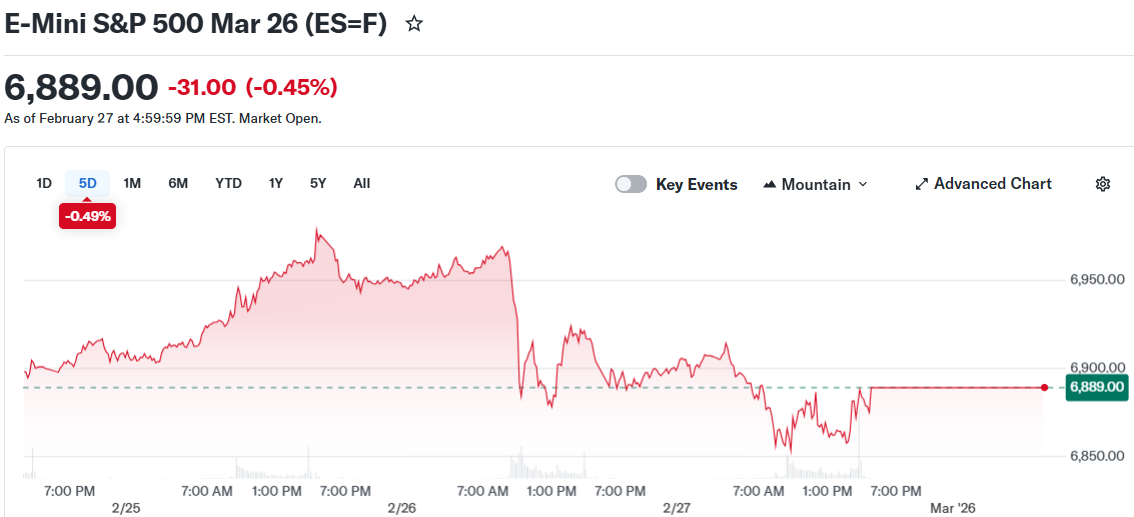
Frontline disclosed that it secured 92% of its first-quarter VLCC spot days at an average daily rate of $107,100. Evercore analyst Jonathan Chappell upgraded his price target on the equity to $42 from $31.
During the 1991 Gulf War, very large crude carrier rates jumped more than 40%. Throughout the second Gulf War, they surged as much as 304%.
Bitcoin Drops While Gold and Treasuries Draw Buyers
Bitcoin decreased 2% on Saturday and has now declined more than 25% over the previous two months. Market observers indicate it has lost its status as a safe-haven instrument.
Gold has appreciated 22% in 2026 and continues attracting additional demand. The Swiss franc has strengthened 3% against the U.S. dollar year-to-date. U.S. Treasury yields have been declining in recent weeks.
The VIX volatility index has increased by one-third this year. Several major oil companies and commodity trading firms have already halted crude shipments through the Strait of Hormuz.
Get 3 Free Stock Ebooks
Discover top-performing stocks in AI, Crypto, and Technology with expert analysis.
- Top 10 AI Stocks - Leading AI companies
- Top 10 Crypto Stocks - Blockchain leaders
- Top 10 Tech Stocks - Tech giants



