


TLDR
- SOL continues trading around $77 following a dip to $75.80, breaking through important support zones
- Futures open interest declined approximately 2% to $5.09 billion as funding rates shifted into negative territory
- Just 20% of Solana wallet addresses remain profitable — marking the weakest reading since the end of 2023
- Staked SOL now represents 67% of total supply, creating supply constraints
- Corporate treasuries control more than $1.3 billion in SOL tokens, limiting available circulation
Solana (SOL) continues hovering near $77 following a recent drop to $75.80, marking a six-week consecutive decline that has dragged the token significantly below its early 2026 peak around $95.
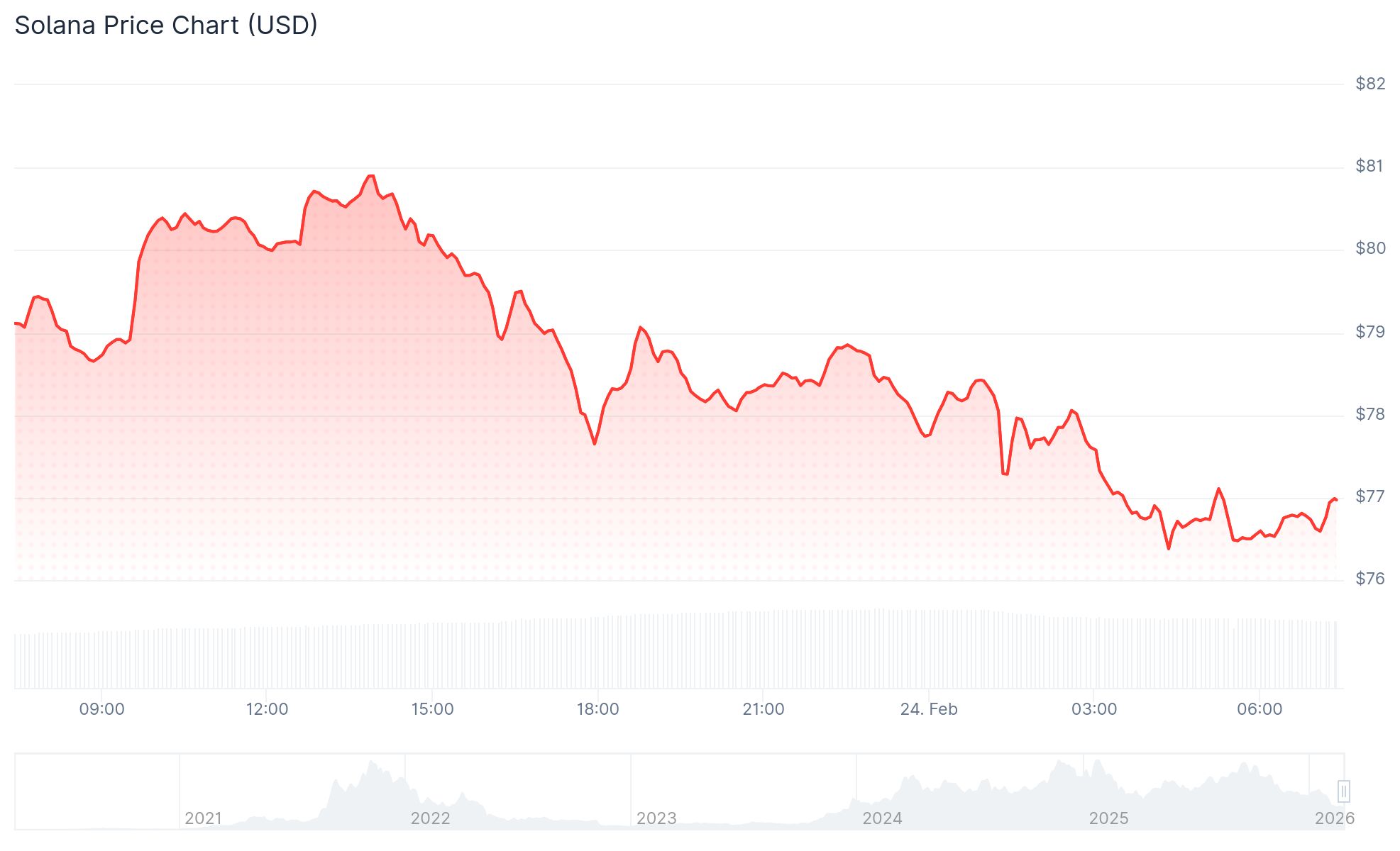
The downward pressure has remained consistent. SOL has breached critical technical support zones, while market metrics indicate increasing trader hesitation.
Futures open interest for Solana contracted by roughly 2% to approximately $5.09 billion, despite a notable surge in trading volume. This pattern often indicates forced position closures rather than fresh capital entering the market.
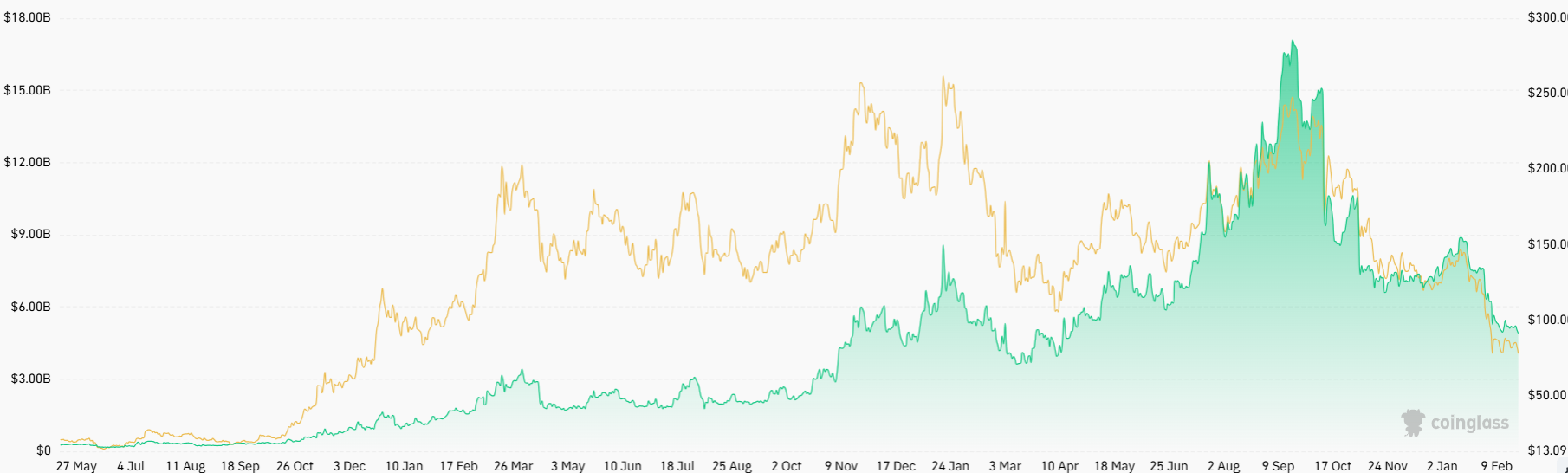
Funding rates have shifted negative. The ratio of long-to-short positions has fallen under 1. These metrics indicate that more market participants are anticipating additional downside rather than an imminent bounce.
Larger trading accounts have established short positions, while retail participants on platforms like Binance and OKX maintain leveraged long exposure. This positioning mismatch increases the potential for heightened volatility should current support zones fail.

Blockchain Metrics Show Growing Concern
Glassnode’s on-chain analytics reveal that merely 20% of Solana wallet addresses currently hold unrealized gains. This represents the weakest profitability metric since the closing months of 2023.
Historically, comparable profitability levels have emerged during capitulation phases throughout previous bear cycles, although market observers warn this doesn’t automatically confirm a price floor.
Accumulation by long-term holders, which was evident during the early part of the year, has decelerated since SOL dropped beneath $100. This suggests weakening confidence among buyers who previously absorbed selling pressure during earlier pullbacks.
Technical momentum indicators continue trending downward. RSI measurements approach oversold levels, reflecting persistent distribution rather than emerging reversal signals.
Restricted Supply May Play a Role Eventually
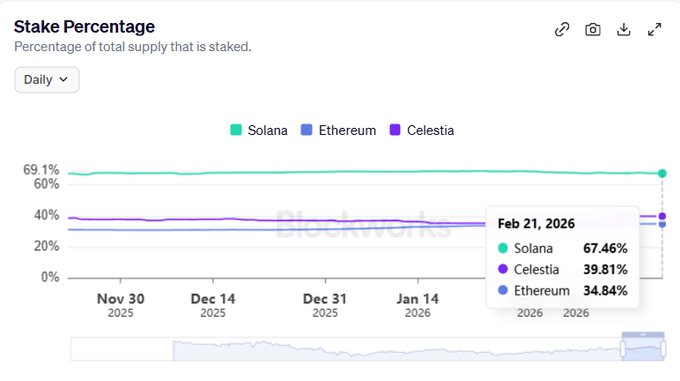
Despite current price weakness, Solana’s supply dynamics have contracted. Data from February 23 shows 67% of total SOL supply is currently staked, representing a substantial portion held by committed long-term participants.
Corporate treasury holdings have also grown beyond $1.3 billion in SOL value, removing additional tokens from available circulation.
When such a significant supply portion becomes locked, the remaining liquid tokens become increasingly scarce. Historical market cycles demonstrate that constrained supply combined with renewed demand can trigger rapid price movements.
This dynamic hasn’t materialized yet. Market analysts suggest broader cryptocurrency market stabilization and improved macroeconomic clarity are necessary prerequisites before supply constraints can influence price action meaningfully.
Currently, market participants are monitoring support between $75 and $67. A decisive break below this zone could expose price levels around $62 or potentially $60.
Regarding upside potential, SOL encounters resistance between $82 and $83, where a descending trend line has developed. Presently, SOL trades at approximately $77, marginally above its recent $75.80 floor.
Get 3 Free Stock Ebooks
Discover top-performing stocks in AI, Crypto, and Technology with expert analysis.
- Top 10 AI Stocks - Leading AI companies
- Top 10 Crypto Stocks - Blockchain leaders
- Top 10 Tech Stocks - Tech giants



