


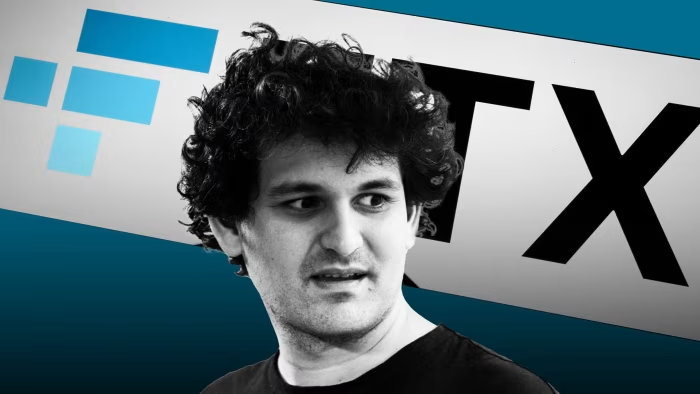
Key Points
- Sam Bankman-Fried abandoned his Rule 33 motion seeking a new trial in New York federal court.
- The former FTX chief expressed doubts about receiving an impartial hearing from Judge Lewis Kaplan.
- He requested withdrawal without prejudice, preserving the option to refile following his direct appeal.
- A federal jury found him guilty in November 2023 on seven fraud-related charges connected to FTX.
- Judge Kaplan imposed a 25-year prison sentence after the guilty verdict.
Sam Bankman-Fried formally withdrew his motion for a new trial in federal court this Wednesday. He communicated to Judge Lewis Kaplan his belief that an impartial hearing would be unlikely. This decision redirects attention to his ongoing direct appeal in New York.
FTX Founder Abandons Rule 33 Motion Strategy
Sam Bankman-Fried submitted a formal letter to the U.S. District Court for the Southern District of New York. The document requested withdrawal of his Rule 33 motion without prejudice. He indicated potential plans to resubmit the motion following the conclusion of his direct appeal.
His letter explained that he had concentrated on addressing the judge’s earlier questions. Those inquiries centered on whether his legal counsel had prepared the Rule 33 motion. This focus, he argued, constrained his capacity to counter the government’s opposition arguments.
He communicated to the court, “I do not believe I will get a fair hearing on this topic in front of you.” As a result, he sought withdrawal pending decisions on his appeal and reassignment motions. He stressed his intention to maintain the right to refile at a later time.
His mother, Barbara Fried, filed the pro se motion on his behalf in March. He had previously submitted a direct appeal in November requesting a new trial. The appellate court has yet to issue a ruling on that matter.
He clarified that he personally conceived and drafted multiple versions of the motion. He performed legal research while detained in Brooklyn. He confirmed he proceeded without consulting his attorney before filing.

He noted that he shared preliminary drafts with his parents. He added, “They made editorial and organizational suggestions, some of which I incorporated.” He also mentioned their assistance with printing the document due to restricted prison resources.
Fraud Conviction, Prison Term, and Appellate Process
A New York jury delivered a guilty verdict against Bankman-Fried in November 2023. The panel convicted him on seven fraud-related counts. Federal prosecutors charged him with defrauding FTX customers, creditors, and equity investors.
Prosecutors characterized the case as among the most significant financial frauds in modern history. They drew parallels between his conduct and that of Bernie Madoff. They claimed he misappropriated billions of dollars belonging to customers.
Bankman-Fried established FTX along with the trading firm Alameda Research. Federal authorities identified Alameda as crucial to the fraudulent scheme. They maintained that he orchestrated fund transfers designed to hide financial losses.
Judge Kaplan imposed a 25-year prison sentence in March 2024. He commenced serving his term immediately following the judgment. He currently remains confined in a federal detention facility in Brooklyn.
Throughout the trial, Judge Kaplan challenged numerous defense strategies. Defense attorneys attempted to redirect some responsibility toward FTX’s legal team. The judge, however, demonstrated doubt during those courtroom exchanges.
Bankman-Fried additionally pursued clemency from President Donald Trump. In January, Trump publicly stated he had no intention of granting a pardon. The retrial motion now stands withdrawn while appellate review continues.
Get 3 Free Stock Ebooks
Discover top-performing stocks in AI, Crypto, and Technology with expert analysis.
- Top 10 AI Stocks - Leading AI companies
- Top 10 Crypto Stocks - Blockchain leaders
- Top 10 Tech Stocks - Tech giants



