


Key Highlights
- Shares of QCOM advanced 5.3% during early Thursday trading following a premarket spike exceeding 10%
- The chipmaker elevated its fiscal 2029 non-handset revenue forecast to $40 billion, representing nearly twice its prior projection
- Meta Platforms will deploy Qualcomm’s Dragonfly C1000 CPUs starting in 2028; Microsoft Azure plans to implement its HBC chip design beginning mid-2027
- The company disclosed a $3.9 billion purchase of AI software firm Modular
- Wall Street price objectives spanned from $190 (Susquehanna) to $300 (Benchmark), featuring varied ratings
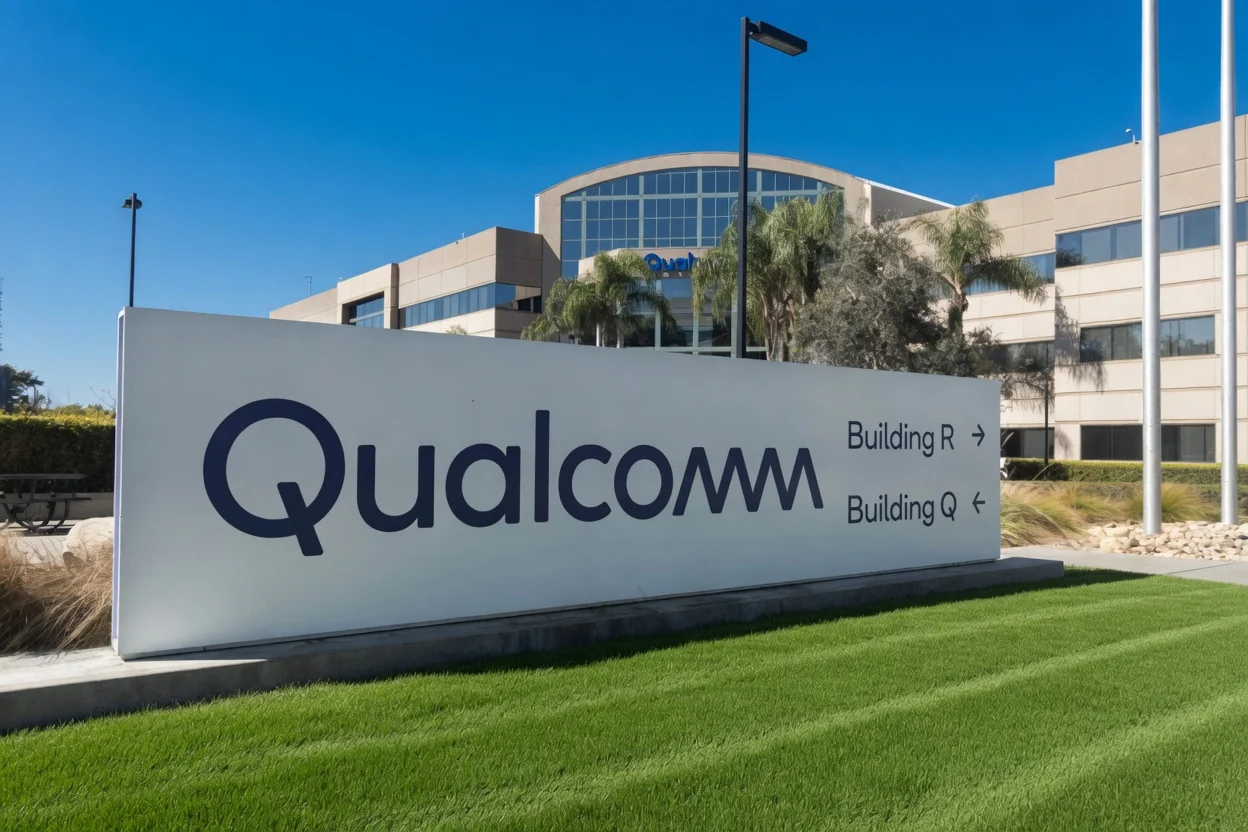
Shares of Qualcomm rallied Thursday after the semiconductor manufacturer disclosed the identities of two major data-center partners — Meta Platforms and Microsoft — while simultaneously increasing its long-term revenue projections by nearly double.
QCOM traded up 5.3% during early Thursday sessions, following a premarket jump of more than 10%. Shares had already gained approximately 12% in after-hours activity Tuesday after Qualcomm’s Investor Day presentation.
During that investor presentation, Qualcomm disclosed that Meta will integrate its Dragonfly C1000 CPUs upon their 2028 release. Meanwhile, Microsoft’s Azure cloud platform will implement Qualcomm’s High Bandwidth Compute (HBC) chip design, scheduled to debut in mid-2027.
Qualcomm CFO Akash Palkhiwala explained to Barron’s that the HBC chip integrates logic and memory elements to provide superior performance and bandwidth while maintaining energy efficiency.

According to the company, each hyperscale custom-silicon agreement is projected to produce over $1 billion in revenue by fiscal 2027.
Qualcomm elevated its fiscal 2029 non-handset revenue projection to $40 billion, compared to the previous $22 billion estimate. Data-center revenue alone is anticipated to reach $15 billion by that fiscal year.
Strategic Shift Beyond Mobile Devices
Handset sales currently represent 72% of Qualcomm’s fiscal 2025 revenue. The company projects this proportion will decline to merely one-third by fiscal 2029 as it accelerates expansion into data centers and artificial intelligence.
“While we’re coming in late, we’re coming in with technology advantages and something unique that solves the problems that these companies have,” Palkhiwala said.
Supporting this strategic transition, Qualcomm unveiled a $3.9 billion acquisition of Modular, an AI infrastructure software provider. Modular has developed an AI programming language designed to compete with Nvidia’s dominant CUDA platform.
“The entire strategy here is to have an industry standard stack that is completely open source that can be deployed by any customers, on Qualcomm chips, but also on competitive chips,” Palkhiwala said.
Qualcomm additionally revealed an enhanced collaboration with Hugging Face to accelerate AI innovation across data center and AI storage systems.
Wall Street’s Response
Benchmark elevated its price objective to $300 from $225, representing the highest analyst target, while maintaining a Buy rating. The firm noted Qualcomm had effectively redirected investor attention from handset-cycle concerns toward edge-to-cloud AI infrastructure opportunities.
Morgan Stanley upgraded QCOM from Underweight to Equalweight, increasing its target to $231, referencing robust fiscal 2027 data-center revenue projections.
Susquehanna increased its target to $190 from $160 while maintaining a Neutral rating, highlighting “headwinds in the mobile market.”
Bank of America lifted its target to $220 from $195 but retained an Underperform rating. BofA recognized the improved guidance yet contended the stock “already embeds meaningful data center success” and identified risks surrounding unproven custom silicon production ramps.
Cantor Fitzgerald similarly increased its target to $220, maintaining a Neutral rating.
KeyCorp analyst John Vinh remained at Sector Weight, noting “it’s early days” despite targets surpassing expectations.
BofA additionally identified an Apple QTL renewal risk as a potential high-margin concern.
Get 3 Free Stock Ebooks
Discover top-performing stocks in AI, Crypto, and Technology with expert analysis.
- Top 10 AI Stocks - Leading AI companies
- Top 10 Crypto Stocks - Blockchain leaders
- Top 10 Tech Stocks - Tech giants



