



Key Highlights
- Reports indicate OpenAI might postpone its public market debut until 2027, creating headwinds for technology equities and artificial intelligence sector enthusiasm.
- Semiconductor stocks declined as escalating memory component pricing pressures device manufacturers, following Apple’s recent price increases for MacBooks and iPads.
- The Nasdaq Composite experienced a 1% intraday decline before bouncing back, while the Dow Jones and S&P 500 moved into positive territory.
- Consumer confidence improved to 49.5 in June from the prior month’s 44.8, despite over half of survey respondents citing elevated prices as a financial burden.
- Crude oil prices retreated approximately 3%, with Brent crude declining to roughly $73 per barrel amid developments in the Strait of Hormuz region.
Equity markets experienced significant volatility during Friday’s trading session. The Nasdaq Composite initially tumbled as much as 1% before mounting a recovery to finish nearly unchanged. The S&P 500 managed a modest 0.1% advance, while the Dow Jones Industrial Average also posted slight gains following early-session weakness.
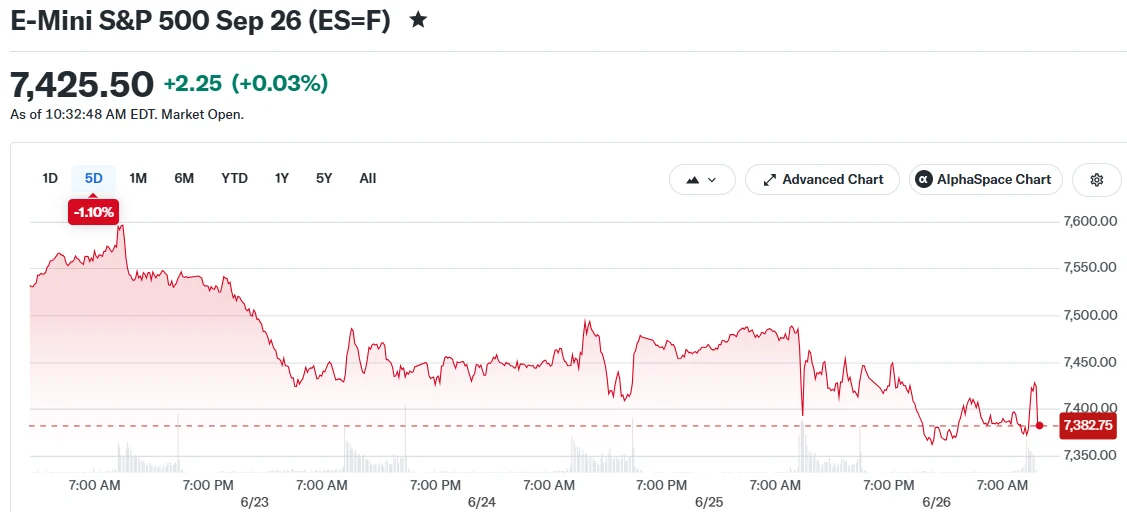
The trading week proved challenging for major benchmarks. Both the Nasdaq Composite and S&P 500 had registered consecutive losses over the previous four sessions before Friday’s action.
OpenAI’s Public Market Debut Potentially Delayed to 2027
According to a New York Times report, [[LINK_START_2]]OpenAI[[LINK_END_2]] is reportedly evaluating a postponement of its highly anticipated initial public offering until 2027. The news weighed on technology sector performance and cooled investor sentiment surrounding artificial intelligence opportunities.
Momentum in AI-related investments had already been moderating. Market participants are increasingly pricing in the possibility that the Federal Reserve might implement interest rate increases this year, a scenario typically unfavorable for growth-focused technology companies.
The latest Personal Consumption Expenditures index reading — the central bank’s favored inflation gauge — showed elevated levels for May. This development maintained the viability of potential rate hikes in policy discussions.

Semiconductor Sector Faces Headwinds
Memory chip manufacturer Micron delivered solid quarterly results, yet the figures highlighted persistent cost challenges affecting the industry. Apple’s recent decision to increase pricing on MacBook and iPad products has been attributed by market analysts to surging costs for memory and storage components.
These dynamics triggered broader concerns throughout the semiconductor industry. Market participants are apprehensive that elevated component pricing could pressure device manufacturers and create negative ripple effects across supply chains.
Chip-related equities were among Friday’s weakest performers, contributing substantially to the Nasdaq’s downward pressure.
Consumer Confidence Shows Modest Improvement
The University of Michigan’s consumer sentiment gauge climbed to 49.5 in June, up from May’s reading of 44.8. Inflation expectations for the coming twelve months edged lower to 4.6% from the previous 4.8%.
Survey director Joanne Hsu emphasized that price levels remain a primary concern for Americans. “For the third consecutive month, more than half of consumers voluntarily mentioned that elevated prices are negatively impacting their household finances,” she stated.
The sentiment data contributed to a partial recovery in major equity benchmarks. The Dow Jones advanced 83 points, or 0.2%, following the report’s release.
Crude Oil Retreats on Middle East Developments
Oil markets experienced approximately 3% declines on Friday. Brent crude settled near $73 per barrel, while West Texas Intermediate traded beneath the $70 threshold.
The United States and Iran have reached agreement on a 60-day cessation of hostilities. Tanker vessels have maintained passage through the Strait of Hormuz following a recent incident involving a container ship. Iranian authorities are reportedly exploring the implementation of transit fees for vessels using the strategic waterway.
Treasury yields and the U.S. dollar both weakened following the PCE inflation data, as concerns about accelerating price pressures moderated somewhat before the weekend.
Get 3 Free Stock Ebooks
Discover top-performing stocks in AI, Crypto, and Technology with expert analysis.
- Top 10 AI Stocks - Leading AI companies
- Top 10 Crypto Stocks - Blockchain leaders
- Top 10 Tech Stocks - Tech giants



