


Key Points
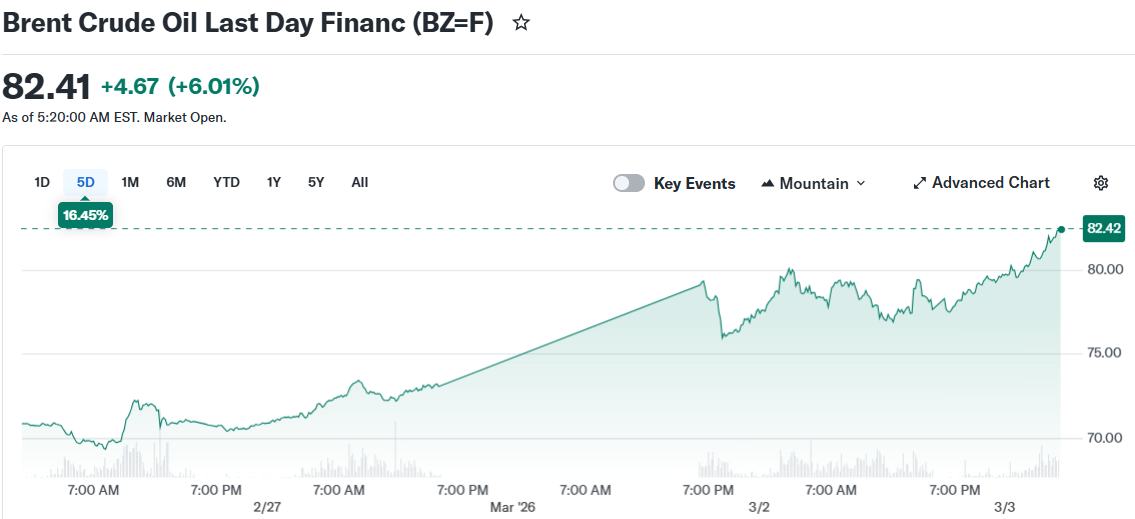
- Brent crude surged past $80 per barrel while WTI reached $73 following coordinated US-Israel military operations against Iran that resulted in Supreme Leader Khamenei’s death.
- Iranian authorities issued threats to block the Strait of Hormuz, effectively stopping tanker movement through the critical waterway responsible for 20% of worldwide oil shipments.
- Major energy facilities including Saudi Aramco’s Ras Tanura refinery and Qatar’s primary LNG plant ceased operations after sustaining drone and missile attacks.
- JPMorgan analysts cautioned that Persian Gulf oil producers may need to curtail production within approximately 25 days if the strait blockade continues.
- OCBC Bank projected Brent could exceed $100 per barrel under worst-case conditions; Washington indicated forthcoming measures to address rising energy expenses.
Energy markets experienced dramatic volatility this week following a coordinated military operation by the United States and Israel against Iran during the weekend that claimed the life of Supreme Leader Ayatollah Ali Khamenei.
Brent crude futures pushed beyond the $80 per barrel threshold on Tuesday, extending Monday’s 7% rally. West Texas Intermediate hovered around $73 per barrel.
In retaliation, Iran declared its intention to shut down the Strait of Hormuz, the narrow maritime passage along its coastline through which approximately 20% of global seaborne petroleum and comparable volumes of liquefied natural gas transit daily.
Tehran announced that military forces would engage any vessel trying to navigate the strategic waterway. Maritime traffic through this critical chokepoint has essentially ground to a halt.
The military escalation expanded rapidly beyond the initial assault. Iranian forces launched two drone strikes targeting the American embassy compound in Riyadh, Saudi Arabia, resulting in limited structural damage and a minor blaze.

Saudi Aramco suspended operations at its Ras Tanura processing facility after a drone attack in the vicinity. Qatar halted production at the planet’s largest liquefied natural gas export terminal following an Iranian assault on the installation.
Israeli forces maintained aerial bombardment campaigns in Lebanon directed at Hezbollah positions. The Leviathan natural gas extraction project situated off Israel’s Mediterranean coast also paused production activities.
Market Expert Analysis
JPMorgan’s research team issued warnings that the Strait of Hormuz has become functionally impassable and that regional Gulf producers may face forced well shutdowns within roughly 25 days as regional storage capacity reaches maximum levels.
Freight rates for crude shipments from Middle Eastern ports to Chinese destinations reached unprecedented levels on Monday. Daily charter earnings on the standard route soared to $424,000, based on Baltic Exchange tracking data.
OCBC Bank analysts projected Brent prices could breach the $100 per barrel mark should the Hormuz obstruction prove persistent. The institution noted that OPEC’s unused production capacity might provide cushioning under baseline scenarios that don’t involve extended closure periods.
ING’s analytical team identified the greater threat as potential Iranian attacks on additional regional energy infrastructure, which would likely generate more sustained supply interruptions than partial strait disruptions.
CMC Markets’ chief market strategist indicated that heightened risk premiums across energy commodities will probably persist until concrete signs of conflict de-escalation emerge or alternative transportation corridors become operational.
Washington’s Position and International Efforts
Secretary of State Marco Rubio indicated the military operations would expand in scope, concentrating on eliminating Iran’s naval capabilities, unmanned aerial vehicle stockpiles, and ballistic missile arsenal.
Rubio further stated that the administration would unveil strategies designed to mitigate escalating energy expenses affecting American consumers, with implementation beginning Tuesday.
The Trump White House confirmed no immediate intention to draw down the Strategic Petroleum Reserve. Officials noted that any SPR deployment would likely occur in partnership with fellow International Energy Agency member nations.
The United Arab Emirates and Qatar are engaging in quiet diplomatic efforts with allied governments to encourage President Trump toward brief, targeted military action against Iran instead of protracted engagement.
China, which imports more crude oil than any other nation, appealed to all involved parties to guarantee secure passage through the Strait of Hormuz and demanded an immediate cessation of armed hostilities.
Get 3 Free Stock Ebooks
Discover top-performing stocks in AI, Crypto, and Technology with expert analysis.
- Top 10 AI Stocks - Leading AI companies
- Top 10 Crypto Stocks - Blockchain leaders
- Top 10 Tech Stocks - Tech giants



