


TLDR
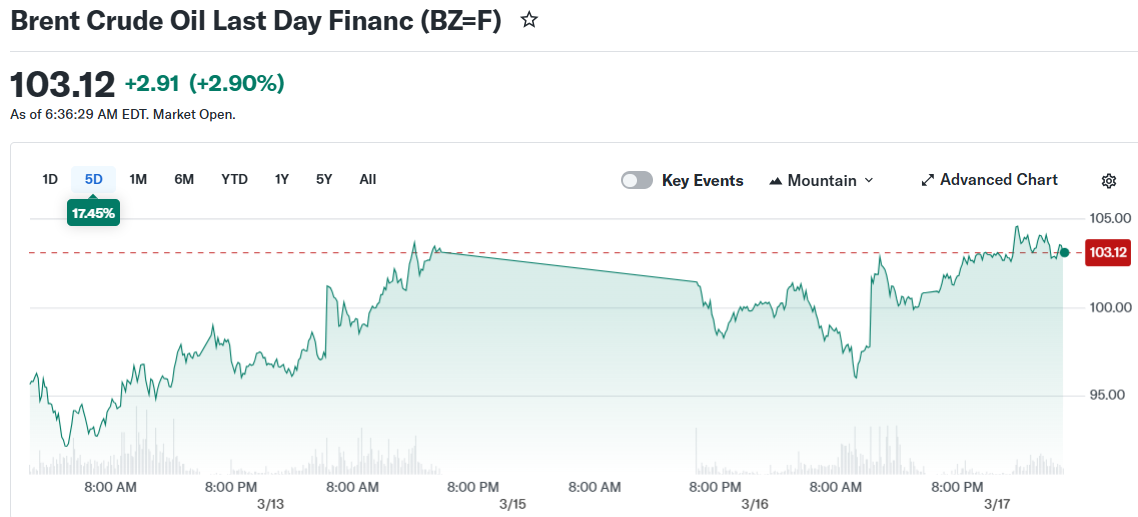
- Brent crude surged past $104 per barrel while WTI approached $97 amid ongoing Iranian attacks on regional energy facilities
- UAE’s Shah gas field operations were suspended and Fujairah port crude loadings came to a halt
- Approximately 20% of worldwide oil supply remains threatened as the Strait of Hormuz blockade continues
- Energy prices have surged over 40% in the three weeks since hostilities commenced
- The Fed, ECB, and Bank of Japan convene this week amid mounting concerns over energy-fueled inflation
Crude oil markets experienced another significant rally Tuesday following a temporary decline, as the three-week-old conflict involving the United States, Israel, and Iran shows no indication of de-escalation.
Brent crude exceeded the $104 per barrel threshold while West Texas Intermediate approached $97. These gains came after both benchmarks declined approximately 3-5% during Monday’s session.
Tehran persisted in targeting energy facilities throughout the Middle East. Operations at the United Arab Emirates’ Shah gas field were temporarily suspended. An Iraqi oil production facility also sustained damage from drone and missile strikes.
According to Inchcape Shipping Services reports, crude oil loading activities at Fujairah port in the UAE were suspended once more. Both the UAE and Kuwait have implemented additional production cuts in response to the continued assaults.
Oil prices have climbed more than 40% since hostilities erupted, despite Monday’s decline following Washington’s announcement of an initial release from strategic petroleum reserves.

Strait of Hormuz at the Center of the Crisis
The strategically vital Strait of Hormuz, through which approximately one-fifth of global oil supplies transit, continues to face severe disruptions. Iranian forces effectively restricted passage through the critical waterway earlier this month.
Monday brought limited progress when gas tankers registered in India and Pakistan successfully navigated the passage. Tehran has indicated it will grant passage to vessels from select nations while interdicting ships associated with the United States and allied countries.
According to JPMorgan analysts, passage through the waterway is expected to become “increasingly conditional,” with Iranian authorities granting access based on vessel registry and national connections.
Several vessels have completed transit using an unconventional route running unusually near to Iranian territorial waters, according to ship-tracking information from Bloomberg.
Riyadh is accelerating efforts to expand crude exports via an alternative pipeline system that completely circumvents the Hormuz chokepoint.
US President Donald Trump appealed to no fewer than seven nations, including China, to assist in reopening the strategic waterway. These diplomatic overtures met with limited success. Trump has warned of expanded military operations targeting Kharg Island’s Iranian oil infrastructure, despite previously avoiding energy-related targets.
Treasury Secretary Scott Bessent confirmed to CNBC that Washington is permitting Iranian crude shipments to continue through the strait and has refrained from intervening in energy derivatives trading.
Inflation Fears Weigh on Global Markets
The dramatic escalation in petroleum prices has intensified concerns regarding energy-driven inflationary pressures. Multiple major central banking institutions, including the Federal Reserve, European Central Bank, and Bank of Japan, are scheduled to convene this week.
Numerous Asian economies face particular vulnerability due to heavy reliance on petroleum imports transiting through Hormuz, amplifying regional concerns about the ongoing disruption.
Israeli authorities announced Tuesday they eliminated high-ranking Iranian officials, including security apparatus chief Ali Larijani. Tehran had not verified these claims by Tuesday evening.
The volume of Iranian-flagged vessels transiting the waterway reached wartime peaks Monday, including a crude tanker bound for Chinese ports, according to Bloomberg maritime tracking data.
Remember: Preserve all tokens like [[EMBED_0]], [[IMG_0]], [[LINK_START_0]], [[LINK_END_0]], [[SCRIPT_0]], [[FIGURE_0]] etc. exactly as they appear. These are placeholders for embeds, images, and links that must not be changed.
Get 3 Free Stock Ebooks
Discover top-performing stocks in AI, Crypto, and Technology with expert analysis.
- Top 10 AI Stocks - Leading AI companies
- Top 10 Crypto Stocks - Blockchain leaders
- Top 10 Tech Stocks - Tech giants



