


Key Takeaways
- NEAR Protocol focuses on “chain abstraction” technology that enables seamless cross-blockchain interactions without technical barriers
- The NEAR Intents framework allows users to specify desired outcomes while competitive solvers execute transactions
- On-chain metrics show legitimate but moderate usage when benchmarked against leading crypto platforms
- Token economics have evolved with reduced inflation rates and enhanced fee structures, though no maximum supply exists
- The competitive landscape extends beyond traditional Layer 1 networks to include middleware solutions and wallet infrastructure
NEAR Protocol has positioned itself distinctly from typical high-speed blockchain platforms. Rather than competing solely on transaction throughput or cost efficiency, the project emphasizes chain abstraction — a framework designed to enable users to interact with multiple blockchain networks without confronting underlying technical complexities.
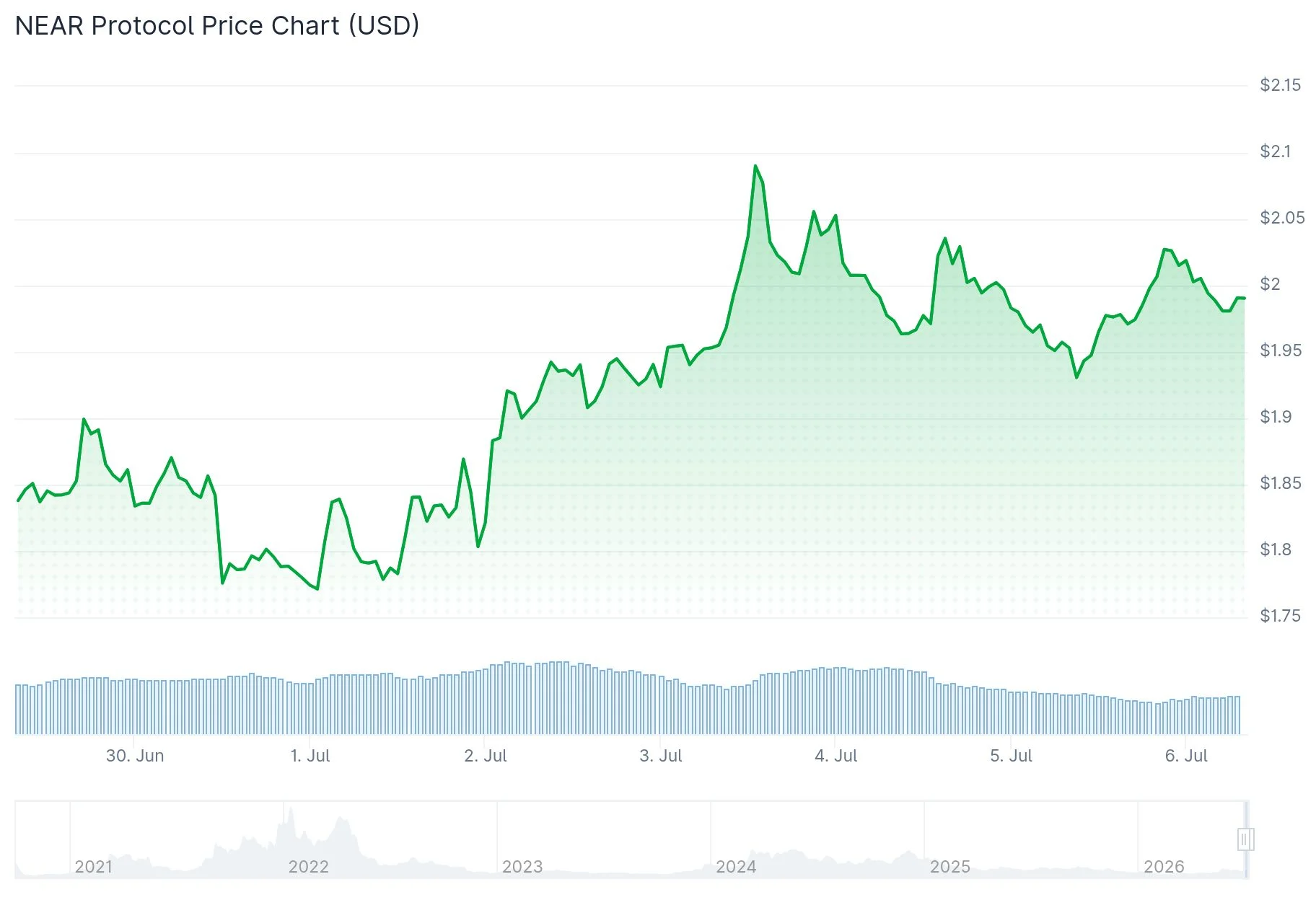
This strategic positioning distinguishes NEAR from conventional Layer 1 competitors who primarily emphasize performance metrics.
The fundamental premise addresses blockchain fragmentation. Current crypto infrastructure requires users to navigate disparate wallets, bridge protocols, and ecosystem-specific tools. NEAR aims to abstract these complications, creating unified experiences for both end users and application developers.
Understanding the NEAR Intents Architecture
Central to this abstraction strategy is the NEAR Intents system. This mechanism shifts away from manual cross-chain asset management toward intent-based interactions. Users simply declare their desired end state, triggering a competitive marketplace where solvers bid to execute the most efficient path.
This architecture resembles internet service layers more than traditional blockchain infrastructure. Successful implementation at scale could provide NEAR with meaningful differentiation in an increasingly saturated market.

Additionally, the project has integrated AI agent functionality, developing infrastructure that enables autonomous agents to orchestrate multi-chain operations. This positions NEAR at the intersection of two significant industry narratives.
Evaluating Token Economic Drivers
For NEAR token holders, the critical consideration remains whether the protocol’s technical vision translates into token value accrual. Currently, protocol fees remain relatively modest. Stablecoin liquidity exists at meaningful levels without dominating the ecosystem. Decentralized exchange volume shows activity but doesn’t rank among market leaders.
This distinction matters because sustainable token appreciation typically requires demonstrable, ongoing demand generated by genuine network utility.
NEAR’s token economics have undergone refinement. While circulating supply remains substantial, inflation rates have decreased, and fee capture mechanisms have been enhanced compared to earlier iterations. However, NEAR lacks Bitcoin’s fixed supply cap. Persistent token demand must therefore originate from actual protocol utilization.
Navigating a Complex Competitive Environment
NEAR faces competition extending beyond major networks like Ethereum or Solana. The protocol contends with middleware platforms, solver networks, and wallet infrastructure providers — all addressing the same user experience challenges.
This expanded competitive terrain differs from typical Layer 1 dynamics. NEAR must execute successfully across multiple strategic dimensions simultaneously.
The protocol’s substantial circulating supply indicates that investors aren’t entering at an early discovery phase. Current market valuation reflects an established project with expectations already partially priced in.
Presently, NEAR represents a protocol with well-defined product strategy, evolving token economics, and genuine though moderate blockchain activity.
Get 3 Free Stock Ebooks
Discover top-performing stocks in AI, Crypto, and Technology with expert analysis.
- Top 10 AI Stocks - Leading AI companies
- Top 10 Crypto Stocks - Blockchain leaders
- Top 10 Tech Stocks - Tech giants



