


Key Takeaways
- Morgan Stanley’s Michael Wilson believes the S&P 500 has reached its bottom and won’t fall to new lows
- A dual-pronged investment approach is advised: combine cyclical sectors with high-quality growth stocks like the Magnificent 7
- Crude oil pricing has emerged as the primary market catalyst, per strategist Serena Tang
- Morgan Stanley maps out three potential oil trajectories: stabilization ($80–$90), sustained elevation ($100–$110), or extreme disruption ($150+)
- Equity markets face significant headwinds if the 10-year Treasury yield climbs above 4.50%
Morgan Stanley is signaling to market participants that the S&P 500 has likely seen its bottom — provided oil prices don’t escalate into uncharted territory.
In a Monday briefing, strategist Michael Wilson expressed confidence that the S&P 500 won’t retest recent lows in any substantial way. According to Wilson, the index is establishing a foundation, creating opportunities for investors to increase positions in select equities.
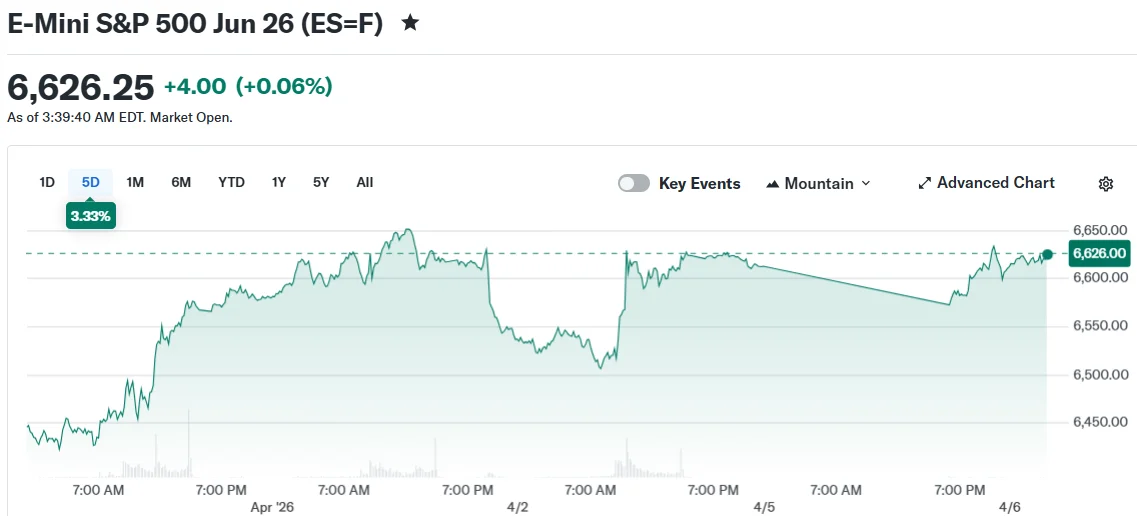
Wilson highlighted how the benchmark index rebounded from the 6,300–6,500 support zone he had previously identified several weeks ago.
According to Wilson, the United States remains in a bull market that kicked off last April, coming on the heels of what he characterizes as a “rolling recession” spanning 2022 through 2025.
The forward price-to-earnings ratio for the S&P 500 has contracted by 18% from its recent peak during the last half-year. Wilson noted that such dramatic valuation compression typically occurs only during economic downturns or aggressive Fed rate-hiking campaigns — neither of which Morgan Stanley anticipates as their primary forecast.
Morgan Stanley’s Recommended Investment Positioning
Wilson advocates for a barbell investment structure. The first component includes cyclical areas such as Financials, Consumer Discretionary, and short-cycle Industrial stocks. The second focuses on high-quality growth companies, particularly the hyperscaler technology firms.

The Magnificent 7 currently commands approximately 24x forward earnings — comparable to Consumer Staples at 22x — while delivering earnings expansion exceeding three times that rate. Wilson observed the cohort sits at the 2nd percentile of its valuation spectrum dating back to 2023.
He identified the 4.50% mark on the 10-year Treasury as a critical inflection point. Historical patterns show that breaches above this threshold typically create headwinds for stock valuations.
Fundamental economic indicators are beginning to validate the recovery narrative. March’s ISM Manufacturing PMI registered 52.7, surpassing expectations, while U.S. hotel revenue per available room jumped 8% across the preceding six-month period.
Crude Oil Has Become the Market’s Primary Driver
In parallel analysis, Morgan Stanley’s Chief Cross-Asset Strategist Serena Tang emphasized that crude oil has transformed into the dominant market variable — influencing investor perspectives on economic expansion, inflation trends, monetary policy, and overall risk appetite.
Tang presented three distinct oil price pathways. Under a de-escalation framework, crude stabilizes within the $80–$90 per barrel band. This environment favors equity outperformance, declining bond yields, and cyclical sector leadership. Tang characterizes this as a “classic risk-on environment.”
Should oil prices maintain a $100–$110 range, markets can digest the impact, though not without challenges. The S&P 500 would probably oscillate within a broad trading band, with financially robust quality companies gaining relative strength, while credit markets experience pressure.
In the most extreme situation — crude surging past $150 — Tang anticipates investors would pivot to recession-oriented positioning, gravitating toward government bonds, cash holdings, and defensive market segments.
Goldman Sachs has characterized the ongoing Strait of Hormuz situation as “the largest supply shock in the history of the global crude market” and cautioned that sustained elevated pricing could compel central banks to postpone interest rate reductions.
Tang emphasized that during oil supply shocks, equities and fixed income can decline simultaneously, undermining the traditional diversification benefits of 60/40 portfolio construction. Throughout the past month, stock valuations have declined roughly 15% on a forward price-to-earnings measurement.
Get 3 Free Stock Ebooks
Discover top-performing stocks in AI, Crypto, and Technology with expert analysis.
- Top 10 AI Stocks - Leading AI companies
- Top 10 Crypto Stocks - Blockchain leaders
- Top 10 Tech Stocks - Tech giants



