



TLDR
- Stock futures showed mixed signals Tuesday morning as investors prepared for major financial institution earnings and critical inflation readings
- U.S. forces conducted a third consecutive night of military operations against Iran, while Trump reestablished a naval blockade at the Strait of Hormuz
- Energy markets surged, with Brent crude climbing above 2% to reach $84.78 per barrel
- JPMorgan Chase, Bank of America, Goldman Sachs, Wells Fargo, and Citigroup all scheduled to release Q2 earnings Tuesday
- June CPI data expected Tuesday, with analysts projecting annual inflation declining to 3.8%
U.S. equity futures displayed mixed performance Tuesday morning as market participants navigated an exceptionally busy news cycle featuring major financial institution earnings releases, updated inflation metrics, and escalating geopolitical tensions in the Middle East.
Nasdaq 100 futures advanced 0.22%, while S&P 500 and Dow Jones futures traded marginally lower as of 1:30 a.m. EDT.
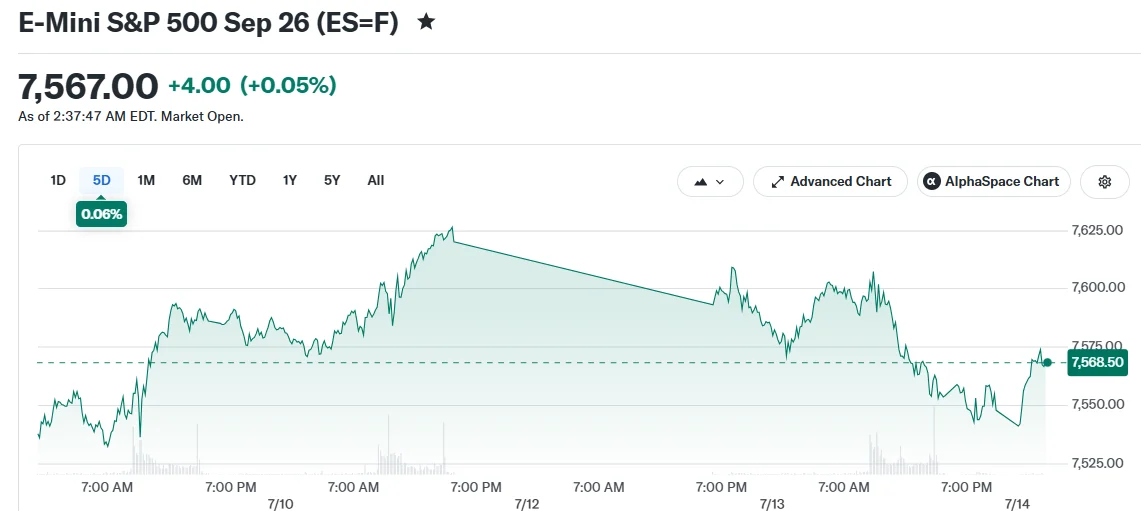
The previous trading session proved challenging for technology equities. The Nasdaq Composite tumbled 1.55% following SK Hynix’s 9.3% decline, which pulled memory chip manufacturers lower across the board. The S&P 500 retreated 0.79% while the Dow shed 0.26%.
Middle East Conflict Drives Energy Prices Up
U.S. military forces concluded their third consecutive evening of operations against Iranian targets Monday, focusing on infrastructure connected to attacks on international shipping routes. President Trump simultaneously restored a naval blockade targeting Iranian vessels in the Strait of Hormuz and proposed implementing a 20% charge for safeguarding commercial ships transiting the waterway.
Oil markets reacted decisively. Brent crude surged over 2% to $84.78 per barrel. WTI crude jumped 2.26% to $79.85.

The Strait of Hormuz represents a critical chokepoint for worldwide oil distribution. Any significant disruption in this region could drive energy costs substantially higher and contribute to broader inflationary pressures.
Nvidia remains under scrutiny as well. Reports indicate the chipmaker reduced by more than half the roster of Asian customers authorized to purchase its artificial intelligence processors. The Financial Times reported that Nvidia established a revised list of approved purchasers across Singapore, Malaysia, and Japan to strengthen adherence to U.S. export regulations. Entities excluded from the updated list have the option to reapply after satisfying the enhanced requirements.
Major Financial Institutions Release Quarterly Results
Five leading U.S. banking giants are scheduled to unveil second-quarter financial performance Tuesday — JPMorgan Chase, Bank of America, Goldman Sachs, Wells Fargo, and Citigroup.
Financial sector earnings attract significant attention because they provide insight into consumer expenditure patterns, commercial lending activity, and credit health throughout the broader economy.
Positive results could bolster market confidence that economic fundamentals remain robust. Disappointing figures might amplify worries regarding decelerating growth momentum.
Market observers will simultaneously focus on the June Consumer Price Index release, scheduled for Tuesday.
Economists surveyed by Dow Jones anticipate consumer prices declined 0.2% during June, partially attributed to falling energy expenses. This would reduce the annualized inflation rate to 3.8%.
Core inflation metrics, which exclude volatile food and energy categories, are projected to remain steady at 2.8% year-over-year — continuing to exceed the Federal Reserve’s 2% objective.
Fed Governor Christopher Waller indicated Monday that an additional rate increase might be necessary if inflation remains persistently elevated. Newly appointed Fed Chair Kevin Warsh commences two days of congressional testimony this week, which may provide additional insight into the central bank’s monetary policy trajectory.
Get 3 Free Stock Ebooks
Discover top-performing stocks in AI, Crypto, and Technology with expert analysis.
- Top 10 AI Stocks - Leading AI companies
- Top 10 Crypto Stocks - Blockchain leaders
- Top 10 Tech Stocks - Tech giants



