



TLDR
- Major U.S. equity indices experienced declines on Wednesday as Federal Reserve Chair Kevin Warsh participated in a European panel discussion
- The Dow Jones Industrial Average declined 0.4%, while the S&P 500 retreated 0.5%, and the Nasdaq Composite slid 0.8% at session lows
- Private payroll data from ADP revealed a significant slowdown in June hiring, with only 98,000 positions added
- Crude oil futures declined approximately 1% following Iran’s decision to skip scheduled meetings with Trump administration officials in Qatar
- Technology sector showed divergence as software companies rallied while semiconductor manufacturers experienced steep losses, with chip ETF falling 3.7%
American equity markets experienced a pullback on Wednesday, marking the opening session of 2026’s second half, as market participants monitored Federal Reserve Chair Kevin Warsh’s appearance at the European Central Bank forum held in Sintra, Portugal.
The Dow Jones Industrial Average retreated as much as 0.4% following Tuesday’s record-setting close. The S&P 500 declined 0.5% while the Nasdaq Composite shed 0.8%.
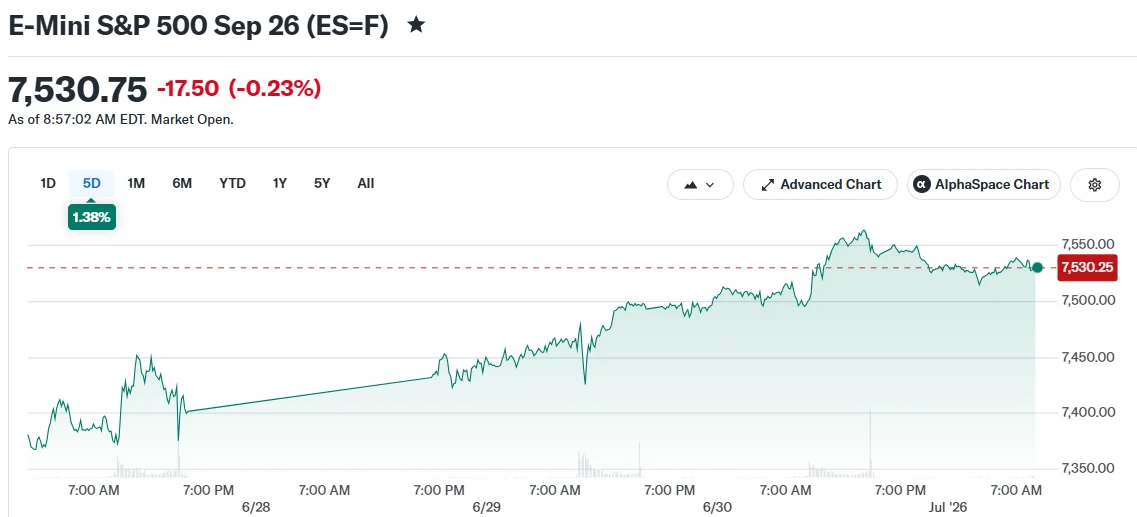
Equity indices recovered a portion of their losses as trading progressed. The Dow reversed course to post approximately 0.2% gains, while the S&P 500 approached breakeven territory. The Nasdaq maintained losses of roughly 0.3%.
Financial markets weren’t anticipating explicit forward guidance on monetary policy from Warsh. However, traders remained attentive to any indications regarding his assessment of inflationary pressures and economic conditions, particularly as speculation around interest rate increases has intensified recently.
Disappointing Employment Figures Heighten Market Concerns
Fresh employment data from ADP revealed the private sector expanded by merely 98,000 positions in June, falling short of analyst projections. Meanwhile, job placement consultancy Challenger, Gray & Christmas disclosed that American companies announced approximately 46,000 workforce reductions in June, marginally below the nearly 48,000 cuts planned during the same month in 2025.

These employment statistics provide context ahead of the official June jobs report scheduled for Thursday, arriving one day ahead of its typical release due to the Independence Day holiday.
Manufacturing sector activity in the United States expanded for a consecutive sixth month, based on Wednesday morning’s data release, providing a positive element within the broader economic landscape.
Oil prices surrendered early session advances and declined roughly 1%. Brent crude futures slipped toward $72 per barrel while West Texas Intermediate dropped beneath $69 following Iran’s announcement that its representatives would bypass scheduled discussions with President Trump’s delegation at the continuing Qatar peace negotiations.
Software Sector Advances While Semiconductor Stocks Tumble
Within equity markets, performance varied considerably across sectors. Software companies emerged as Wednesday’s standout performers. Salesforce led gains among Dow components. The iShares Expanded Tech-Software Sector ETF surged 3.6% after Guggenheim investment bank released an optimistic sector analysis.
Semiconductor manufacturers moved in the opposite direction. The iShares Semiconductor ETF tumbled 3.7%, creating headwinds for both the S&P 500 and Nasdaq indices. Micron and Sandisk numbered among the technology shares declining in premarket activity.
Despite benchmark index weakness, the majority of S&P 500 constituents actually advanced. The Invesco S&P 500 Equal Weight ETF, which monitors the average constituent performance, gained 0.7%.
Leading sectors included communication services, financials, materials, and consumer discretionary. Technology, utilities, consumer staples, and energy sectors lagged behind.
Gold also retreated, sliding below $4,000 per ounce as concerns about potential rate increases pressured the precious metal.
The Dow concluded Tuesday’s session at a record level, indicating any positive Wednesday close would establish a fresh benchmark.
Get 3 Free Stock Ebooks
Discover top-performing stocks in AI, Crypto, and Technology with expert analysis.
- Top 10 AI Stocks - Leading AI companies
- Top 10 Crypto Stocks - Blockchain leaders
- Top 10 Tech Stocks - Tech giants



